Wang Ping, Wang Zhenming, Yan Yizhi, Xiao Lin, Tian Wenxiu, Qu Meihua, Meng Aixia, Sun Fengxiang, Li Guizhi, Dong Junhong
Department of Biochemistry, School of Basic Medicine, Weifang Medical University, Weifang, China.
Department of Clinical Laboratory, Weifang City People's Hospital, Weifang, China.
Front Oncol. 2020 Oct 15;10:571181. doi: 10.3389/fonc.2020.571181. eCollection 2020.
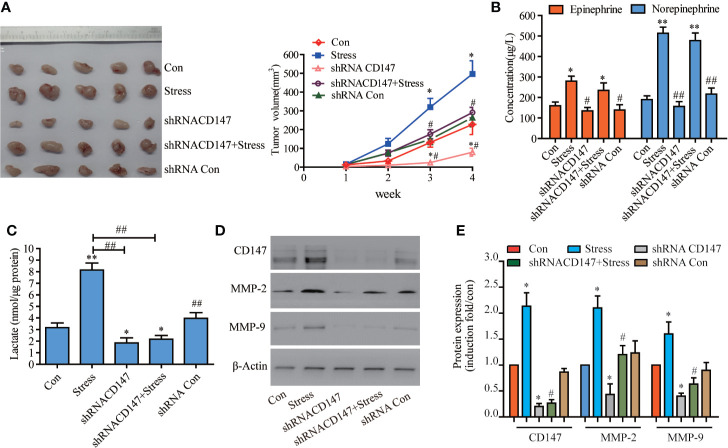
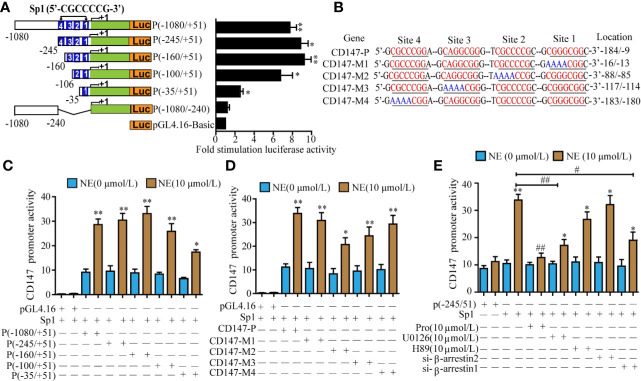
Psychological stress is closely related to the occurrence and prognosis of various malignant tumors, but the underlying mechanisms are not well studied. CD147 has been reported to be expressed in glioma and other malignant tumors. CD147 not only participates in lactic acid transport, but it also plays an important role in the invasion and metastasis of malignant tumor cells by stimulating the production of numerous matrix metalloproteinases (MMPs) and vascular endothelial growth factor by fibroblasts, and could also act as an autocrine factor stimulating MMPs production in metastatic tumor cells. Here, we found that silencing CD147 in chronically stressed nude mice not only inhibited the proliferation of xenografts but also decreased matrix metalloproteinase-2, 9 expression and lactic acid content in tumor tissues. Furthermore, norepinephrine (NE) was significantly increased in the serum of nude mice in glioma stress model. To determine the underlying cellular mechanism, we added exogenous NE into LN229 and U87 cells to simulate the stress environment . The invasiveness of the glioma cells was subsequently examined using a Matrigel invasion assay. We demonstrated that knockdown of CD147 inhibited glioma invasiveness and metastasis with norepinephrine stimulation. Luciferase reporter gene experiments further demonstrated that the expression of CD147 is up-regulated primarily by norepinephrine the β-Adrenalin receptor (βAR)-β-arrestin1-ERK1/2-Sp1 pathway. High expression of CD147 promoted the secretion of MMP-2 and the increment of lactic acid, which accelerated the augmented invasion and metastasis of glioma induced by psychological stress. Taken together, these results suggest that psychological stress promotes glioma proliferation and invasiveness by up-regulating CD147 expression. Thus, CD147 might be a potential target site in the treatment of glioma progression induced by chronic psychological stress.
心理应激与各种恶性肿瘤的发生和预后密切相关,但其潜在机制尚未得到充分研究。据报道,CD147在胶质瘤和其他恶性肿瘤中表达。CD147不仅参与乳酸转运,还通过刺激成纤维细胞产生大量基质金属蛋白酶(MMPs)和血管内皮生长因子,在恶性肿瘤细胞的侵袭和转移中发挥重要作用,并且还可以作为自分泌因子刺激转移瘤细胞中MMPs的产生。在此,我们发现,在长期应激的裸鼠中沉默CD147不仅抑制了异种移植瘤的增殖,还降低了肿瘤组织中基质金属蛋白酶-2、9的表达和乳酸含量。此外,胶质瘤应激模型裸鼠血清中的去甲肾上腺素(NE)显著增加。为了确定潜在的细胞机制,我们向LN229和U87细胞中添加外源性NE以模拟应激环境。随后使用基质胶侵袭试验检测胶质瘤细胞的侵袭能力。我们证明,在去甲肾上腺素刺激下,敲低CD147可抑制胶质瘤的侵袭和转移。荧光素酶报告基因实验进一步证明,CD147的表达主要通过去甲肾上腺素-β-肾上腺素能受体(βAR)-β-抑制蛋白1-ERK1/2-Sp1途径上调。CD147的高表达促进了MMP-2的分泌和乳酸的增加,加速了心理应激诱导的胶质瘤侵袭和转移增强。综上所述,这些结果表明,心理应激通过上调CD147表达促进胶质瘤增殖和侵袭。因此,CD147可能是治疗慢性心理应激诱导的胶质瘤进展的潜在靶点。