Medical Sociology Unit, Hannover Medical School, Center for Public Health and Health Care, Carl-Neuberg-Street 1, 30625, Hannover, Germany.
Department of Public Health and Maternal and Child Health, Complutense University of Madrid, Madrid, Spain.
Soc Psychiatry Psychiatr Epidemiol. 2021 Jul;56(7):1249-1262. doi: 10.1007/s00127-020-01979-6. Epub 2020 Nov 12.
We examined changes in the burden of depressive symptoms between 2006 and 2014 in 18 European countries across different age groups.
We used population-based data drawn from the European Social Survey (N = 64.683, 54% female, age 14-90 years) covering 18 countries (Austria, Belgium, Denmark, Estonia, Finland, France, Germany, Great Britain, Hungary, Ireland, The Netherlands, Norway, Poland, Portugal, Slovenia, Spain, Sweden, Switzerland) from 2006 to 2014. Depressive symptoms were measured via the CES-D 8. Generalized additive models, multilevel regression, and linear regression analyses were conducted.
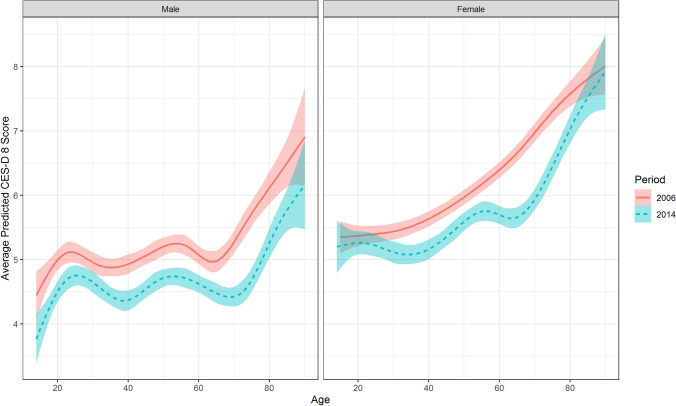
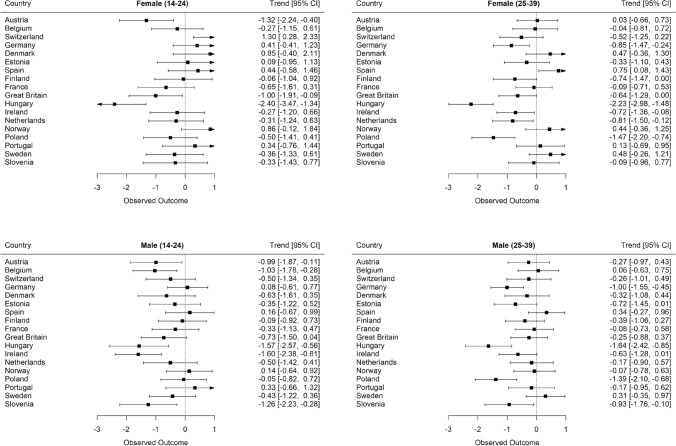
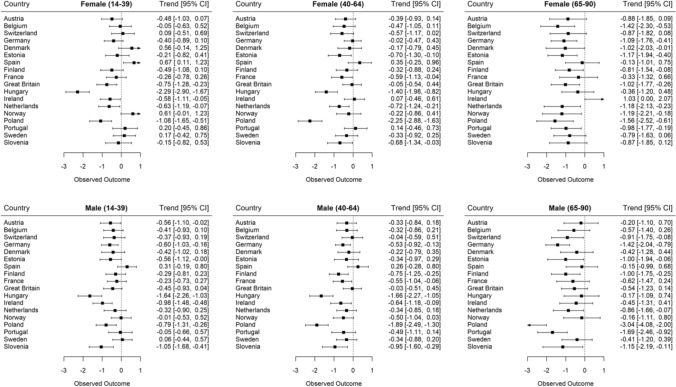
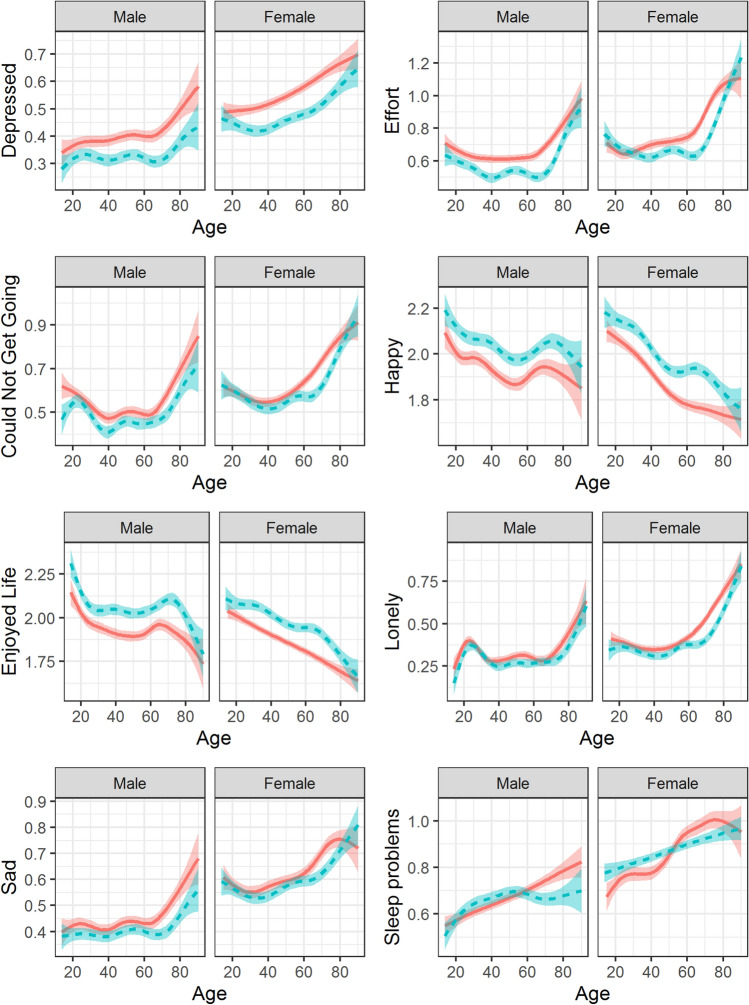
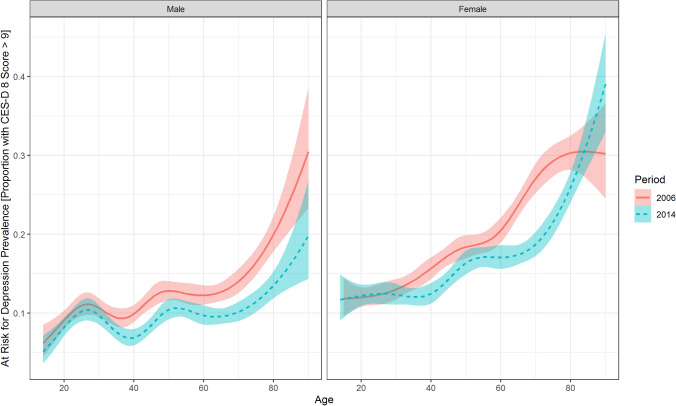
We found a general decline in CES-D 8 scale scores in 2014 as compared with 2006, with only few exceptions in some countries. This decline was most strongly pronounced in older adults, less strongly in middle-aged adults, and least in young adults. Including education, health and income partially explained the decline in older but not younger or middle-aged adults.
Burden of depressive symptoms decreased in most European countries between 2006 and 2014. However, the decline in depressive symptoms differed across age groups and was most strongly pronounced in older adults and least in younger adults. Future studies should investigate the mechanisms that contribute to these overall and differential changes over time in depressive symptoms.
我们研究了 2006 年至 2014 年期间 18 个欧洲国家不同年龄组人群抑郁症状负担的变化。
我们使用了来自欧洲社会调查(N=64683,女性占 54%,年龄 14-90 岁)的基于人群的数据,涵盖了 18 个国家(奥地利、比利时、丹麦、爱沙尼亚、芬兰、法国、德国、英国、匈牙利、爱尔兰、荷兰、挪威、波兰、葡萄牙、斯洛文尼亚、西班牙、瑞典、瑞士)的 2006 年至 2014 年的数据。抑郁症状通过 CES-D 8 量表进行测量。使用广义加性模型、多层次回归和线性回归分析进行分析。
与 2006 年相比,我们发现 2014 年 CES-D 8 量表评分普遍下降,只有少数几个国家存在例外。这种下降在老年人中最为明显,在中年人中较弱,在年轻人中最弱。包括教育、健康和收入在内的因素部分解释了老年人抑郁症状的下降,但不能解释年轻人或中年人的抑郁症状下降。
2006 年至 2014 年间,大多数欧洲国家的抑郁症状负担有所下降。然而,抑郁症状的下降在不同年龄组之间存在差异,在老年人中最为明显,在年轻人中最为不明显。未来的研究应该调查导致这些总体和随时间变化的抑郁症状差异的机制。