Nakano Takashi, Ikeda Yoichi
Research Center for Nuclear Physics, Osaka University, Osaka, Japan.
Department of Physics, Faculty of Science, Kyushu University, Fukuoka, Japan.
J Med Internet Res. 2020 Nov 30;22(11):e20144. doi: 10.2196/20144.
In the fight against the pandemic of COVID-19, it is important to ascertain the status and trend of the infection spread quickly and accurately.
The purpose of our study is to formulate a new and simple indicator that represents the COVID-19 spread rate by using publicly available data.
The new indicator K is a backward difference approximation of the logarithmic derivative of the cumulative number of cases with a time interval of 7 days. It is calculated as a ratio of the number of newly confirmed cases in a week to the total number of cases.
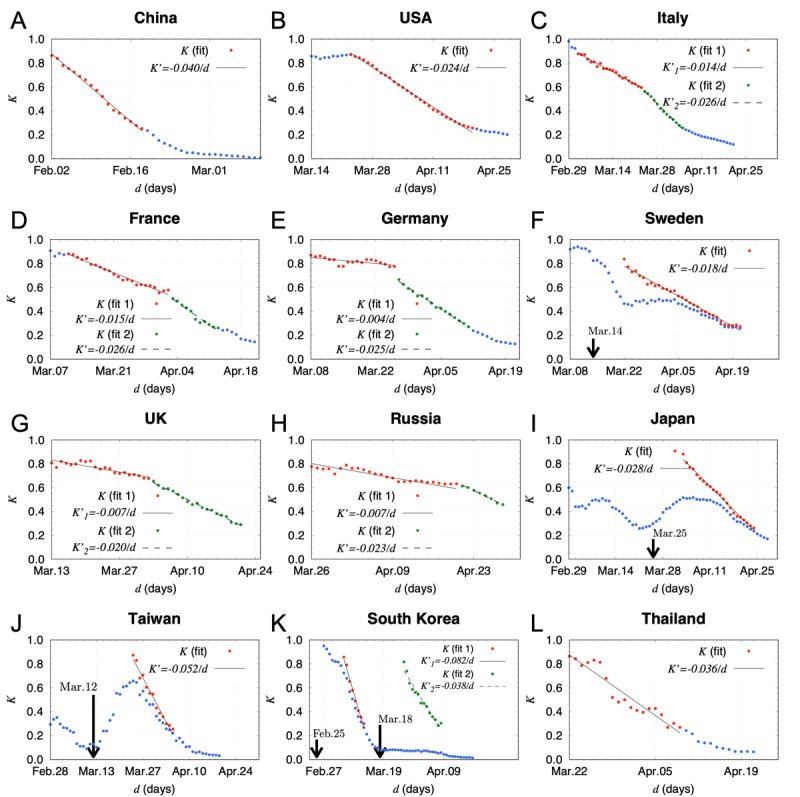
The analysis of the current status of COVID-19 spreading over countries showed an approximate linear decrease in the time evolution of the K value. The slope of the linear decrease differed from country to country. In addition, it was steeper for East and Southeast Asian countries than for European countries. The regional difference in the slope seems to reflect both social and immunological circumstances for each country.
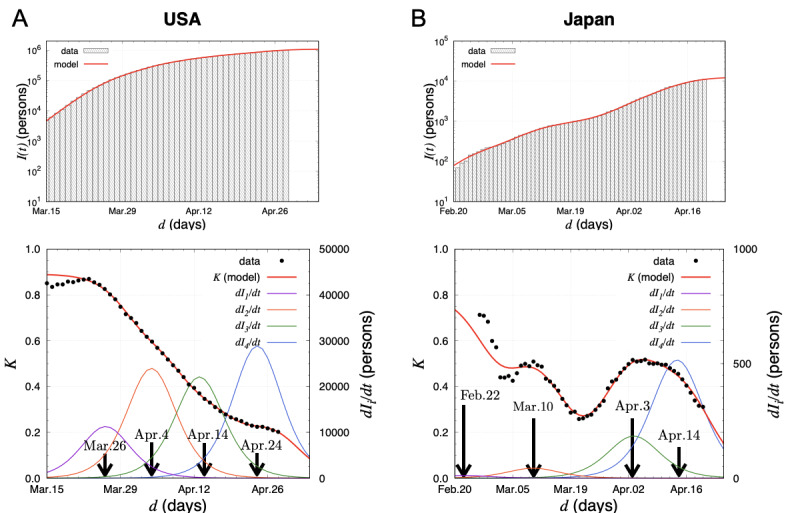
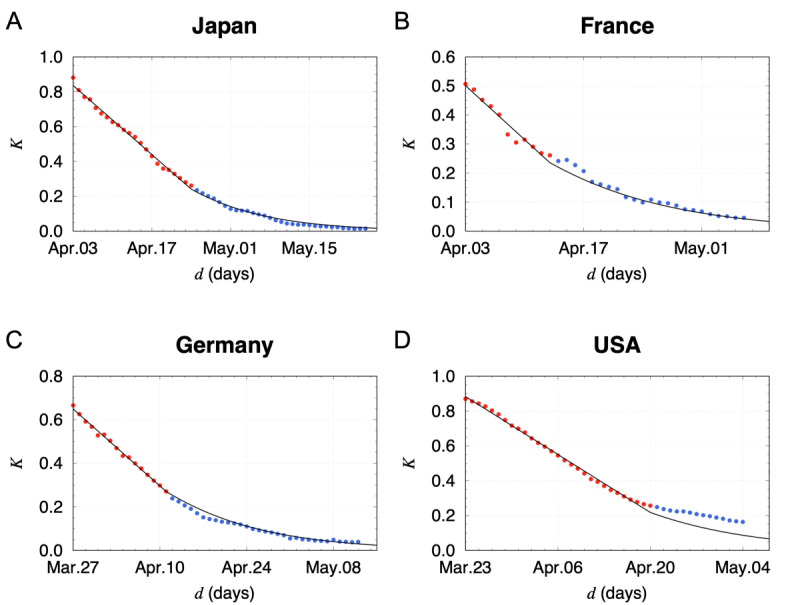
The approximate linear decrease of the K value indicates that the COVID-19 spread does not grow exponentially but starts to attenuate from the early stage. The K trajectory in a wide range was successfully reproduced by a phenomenological model with the constant attenuation assumption, indicating that the total number of the infected people follows the Gompertz curve. Focusing on the change in the value of K will help to improve and refine epidemiological models of COVID-19.
在抗击新冠疫情的斗争中,快速准确地确定感染传播的状况和趋势至关重要。
我们研究的目的是利用公开数据制定一个新的、简单的指标来代表新冠病毒的传播率。
新指标K是累计病例数的对数导数在7天时间间隔下的后向差分近似值。它通过一周内新增确诊病例数与病例总数的比值来计算。
对新冠病毒在各国传播现状的分析表明,K值的时间演变呈近似线性下降。线性下降的斜率因国家而异。此外,东亚和东南亚国家的斜率比欧洲国家更陡。斜率的区域差异似乎反映了每个国家的社会和免疫状况。
K值的近似线性下降表明新冠病毒传播并非呈指数增长,而是从早期就开始减弱。通过具有恒定衰减假设的现象学模型成功再现了大范围的K轨迹,这表明感染人数总数遵循冈珀茨曲线。关注K值的变化将有助于改进和完善新冠病毒的流行病学模型。