Disciplina de Ginecologia, Faculdade de Medicina, Universidade de Sao Paulo, Sao Paulo, SP, Brazil.
Study Design and Scientific Writing Laboratory at ABC Medical School, Santo André, SP, Brazil.
PLoS One. 2020 Nov 12;15(11):e0241674. doi: 10.1371/journal.pone.0241674. eCollection 2020.
Low national immunization coverage (44.64%) requires strengthening the vaccination campaign to improve knowledge about HPV and its vaccine among adolescents and parents/guardians. Our aim is to evaluate factors related to knowledge about HPV, its vaccine, acceptability and divergences among Brazilian adolescents and parents/guardians.
A cross-sectional study was performed at a health unit of Sao Paulo University, Brazil, from 2015 to 2016. The convenience sample comprised 1047 individuals, including 74% (n = 776) adolescents and 26% (n = 271) parents/guardians, who answered a survey (knowledge about HPV, its vaccine, barriers and acceptability).
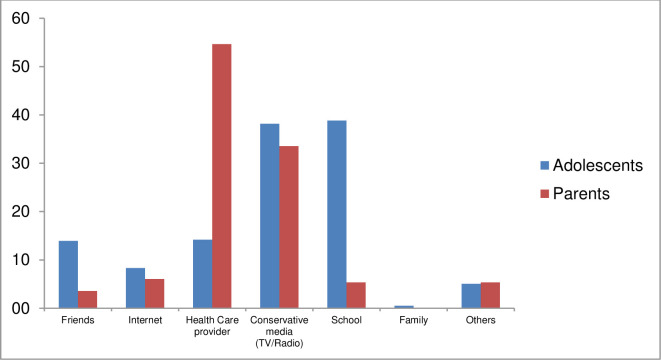
The main source of information for adolescents was school (39%, n = 298); for parents/guardians, it was health professionals (55%, n = 153). Parents/guardians were 2.48 times more likely than adolescents to know that HPV caused changes in the Pap smear test [RR 2.48, 95% CI 2.03-3.01 (p < 0.001)], 1.43 times likely to be aware that HPV was a sexually transmitted infection [RR 1.43, 95% CI 1.22-1.68 (p < 0.001)], and 2.77 times likely to be informed that the HPV vaccine decreased the chance of having genital warts [RR 2.77, 95% CI 2.22-2.47 (p < 0.001)]. Girls knew more about the topic than boys (RR 1.67; 95% CI 1.10-2.60); education increased parents' knowledge [(RR 3.38; 95% CI 1.71-6.69)].
Female adolescents and parents/guardians with a higher level of education are factors related to suitable knowledge about HPV and its vaccine among Brazilian respondents. There were differences between parents/guardians and adolescents in HPV awareness, clinical implications, vaccine knowledge and vaccine acceptance.
巴西的国民免疫接种率较低(44.64%),这要求加强疫苗接种运动,提高青少年及其父母/监护人对 HPV 及其疫苗的认识。我们的目的是评估与巴西青少年及其父母/监护人对 HPV、HPV 疫苗的认识、可接受性和差异相关的因素。
本横断面研究于 2015 年至 2016 年在巴西圣保罗大学的一个卫生单位进行。便利样本包括 1047 人,其中 74%(n=776)为青少年,26%(n=271)为父母/监护人,他们回答了一份关于 HPV、HPV 疫苗、障碍和可接受性的调查。
青少年的主要信息来源是学校(39%,n=298);父母/监护人的主要信息来源是卫生专业人员(55%,n=153)。与青少年相比,父母/监护人更有可能知道 HPV 导致巴氏涂片检查的变化[RR 2.48,95%CI 2.03-3.01(p<0.001)],更有可能知道 HPV 是一种性传播感染[RR 1.43,95%CI 1.22-1.68(p<0.001)],更有可能知道 HPV 疫苗降低了患生殖器疣的机会[RR 2.77,95%CI 2.22-2.47(p<0.001)]。女孩比男孩更了解这一主题(RR 1.67;95%CI 1.10-2.60);教育程度提高了父母的知识水平[RR 3.38;95%CI 1.71-6.69]。
巴西调查对象中,女性青少年和受教育程度较高的父母/监护人是与 HPV 和 HPV 疫苗相关的适宜知识相关的因素。父母/监护人与青少年在 HPV 意识、临床意义、疫苗知识和疫苗接受度方面存在差异。