Department of Experimental Psychology, University of Oxford, Oxford, United Kingdom.
The Oxford Institute of Clinical Psychology Training and Research, University of Oxford, Oxford, United Kingdom.
PLoS One. 2020 Nov 12;15(11):e0241704. doi: 10.1371/journal.pone.0241704. eCollection 2020.
Emergency responders are routinely exposed to traumatic critical incidents and other occupational stressors that place them at higher risk of mental ill health compared to the general population. There is some evidence to suggest that resilience training may improve emergency responders' wellbeing and related health outcomes. The aim of this study was to evaluate the effectiveness of a tertiary service resilience intervention compared to psychoeducation for improving psychological outcomes among emergency workers.
We conducted a multicentre, parallel-group, randomised controlled trial. Minim software was used to randomly allocate police, ambulance, fire, and search and rescue services personnel, who were not suffering from depression or post-traumatic stress disorder, to Mind's group intervention or to online psychoeducation on a 3:1 basis. The resilience intervention was group-based and included stress management and mindfulness tools for reducing stress. It was delivered by trained staff at nine centres across England in six sessions, one per week for six weeks. The comparison intervention was psychoeducation about stress and mental health delivered online, one module per week for six weeks. Primary outcomes were assessed by self-report and included wellbeing, resilience, self-efficacy, problem-solving, social capital, confidence in managing mental health, and number of days off work due to illness. Follow-up was conducted at three months. Blinding of participants, researchers and outcome assessment was not possible due to the type of interventions.
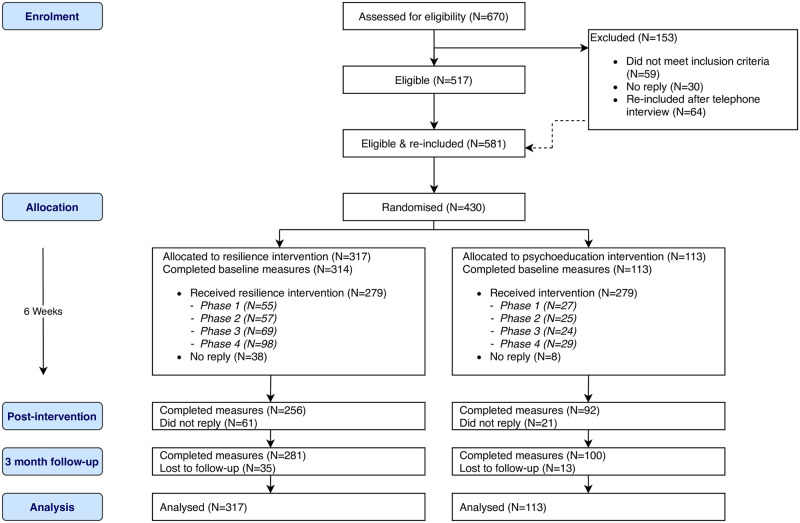
A total of 430 participants (resilience intervention N = 317; psychoeducation N = 113) were randomised and included in intent-to-treat analyses. Linear Mixed-Effects Models did not show a significant difference between the interventions, at either the post-intervention or follow-up time points, on any outcome measure.
The limited success of this intervention is consistent with the wider literature. Future refinements to the intervention may benefit from targeting predictors of resilience and mental ill health.
ISRCTN registry, ISRCTN79407277.
与普通人群相比,急救人员经常接触创伤性危急事件和其他职业应激源,使他们面临更高的心理健康问题风险。有一些证据表明,韧性训练可能会改善急救人员的幸福感和相关健康结果。本研究旨在评估三级服务韧性干预措施与心理教育相比,对改善急救人员心理结果的有效性。
我们进行了一项多中心、平行组、随机对照试验。使用 Minim 软件以 3:1 的比例随机分配警察、救护、消防和搜索与救援服务人员(未患有抑郁症或创伤后应激障碍)到 Mind 的小组干预或在线心理教育。韧性干预是基于小组的,包括压力管理和正念工具,以减轻压力。它由英格兰九个中心的经过培训的工作人员在六周内每周一次,共六次进行。比较干预是关于压力和心理健康的在线心理教育,每周一个模块,共六周。主要结果通过自我报告评估,包括幸福感、韧性、自我效能、解决问题、社会资本、管理心理健康的信心以及因疾病而休假的天数。在三个月时进行随访。由于干预措施的类型,参与者、研究人员和结果评估无法进行盲法。
共有 430 名参与者(韧性干预组 N = 317;心理教育组 N = 113)被随机分配并进行意向治疗分析。线性混合效应模型显示,在干预后的任何时间点或随访时间点,干预之间在任何结果测量上均无显著差异。
该干预措施的有限成功与更广泛的文献一致。未来对干预措施的改进可能受益于针对韧性和心理健康问题的预测因素。
ISRCTN 注册,ISRCTN79407277。