Laboratorio Genetica-Trapiantologia e Malattie Cardiovascolari, Fondazione IRCCS Policlinico San Matteo, Pavia, Italy.
Microbiologia e Virologia, Fondazione IRCCS Policlinico San Matteo, Pavia, Italy.
PLoS One. 2020 Nov 12;15(11):e0242305. doi: 10.1371/journal.pone.0242305. eCollection 2020.
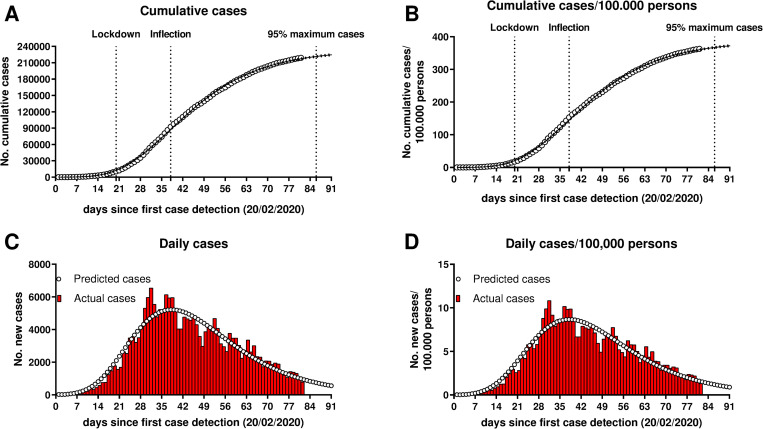
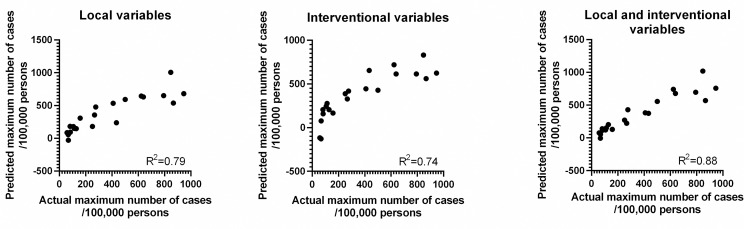
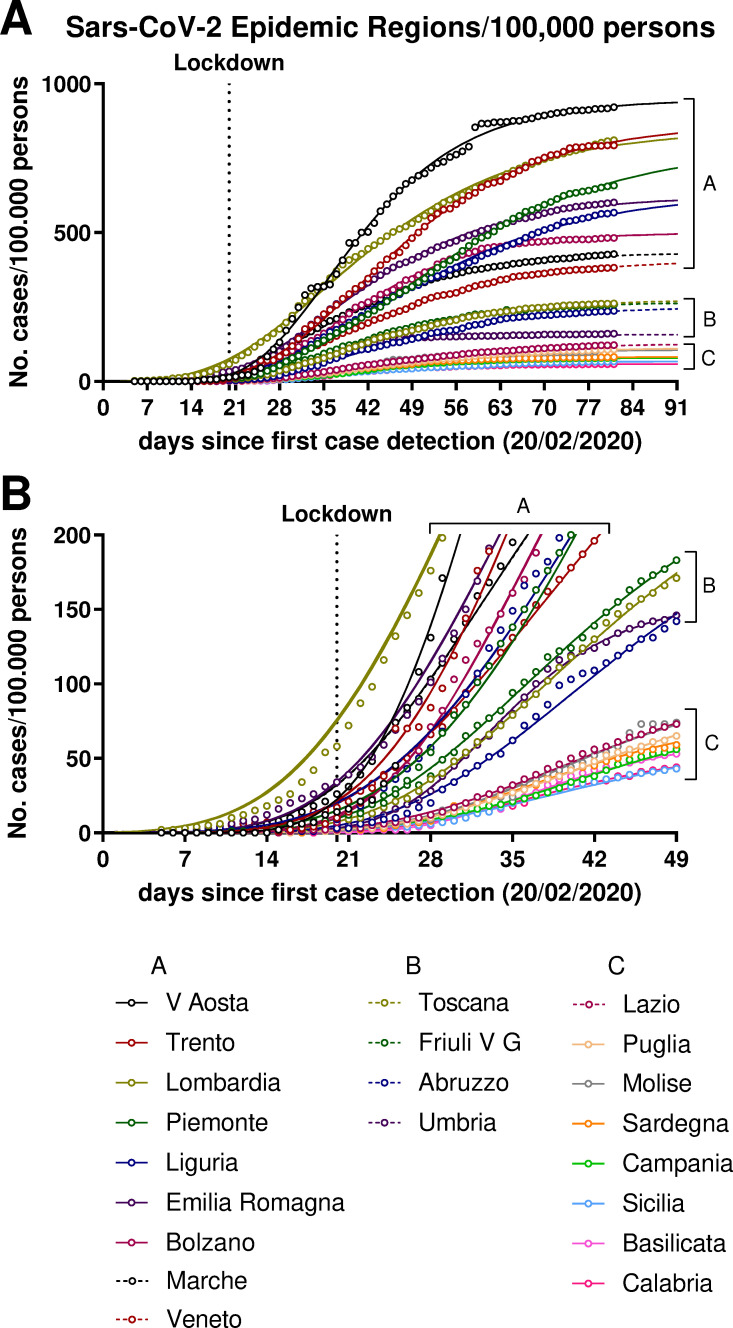
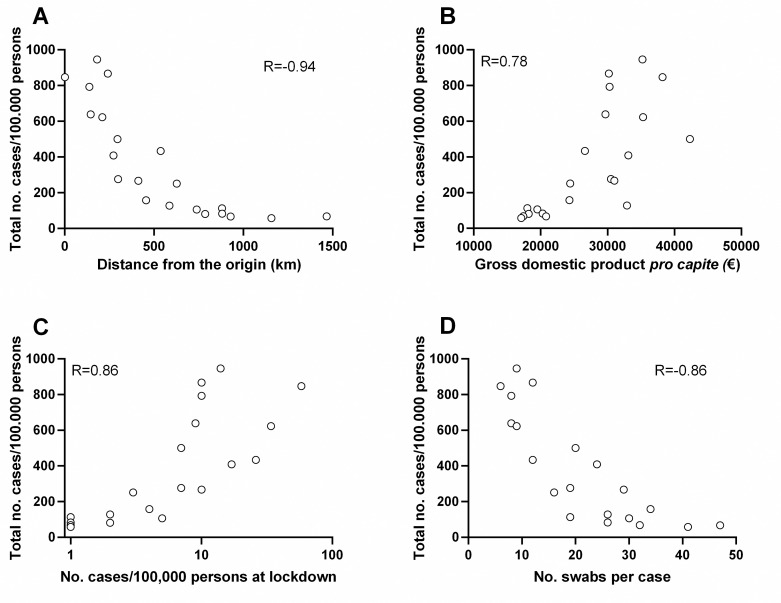
Containment measures have been applied in several countries in order to limit the diffusion of the SARS-CoV-2 epidemic. The scope of this study is to analyze the evolution of the first wave of the SARS-CoV-2 epidemic throughout Italy and factors associated to the different way it spread in the Italian Regions, starting from the day that the first indigenous cases were detected through day 81 (6 days after the end of the strict lockdown). Data were obtained from daily reports and are represented as number (and percentage) of cases/100,000 persons. A lockdown with movement restrictions, especially across Regions, was declared at day 20. At day 81, 219,070 cases (363/100,000 persons) were diagnosed. A regression analysis based on the Gompertz model predicts a total number 233,606 cases (386/100,000 persons) at the end of the epidemic. The 21 areas, divided into Italian Regions and autonomous Provinces, showed a wide range in the frequency of cases at day 81 (58-921, median 258/100,000 persons) and total predicted cases (58-946, median 267/100,000 persons). Similarly, the predicted time for the end of the wave of the epidemic (considering as surrogate marker the time at which 99% of the total cases are predicted to occur) was highly variable, ranging from 64 to 136 (median 99) days. We analyzed the impact of local and interventional variables on the epidemic curve in each Region. The number of cases correlated inversely with the distance from the area in which first cases were detected and directly also with the gross domestic product pro capite (as a marker of industrial activity) of the Region. Moreover, an earlier start of the lockdown (i.e. in the presence of a lower number of cases) and wider testing were associated with a lower final number of total cases. In conclusion, this analysis shows that population-wide testing and early lockdown enforcement appear effective in limiting the spreading of the SARS-CoV-2 epidemic.
为了限制 SARS-CoV-2 疫情的扩散,几个国家已经采取了遏制措施。本研究的范围是分析意大利境内 SARS-CoV-2 疫情第一波的演变,以及与意大利各地区传播方式不同相关的因素,从首次发现本地病例的那一天开始,到第 81 天(严格封锁结束后的第 6 天)。数据来自每日报告,以每 10 万人中出现的病例数(和百分比)表示。第 20 天宣布了限制行动的封锁措施,尤其是在各地区之间。第 81 天,诊断出 219070 例病例(363/100000 人)。基于戈珀兹模型的回归分析预测,疫情结束时将有 233606 例病例(386/100000 人)。这 21 个地区分为意大利大区和自治省,第 81 天的病例频率范围很广(58-921,中位数 258/100000 人),总预测病例数也范围很广(58-946,中位数 267/100000 人)。同样,疫情波峰结束的预测时间(考虑到预测 99%总病例发生的时间作为替代指标)也差异很大,范围从 64 到 136 天(中位数 99 天)。我们分析了地方和干预变量对各地区疫情曲线的影响。病例数与距首次发现病例地区的距离呈反比,与地区人均国内生产总值(作为工业活动的标志)也呈正相关。此外,较早开始封锁(即出现的病例数较低时)和扩大检测范围与总病例数最终减少有关。总之,本分析表明,全民检测和早期封锁执行对于限制 SARS-CoV-2 疫情的传播是有效的。