Huang Mengqin, Li Chengfa, Kong Fanliang, Wu Yan, Yuan Qianqian, Hu Lixia
Department of Oncology, The Second People's Hospital of Hefei, Hefei, Anhui, China.
Medicine (Baltimore). 2020 Nov 13;99(46):e22833. doi: 10.1097/MD.0000000000022833.
Several studies have explored the prognostic value of MicroRNA-153 (miR-153) in various cancers, but obtained inconsistent results. Thus, we conducted a meta-analysis to assess the prognostic significance of miR-153 for patients with cancer.
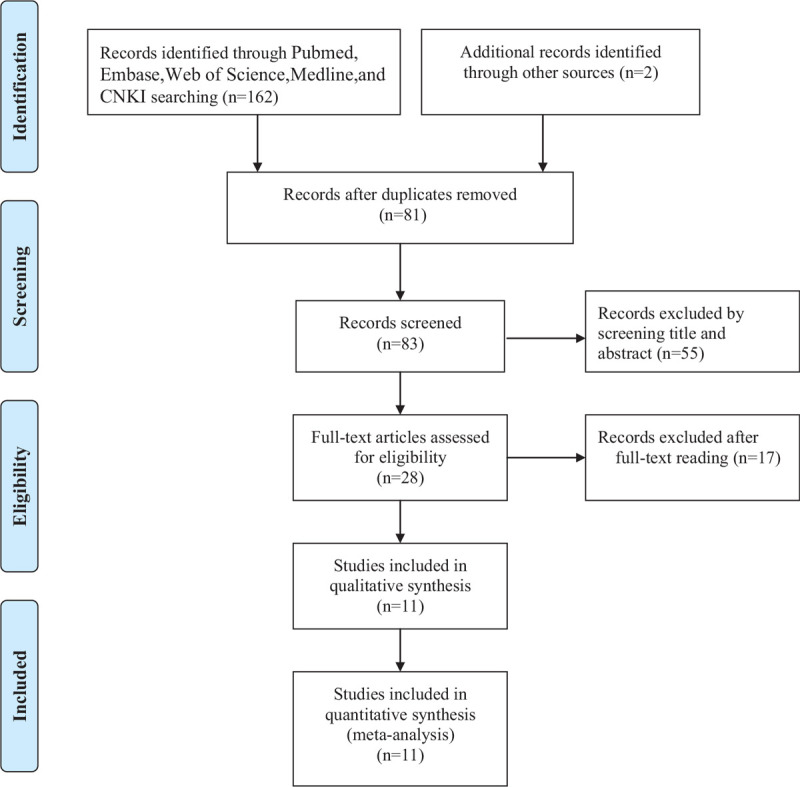
Eligible studies were identified by searching the online databases Pubmed, Embase, Web of Science, Medline,and the China National Knowledge Infrastructure (CNKI) up to March 2020. Hazard ratios (HRs) with 95% CIs and were calculated to clarify the correlation between miR-153 expression and prognosis of different cancers. Odds ratios (ORs) with 95% CI were selected to appraise the correlation between miR-153 with clinicopathological characteristics of cancer patients.
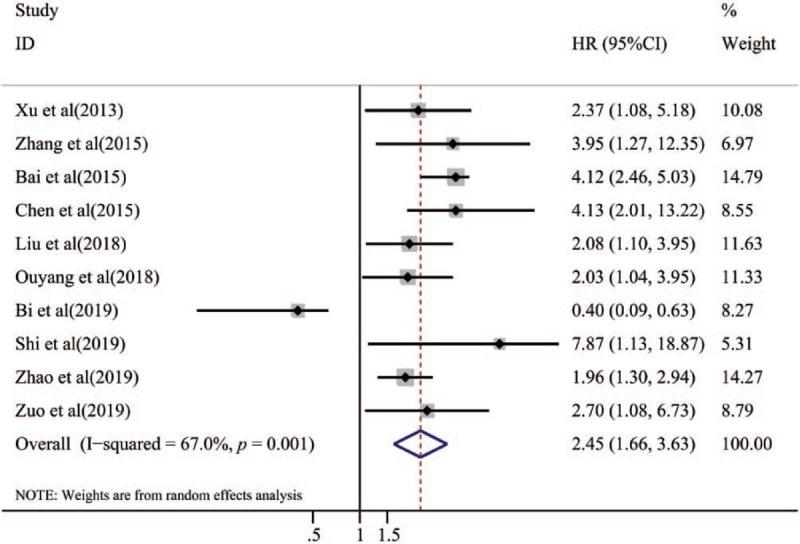
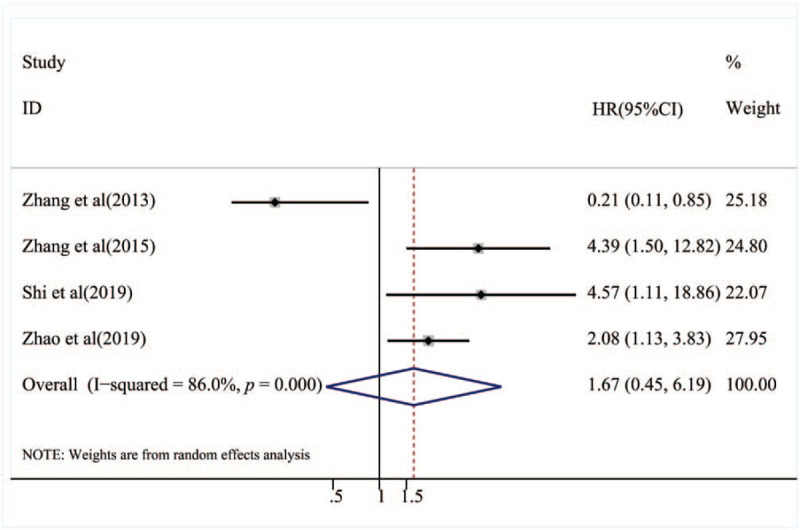
In total, 933 patients from 11 articles were enrolled in our meta-analysis. The results revealed that low miR-153 expression was significantly correlated with poor overall survival (OS) (HR = 2.45, 95% CI = 1.66-3.63, P < .001), but not with disease-free survival (DFS) (HR = 1.67, 95% CI = 0.45-6.19, P = .442). Subgroup analysis found that low miR-153 expression was associated with worse OS in the reported directly from articles group (HR = 2.67, 95% CI: 1.32-5.37, P = .006), survival curves group (HR = 2.10, 95% CI: 1.56-2.84, P < .001), digestive system tumor (HR = 2.76, 95% CI: 1.73-4.41, P < .001), and breast cancer (HR = 4.01, 95% CI: 1.46-11.04, P = .007).Moreover, cancer patients with low miR-153 expression were prone to poor tumor differentiation(poor vs well+moderate, OR = 2.41, 95% CI = 1.52-3.82, P < .001), earlier lymph node metastasis (present vs absent, OR = 2.19, 95% CI = 1.12-4.25, P = .021) and earlier distant metastasis (present vs absent,OR = 8.24, 95% CI = 2.93-23.21, P < .001), but not associated with age,gender and TNM stage.
This meta-analysis indicated that low miR-153 expression is associated with poor prognosis. miR-153 may serve as an effective predictive biomarker for tumor prognosis, especially for digestive system tumor and breast cancer.
多项研究探讨了微小RNA - 153(miR - 153)在各种癌症中的预后价值,但结果并不一致。因此,我们进行了一项荟萃分析,以评估miR - 153对癌症患者的预后意义。
通过检索在线数据库PubMed、Embase、Web of Science、Medline以及中国国家知识基础设施(CNKI),直至2020年3月,确定符合条件的研究。计算风险比(HR)及95%置信区间(CI),以阐明miR - 153表达与不同癌症预后之间的相关性。选择比值比(OR)及95%CI来评估miR - 153与癌症患者临床病理特征之间的相关性。
我们的荟萃分析共纳入了11篇文章中的933例患者。结果显示,miR - 153低表达与总体生存率(OS)显著相关(HR = 2.45,95%CI = 1.66 - 3.63,P <.001),但与无病生存率(DFS)无关(HR = 1.67,95%CI = 0.45 - 6.19,P = 0.442)。亚组分析发现,在文章直接报道组(HR = 2.67,95%CI:1.32 - 5.37,P = 0.006)、生存曲线组(HR = 2.10,95%CI:1.56 - 2.84,P <.001)、消化系统肿瘤组(HR = 2.76,95%CI:1.73 - 4.41,P <.001)和乳腺癌组(HR = 4.01,95%CI:1.46 - 11.04,P = 0.007)中,miR - 153低表达与较差的OS相关。此外,miR - 153低表达的癌症患者更容易出现肿瘤分化差(差vs好+中等,OR = 2.41,95%CI = 1.52 - 3.82,P <.001)、较早的淋巴结转移(存在vs不存在,OR = 2.19,95%CI = 1.12 - 4.25,P = 0.021)和较早的远处转移(存在vs不存在,OR = 8.24,95%CI = 2.93 - 23.21,P <.001),但与年龄、性别和TNM分期无关。
这项荟萃分析表明,miR - 153低表达与预后不良相关。miR - 153可能作为一种有效的肿瘤预后预测生物标志物,尤其是对于消化系统肿瘤和乳腺癌。