Novotný Jiří, Strnadová Karolína, Dvořánková Barbora, Kocourková Šárka, Jakša Radek, Dundr Pavel, Pačes Václav, Smetana Karel, Kolář Michal, Lacina Lukáš
Laboratory of Genomics and Bioinformatics, Institute of Molecular Genetics of the Czech Academy of Sciences, 142 20 Prague, Czech Republic.
Department of Informatics and Chemistry, Faculty of Chemical Technology, University of Chemistry and Technology, 160 00 Prague, Czech Republic.
Cancers (Basel). 2020 Nov 10;12(11):3324. doi: 10.3390/cancers12113324.
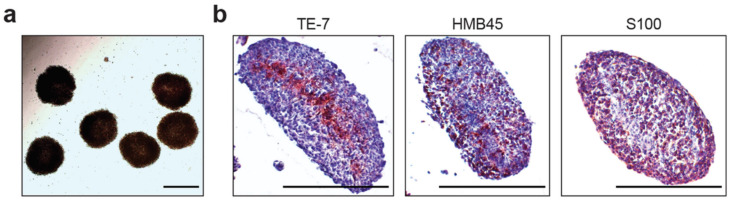
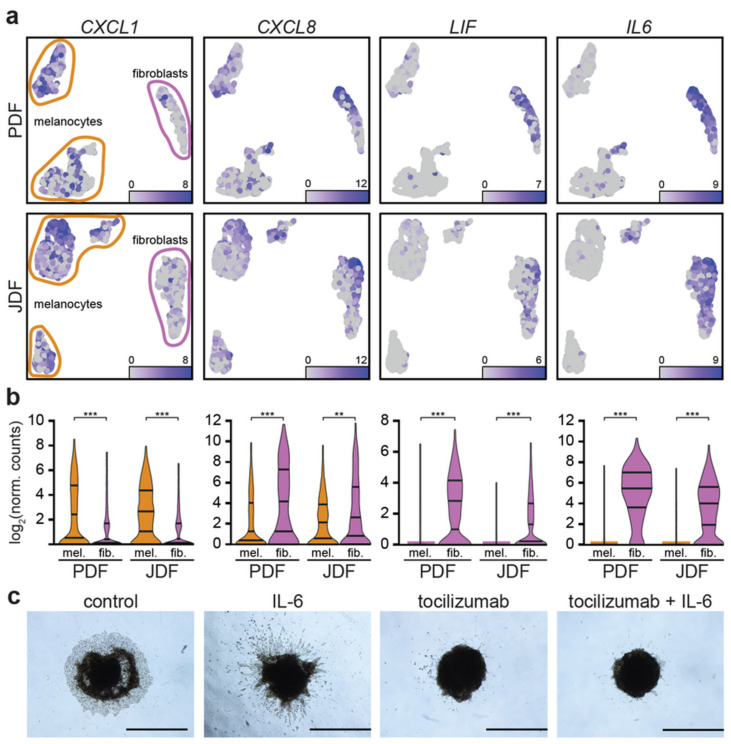
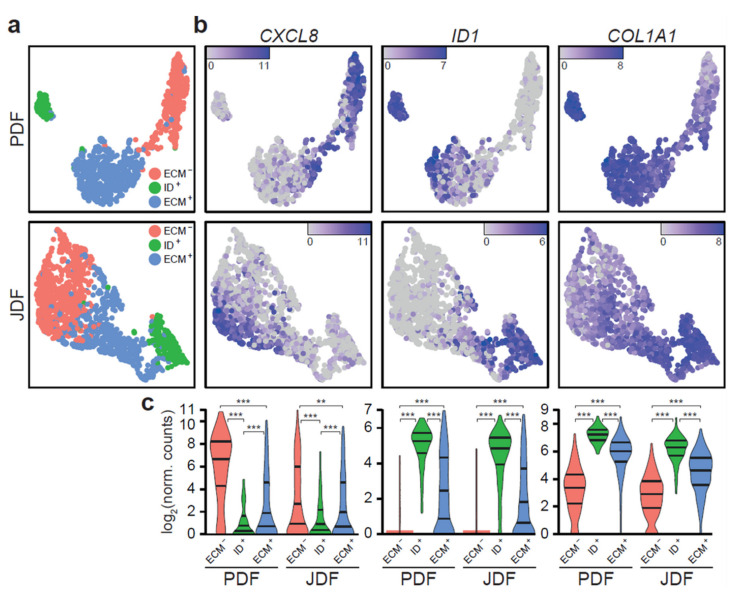
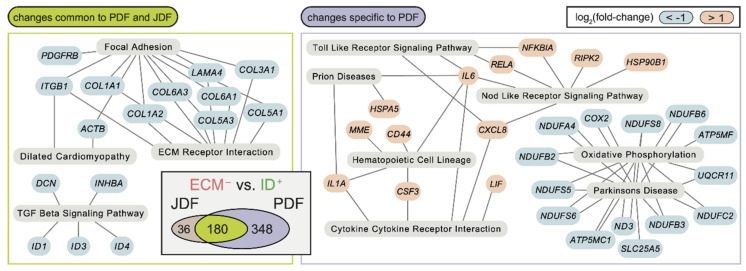
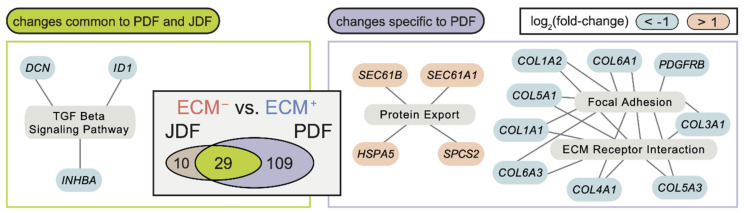
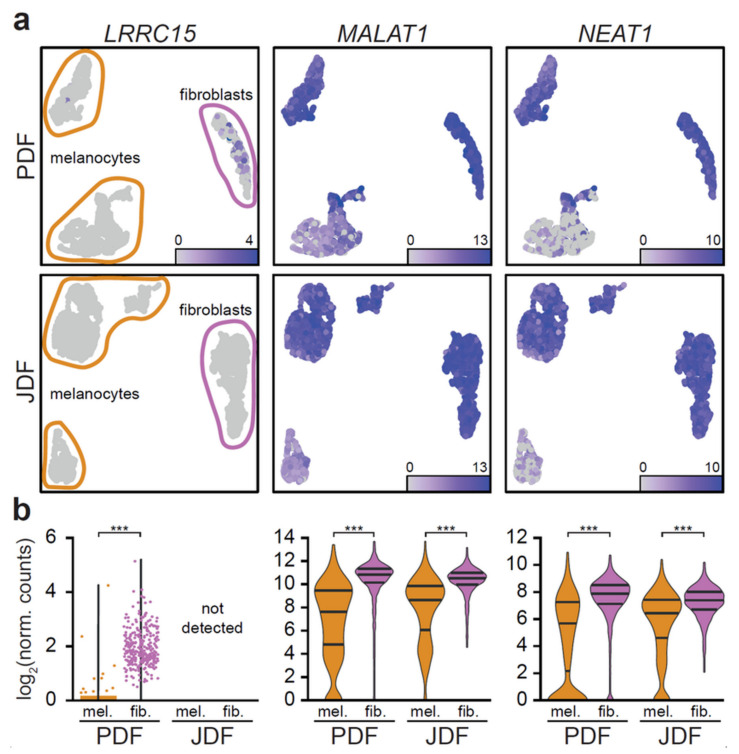
Heterogeneous spheroids have recently acquired a prominent position in melanoma research because they incorporate microenvironmental cues relevant for melanoma. In this study, we focused on the analysis of microenvironmental factors introduced in melanoma heterogeneous spheroids by different dermal fibroblasts. We aimed to map the fibroblast diversity resulting from previously acquired damage caused by exposure to extrinsic and intrinsic stimuli. To construct heterogeneous melanoma spheroids, we used normal dermal fibroblasts from the sun-protected skin of a juvenile donor. We compared them to the fibroblasts from the sun-exposed photodamaged skin of an adult donor. Further, we analysed the spheroids by single-cell RNA sequencing. To validate transcriptional data, we also compared the immunohistochemical analysis of heterogeneous spheroids to melanoma biopsies. We have distinguished three functional clusters in primary human fibroblasts from melanoma spheroids. These clusters differed in the expression of (a) extracellular matrix-related genes, (b) pro-inflammatory factors, and (c) TGFβ signalling superfamily. We observed a broader deregulation of gene transcription in previously photodamaged cells. We have confirmed that pro-inflammatory cytokine IL-6 significantly enhances melanoma invasion to the extracellular matrix in our model. This supports the opinion that the aspects of ageing are essential for reliable melanoma 3D modelling in vitro.
异质性球体最近在黑色素瘤研究中占据了显著地位,因为它们纳入了与黑色素瘤相关的微环境线索。在本研究中,我们专注于分析不同真皮成纤维细胞引入黑色素瘤异质性球体中的微环境因素。我们旨在描绘因先前暴露于外在和内在刺激而造成的损伤所导致的成纤维细胞多样性。为构建异质性黑色素瘤球体,我们使用了来自一名青少年供体防晒皮肤的正常真皮成纤维细胞。我们将它们与来自一名成年供体阳光暴露的光损伤皮肤的成纤维细胞进行比较。此外,我们通过单细胞RNA测序分析球体。为验证转录数据,我们还将异质性球体的免疫组织化学分析与黑色素瘤活检进行比较。我们在来自黑色素瘤球体的原代人成纤维细胞中区分出三个功能簇。这些簇在(a)细胞外基质相关基因、(b)促炎因子和(c)TGFβ信号超家族的表达上有所不同。我们观察到在先前光损伤的细胞中基因转录有更广泛的失调。我们已经证实,在我们的模型中促炎细胞因子IL-6显著增强黑色素瘤向细胞外基质的侵袭。这支持了这样一种观点,即衰老方面对于体外可靠的黑色素瘤3D建模至关重要。