Petrocchi Serena, Ludolph Ramona, Labrie Nanon H M, Schulz Peter
Institute of Communication & Health, Università della Svizzera italiana, Lugano, Switzerland
Institute of Communication & Health, Università della Svizzera italiana, Lugano, Switzerland.
BMJ Open. 2020 Nov 12;10(11):e037748. doi: 10.1136/bmjopen-2020-037748.
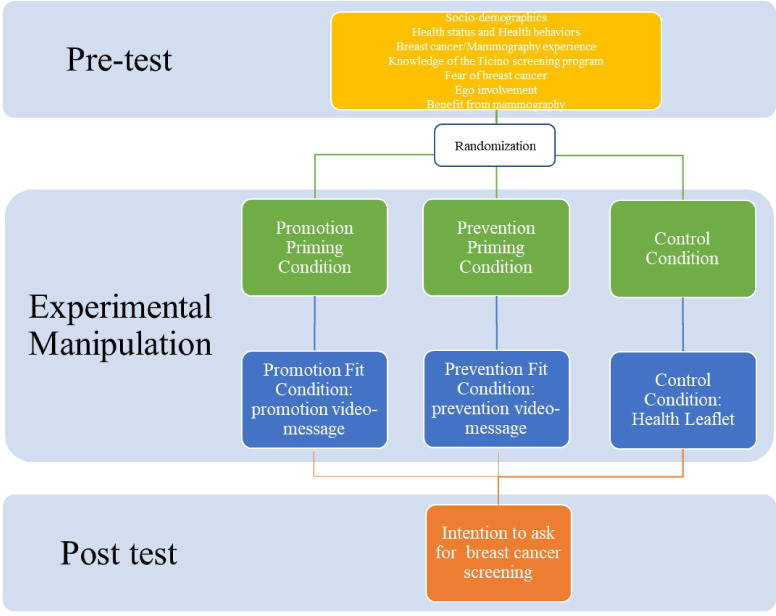
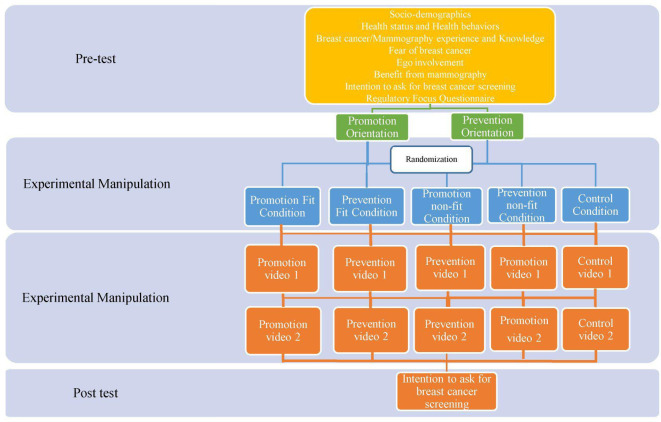
To reduce overtreatment caused by overuse of screening, it is advisable to reduce the demand for mammography screening outside the recommended guidelines among women who are not yet eligible for inclusion in systematic screening programmes. According to principles of regulatory fit theory, people make decisions motivated by either orientation to achieving and maximising gains or avoiding losses. A study developed in two phases investigated whether video messages, explaining the risks and benefits of mammography screening for those not yet eligible, are perceived as persuasive DESIGN: Phase 1 was an experimental study in which women's motivation orientation was experimentally induced and then they were exposed to a matching video message about mammography screening. A control group received a neutral stimulus. Phase 2 introduced a longitudinal component to study 1, adding a condition in which the messages did not match with the group's motivation orientation. Participants' natural motivation orientation was measured through a validated questionnaire PARTICIPANTS: 360 women participated in phase 1 and another 292 in phase 2. Participants' age ranged from 30 to 45 years, and had no history of breast cancer or known BReast CAncer gene (BRCA) 1/2 mutation.
In phase 1, a match between participants' motivation orientation and message content decreased the intention to seek mammography screening outside the recommended guidelines. Phase 2, however, did not show such an effect. Fear of breast cancer and risk perception were significantly related to intention to seek mammography screening CONCLUSIONS: Public health researchers should consider reducing the impact of negative emotions (ie, fear of breast cancer) and risk perception when promoting adherence to evidence-based breast cancer screening recommendations.
为减少因过度筛查导致的过度治疗,对于尚未符合系统性筛查计划纳入标准的女性,减少其在推荐指南之外进行乳腺钼靶筛查的需求是可取的。根据监管契合理论的原则,人们做出决策的动机要么是追求收益最大化,要么是避免损失。一项分两个阶段开展的研究调查了向尚未符合条件者解释乳腺钼靶筛查的风险和益处的视频信息是否具有说服力。设计:第一阶段是一项实验性研究,通过实验诱导女性的动机取向,然后让她们观看一条关于乳腺钼靶筛查的匹配视频信息。一个对照组接受中性刺激。第二阶段在研究1中引入了纵向研究部分,增加了一种信息与该组动机取向不匹配的情况。通过一份经过验证的问卷来测量参与者的自然动机取向。参与者:360名女性参与了第一阶段,另有292名参与了第二阶段。参与者年龄在30至45岁之间,无乳腺癌病史或已知的乳腺癌1/2基因(BRCA)突变。
在第一阶段,参与者的动机取向与信息内容相匹配降低了在推荐指南之外寻求乳腺钼靶筛查的意愿。然而,第二阶段并未显示出这种效果。对乳腺癌的恐惧和风险认知与寻求乳腺钼靶筛查的意愿显著相关。结论:公共卫生研究人员在促进遵循基于证据的乳腺癌筛查建议时,应考虑减少负面情绪(即对乳腺癌的恐惧)和风险认知的影响。