Fernandez Hospital, Hyderabad, Telangana, India.
Department of Neonatology, SGPGIMS, Lucknow, UP, India.
Eur J Pediatr. 2021 Apr;180(4):1009-1031. doi: 10.1007/s00431-020-03866-3. Epub 2020 Nov 12.
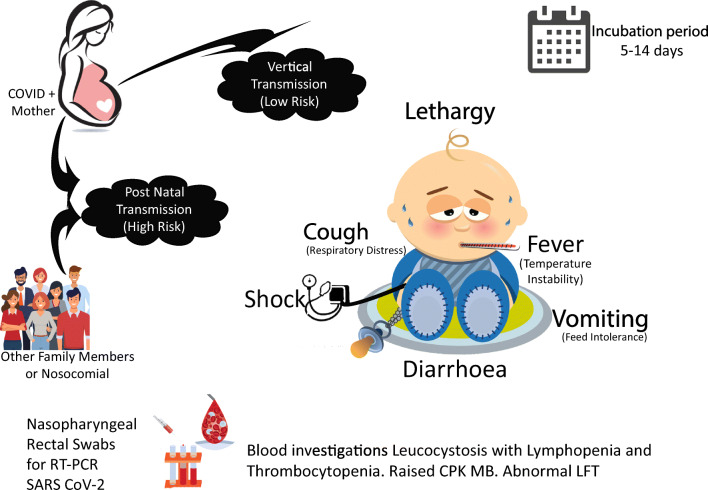
The clinical spectrum of the perinatal COVID-19 and prospective data on neonatal outcomes remains largely unexplored. Most of the existing literature is in the form of case series or single-centre experience. In this review, we aim to summarize available literature on the clinical spectrum of COVID-19 in neonates and mothers and suggest a practical approach towards management of clinical scenarios. This review explores the clinical characteristics and outcomes of COVID-19 in neonates born to mothers who were detected with the virus during the pregnancy. We conducted a comprehensive search of PubMed, Google Scholar and Cochrane Database of Systematic Review between November 2019 and June 2020 and screened articles related to perinatal COVID-19. This review included 786 mothers, among which 64% (504) were delivered by caesarian section. There were 3 still births and 107 (14%) were delivered preterm. Out of 793 neonates born, 629 neonates (79%) were tested after birth. The commonest symptom in neonates was respiratory distress. Respiratory support was needed in 60 neonates (7.6%), with 14 babies needing mechanical ventilation (1.8%), 25 needing non-invasive ventilation and 21 needing nasal oxygen. Only 35 of the 629 tested neonates (5.5%) were positive for COVID-19. Of the 35 positive neonates, 14 (40%) were symptomatic. The COVID-19 seems to have favourable neonatal outcomes. Majority of neonates are asymptomatic. Respiratory distress is the most common manifestation. What is known: •COVID-19 affects all ages. •Neonatal disease is usually mild. What is new: •Vertical transmission is a possible route of infection in neonates. •Breast milk and skin-to-skin contact are safe in COVID-19-infected mothers if performed with appropriate use of precautions such as hand and breast hygiene and masking.
围产期 COVID-19 的临床特征以及新生儿结局的前瞻性数据仍在很大程度上尚未得到探索。现有的大部分文献都是病例系列或单中心经验。在这篇综述中,我们旨在总结 COVID-19 新生儿和母亲的现有文献,提出一种针对临床情况的实用管理方法。
本综述探讨了在妊娠期间母亲被检测出携带病毒的情况下 COVID-19 新生儿的临床特征和结局。我们在 2019 年 11 月至 2020 年 6 月期间对 PubMed、Google Scholar 和 Cochrane 系统评价数据库进行了全面检索,并筛选了与围产期 COVID-19 相关的文章。
本综述纳入了 786 名母亲,其中 64%(504 名)行剖宫产分娩。有 3 例死胎,107 例(14%)早产儿分娩。793 名新生儿中,629 名(79%)在出生后接受了检测。新生儿最常见的症状是呼吸窘迫。60 名新生儿(7.6%)需要呼吸支持,其中 14 名婴儿需要机械通气(1.8%),25 名需要无创通气,21 名需要鼻氧。在 629 名接受检测的新生儿中,仅有 35 名(5.5%) COVID-19 检测呈阳性。在 35 名阳性新生儿中,14 名(40%)有症状。COVID-19 似乎对新生儿有良好的结局。大多数新生儿无症状。呼吸窘迫是最常见的表现。
COVID-19 可影响所有年龄段。
新生儿疾病通常较轻。
垂直传播可能是新生儿感染的途径之一。
在 COVID-19 感染的母亲中,如果适当使用手部和乳房卫生以及戴口罩等预防措施进行母乳喂养和皮肤接触,是安全的。