Yale University, School of Medicine, Clinical and Translational Research Accelerator, New Haven, Connecticut, USA.
University of Minnesota Medical School, Department of Medicine, Division of Nephrology and Hypertension, Minneapolis, Minnesota, USA.
Am J Hypertens. 2021 May 22;34(5):511-520. doi: 10.1093/ajh/hpaa184.
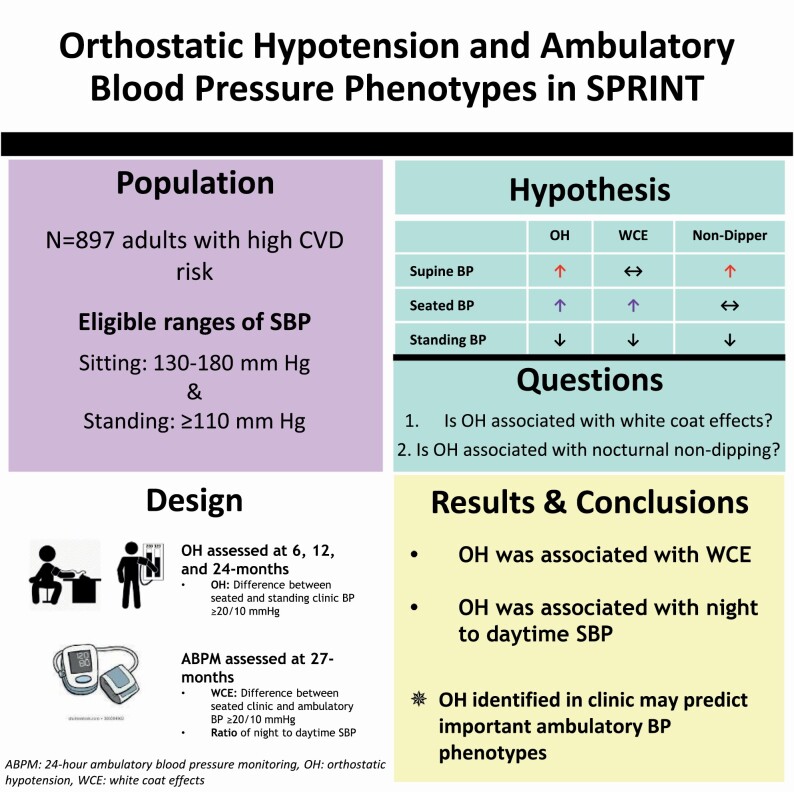
Clinic blood pressure (BP) when measured in the seated position, can miss meaningful BP phenotypes, including low ambulatory BP (white coat effects [WCE]) or high supine BP (nocturnal non-dipping). Orthostatic hypotension (OH) measured using both seated (or supine) and standing BP, could identify phenotypes poorly captured by seated clinic BP alone.
We examined the association of OH with WCE and night-to-daytime systolic BP (SBP) in a subpopulation of SPRINT, a randomized trial testing the effects of intensive or standard (<120 vs. <140 mm Hg) SBP treatment strategies in adults at increased risk of cardiovascular disease. OH was assessed during follow-up (6, 12, and 24 months) and defined as a decrease in mean seated SBP ≥20 or diastolic BP ≥10 mm Hg after 1 min of standing. WCE, based on 24-hour ambulatory BP monitoring performed at 27 months, was defined as the difference between 27-month seated clinic and daytime ambulatory BP ≥20/≥10 mm Hg. Reverse dipping was defined as a ratio of night-to-daytime SBP >1.
Of 897 adults (mean age 71.5±9.5 years, 29% female, 28% black), 128 had OH at least once. Among those with OH, 15% had WCE (vs. 7% without OH). Moreover, 25% of those with OH demonstrated a non-dipping pattern (vs. 14% without OH). OH was positively associated with both WCE (OR=2.24; 95%CI: 1.28, 4.27) and reverse dipping (OR=2.29; 95% CI: 1.31, 3.99).
The identification of OH in clinic was associated with two BP phenotypes often missed with traditional seated BP assessments. Further studies on mechanisms of these relationships are needed.
Trial Number NCT03569020.
在坐姿下测量诊所血压(BP)时,可能会错过有意义的 BP 表型,包括低动态血压(白大衣效应[WCE])或高卧位血压(夜间非杓型)。使用坐姿(或卧位)和站立 BP 测量的直立性低血压(OH),可能会识别仅通过坐姿诊所 BP 难以捕捉到的表型。
我们在 SPRINT 的一个亚组中研究了 OH 与 WCE 和夜间日间收缩压(SBP)之间的关联,SPRINT 是一项随机试验,测试了强化或标准(<120 与<140mmHg)SBP 治疗策略在心血管疾病风险增加的成年人中的效果。在随访期间(6、12 和 24 个月)评估 OH,并定义为站立 1 分钟后平均坐姿 SBP 下降≥20mmHg 或舒张压下降≥10mmHg。基于 27 个月时进行的 24 小时动态血压监测的 WCE,定义为 27 个月时坐姿诊所和日间动态血压之间的差异≥20/≥10mmHg。反向杓型定义为夜间与日间 SBP 比值>1。
在 897 名成年人(平均年龄 71.5±9.5 岁,29%为女性,28%为黑人)中,有 128 人至少发生一次 OH。在患有 OH 的人群中,有 15%存在 WCE(而无 OH 的人群为 7%)。此外,25%患有 OH 的人表现出非杓型模式(而无 OH 的人群为 14%)。OH 与 WCE(OR=2.24;95%CI:1.28,4.27)和反向杓型(OR=2.29;95%CI:1.31,3.99)均呈正相关。
在诊所中识别 OH 与两种常用坐姿 BP 评估方法经常错过的两种 BP 表型有关。需要进一步研究这些关系的机制。
试验编号 NCT03569020。