Department of Molecular Sciences, Macquarie University, Sydney, NSW, 2109, Australia.
Australian Research Council Industrial Transformation Training Centre for Fruit Fly Biosecurity Innovation, Macquarie University, Sydney, NSW, 2109, Australia.
Sci Rep. 2020 Nov 13;10(1):19799. doi: 10.1038/s41598-020-76622-0.
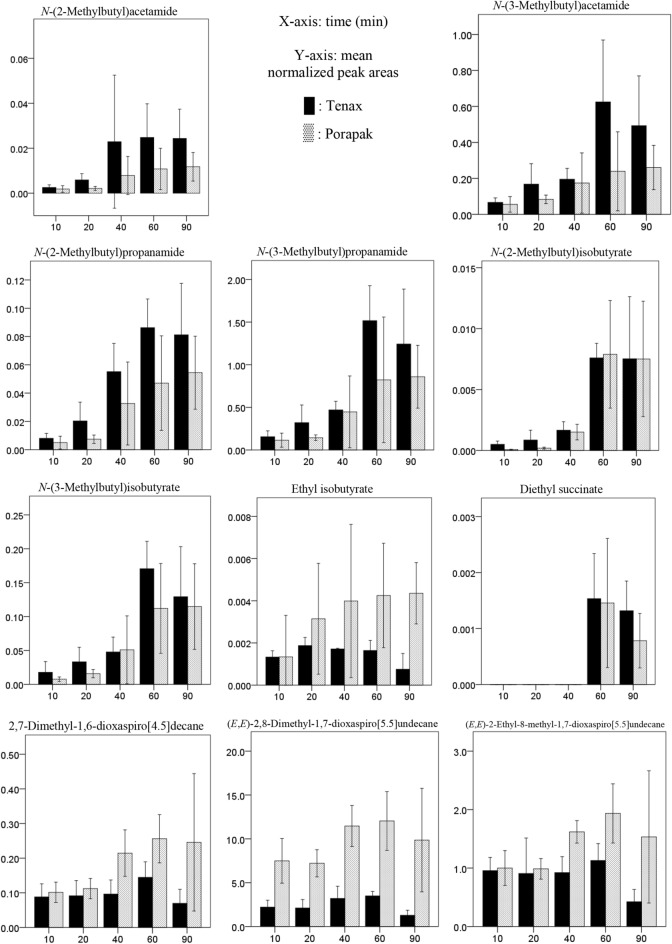
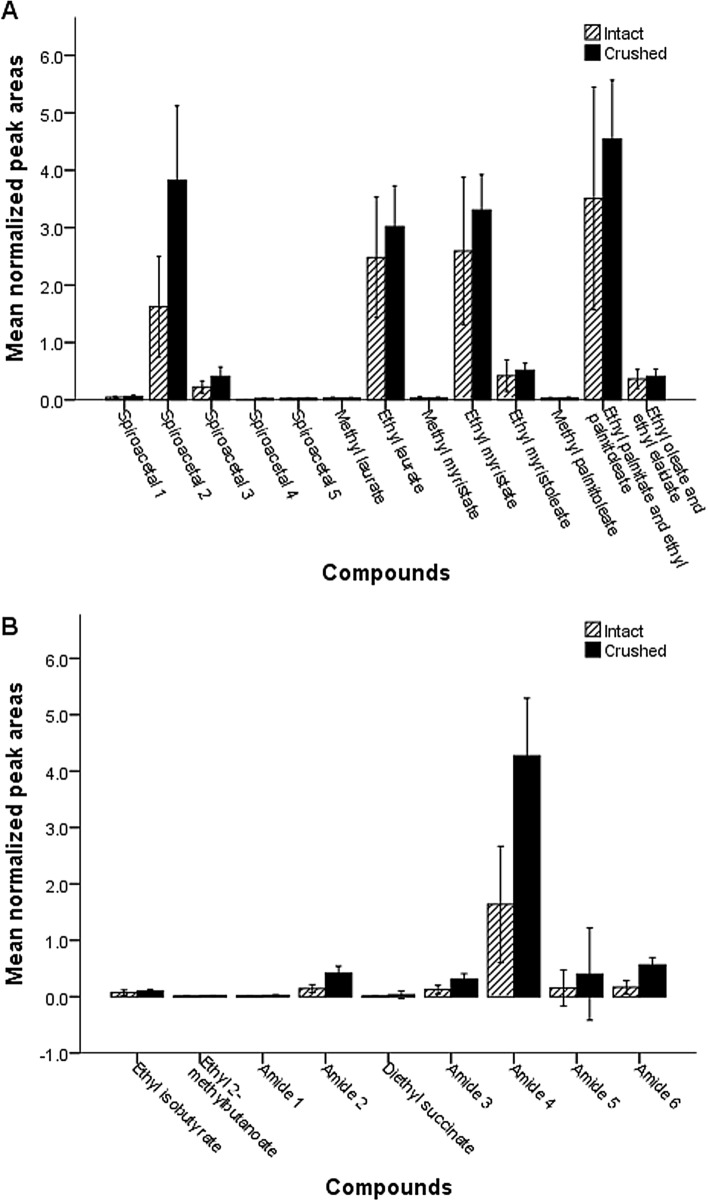
Diverse methods have been used to sample insect semiochemicals. Sampling methods can differ in efficiency and affinity and this can introduce significant biases when interpreting biological patterns. We compare common methods used to sample tephritid fruit fly rectal gland volatiles ('pheromones'), focusing on Queensland fruit fly, Bactrocera tryoni. Solvents of different polarity, n-hexane, dichloromethane and ethanol, were compared using intact and crushed glands. Polydimethylsiloxane, polydimethylsiloxane/divinylbenzene and polyacrylate were compared as adsorbents for solid phase microextraction. Tenax-GR and Porapak Q were compared as adsorbents for dynamic headspace sampling. Along with compounds previously reported for B. tryoni, we detected five previously unreported compounds in males, and three in females. Dichloromethane extracted more amides while there was no significant difference between the three solvents in extraction of spiroacetals except for (E,E)-2,8-dimethyl-1,7-dioxaspiro[5.5]undecane for which n-hexane extracted higher amount than both dichloromethane and ethanol. Ethanol failed to contain many of the more volatile compounds. Crushed rectal gland samples provided higher concentrations of extracted compounds than intact rectal gland samples, but no compounds were missed in intact samples. Of solid phase microextraction fibers, polyacrylate had low affinity for spiroacetals, ethyl isobutyrate and ethyl-2-methylbutanoate. Polydimethylsiloxane was more efficient for spiroacetals while type of fiber did not affect the amounts of amides and esters. In dynamic headspace sampling, Porapak was more efficient for ethyl isobutyrate and spiroacetals, while Tenax was more efficient for other esters and amides, and sampling time was a critical factor. Biases that can be introduced by sampling methods are important considerations when collecting and interpreting insect semiochemical profiles.
已经使用了多种方法来采样昆虫信息素。采样方法在效率和亲和力上可能存在差异,这在解释生物模式时会引入显著的偏差。我们比较了常用于采样桔小实蝇直肠腺挥发物(“信息素”)的常见方法,重点是昆士兰实蝇,Bactrocera tryoni。使用完整和粉碎的腺体比较了不同极性的溶剂,正己烷、二氯甲烷和乙醇。比较了聚二甲基硅氧烷、聚二甲基硅氧烷/二乙烯基苯和聚丙烯酸酯作为固相微萃取的吸附剂。比较了 Tenax-GR 和 Porapak Q 作为动态顶空采样的吸附剂。除了先前报道的 B. tryoni 化合物外,我们还在雄性中检测到了五种以前未报告的化合物,在雌性中检测到了三种。二氯甲烷提取的酰胺更多,而三种溶剂在提取螺缩醛方面没有显著差异,除了(E,E)-2,8-二甲基-1,7-二氧杂螺[5.5]十一烷,正己烷提取的量高于二氯甲烷和乙醇。乙醇未能包含许多更易挥发的化合物。粉碎的直肠腺样本提供的提取化合物浓度高于完整的直肠腺样本,但完整样本中没有遗漏任何化合物。在固相微萃取纤维中,聚丙烯酸酯对螺缩醛、异丁酸乙酯和 2-甲基丁酸乙酯的亲和力较低。聚二甲基硅氧烷对螺缩醛更有效,而纤维类型对酰胺和酯的量没有影响。在动态顶空采样中,Porapak 对异丁酸乙酯和螺缩醛更有效,而 Tenax 对其他酯和酰胺更有效,采样时间是一个关键因素。采样方法引入的偏差是在收集和解释昆虫信息素图谱时需要考虑的重要因素。