Infectious Diseases Institute, Rambam Health Care Campus, Haifa, Israel.
Division of Infectious Diseases, Department of Diagnostics and Public Health, University of Verona, Verona, Italy.
Clin Microbiol Infect. 2021 Mar;27(3):341-351. doi: 10.1016/j.cmi.2020.11.002. Epub 2020 Nov 11.
Management and control of coronavirus disease 2019 (COVID-19) relies on reliable diagnostic testing.
To evaluate the diagnostic test accuracy (DTA) of nucleic acid amplification tests (NAATs) for the diagnosis of coronavirus infections.
PubMed, Web of Science, the Cochrane Library, Embase, Open Grey and conference proceeding until May 2019. PubMed and medRxiv were updated for COVID-19 on 31st August 2020.
Studies were eligible if they reported on agreement rates between different NAATs using clinical samples.
Symptomatic patients with suspected upper or lower respiratory tract coronavirus infection.
The new NAAT was defined as the index test and the existing NAAT as reference standard. Data were extracted independently in duplicate. Risk of bias was assessed using the Quality Assessment of Diagnostic Accuracy Studies 2 tool. Confidence regions (CRs) surrounding summary sensitivity/specificity pooled by bivariate meta-analysis are reported. Heterogeneity was assessed using meta-regression.
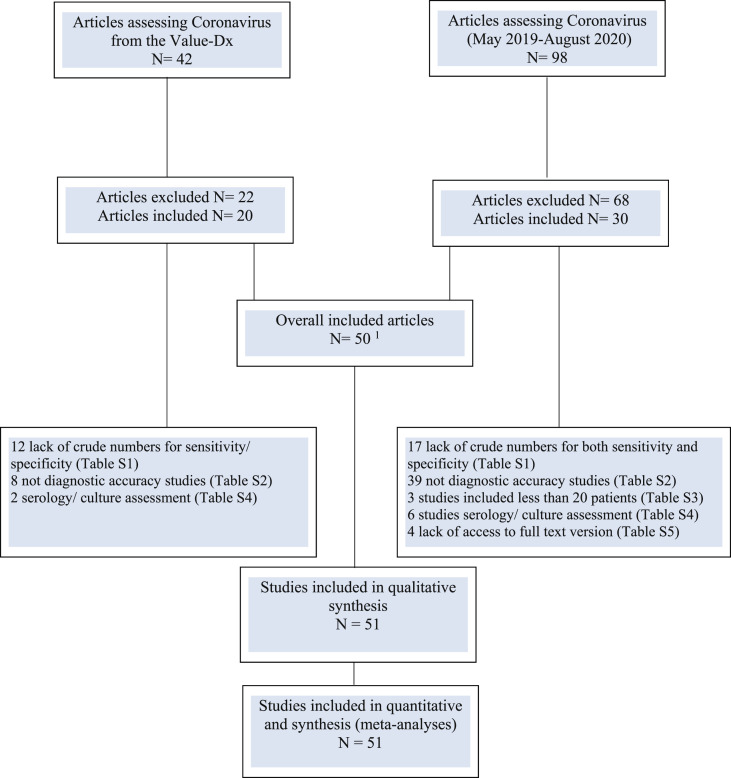
Fifty-one studies were included, 22 of which included 10 181 persons before COVID-19 and 29 including 8742 persons diagnosed with severe acute respiratory syndrome coronavirus 2 (SARS-CoV-2). The overall summary sensitivity was 89.1% (95%CR 84.0-92.7%) and specificity 98.9% (95%CR 98.0-99.4%). Nearly all the studies evaluated different PCRs as both index and reference standards. Real-time RT PCR assays resulted in significantly higher sensitivity than other tests. Reference standards at high risk of bias possibly exaggerated specificity. The pooled sensitivity and specificity of studies evaluating SARS-COV-2 were 90.4% (95%CR 83.7-94.5%) and 98.1% (95%CR 95.9-99.2), respectively. SARS-COV-2 studies using samples from the lower respiratory tract, real-time RT-PCR, and tests targeting the N or S gene or more than one gene showed higher sensitivity, and assays based on reverse transcriptase loop-mediated isothermal amplification (RT-LAMP), especially when targeting only the RNA-dependent RNA polymerase (RdRp) gene, showed significantly lower sensitivity compared to other studies.
Pooling all studies to date shows that on average 10% of patients with coronavirus infections might be missed with PCR tests. Variables affecting sensitivity and specificity can be used for test selection and development.
对 2019 年冠状病毒病(COVID-19)的管理和控制依赖于可靠的诊断检测。
评估用于诊断冠状病毒感染的核酸扩增检测(NAAT)的诊断测试准确性(DTA)。
PubMed、Web of Science、Cochrane 图书馆、Embase、Open Grey 和会议记录,直至 2019 年 5 月。2020 年 8 月 31 日,PubMed 和 medRxiv 更新了 COVID-19 内容。
如果研究报告了使用临床样本的不同 NAAT 之间的一致性率,则研究符合入选标准。
疑似上呼吸道或下呼吸道冠状病毒感染的有症状患者。
新的 NAAT 被定义为指标检测,现有的 NAAT 被定义为参考标准。数据由两名独立人员重复提取。使用诊断准确性研究的质量评估 2 工具评估偏倚风险。通过二元荟萃分析汇总的综合敏感性/特异性置信区间(CR)进行报告。使用 meta 回归评估异质性。
共纳入 51 项研究,其中 22 项研究纳入了 COVID-19 前的 10081 人,29 项研究纳入了 8742 人被诊断为严重急性呼吸综合征冠状病毒 2(SARS-CoV-2)。总体汇总敏感性为 89.1%(95%CR 84.0-92.7%),特异性为 98.9%(95%CR 98.0-99.4%)。几乎所有研究都将不同的 PCR 作为指标和参考标准进行了评估。实时 RT-PCR 检测的敏感性显著高于其他检测。参考标准的高偏倚风险可能夸大了特异性。评估 SARS-CoV-2 的研究的汇总敏感性和特异性分别为 90.4%(95%CR 83.7-94.5%)和 98.1%(95%CR 95.9-99.2%)。针对下呼吸道样本、实时 RT-PCR 以及针对 N 或 S 基因或多个基因的检测的 SARS-CoV-2 研究显示出较高的敏感性,而基于逆转录环介导等温扩增(RT-LAMP)的检测,特别是仅针对 RNA 依赖性 RNA 聚合酶(RdRp)基因的检测,与其他研究相比,敏感性显著降低。
迄今为止,对所有研究进行汇总表明,平均有 10%的冠状病毒感染患者可能会被 PCR 检测遗漏。影响敏感性和特异性的变量可用于检测选择和开发。