Public Health Risk Sciences Division, National Microbiology Laboratory, Public Health Agency of Canada, St-Hyacinthe, QC, Canada.
Epidemiology of Zoonoses and Public Health Research Unit, Faculté de médecine vétérinaire, Université de Montréal, Saint-Hyacinthe, QC, Canada.
BMC Public Health. 2024 Apr 19;24(1):1088. doi: 10.1186/s12889-024-18563-1.
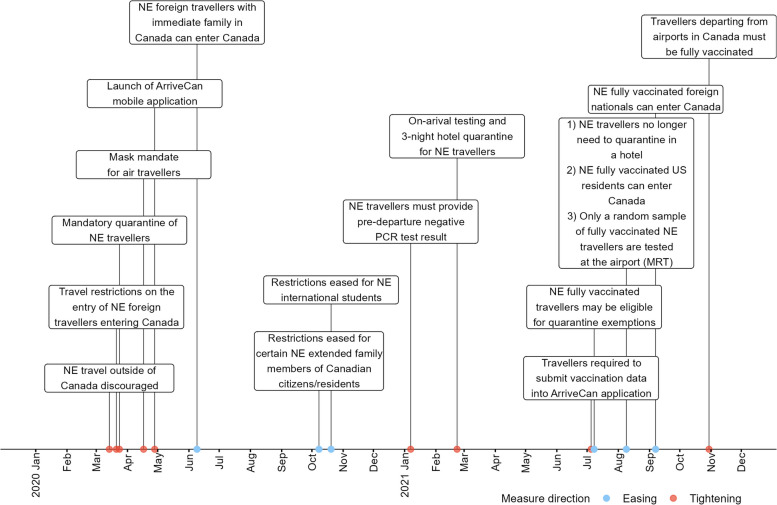
Estimating rates of disease importation by travellers is a key activity to assess both the risk to a country from an infectious disease emerging elsewhere in the world and the effectiveness of border measures. We describe a model used to estimate the number of travellers infected with SARS-CoV-2 into Canadian airports in 2021, and assess the impact of pre-departure testing requirements on importation risk.
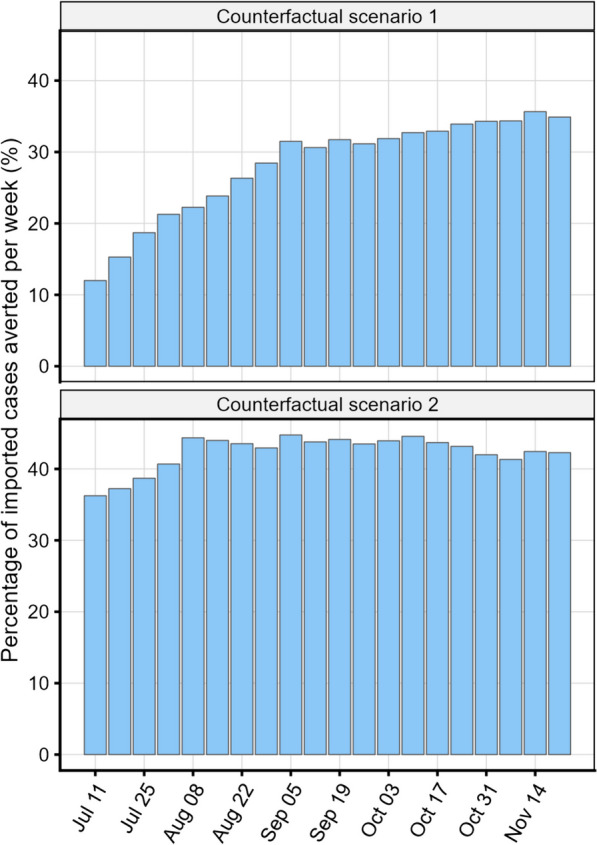
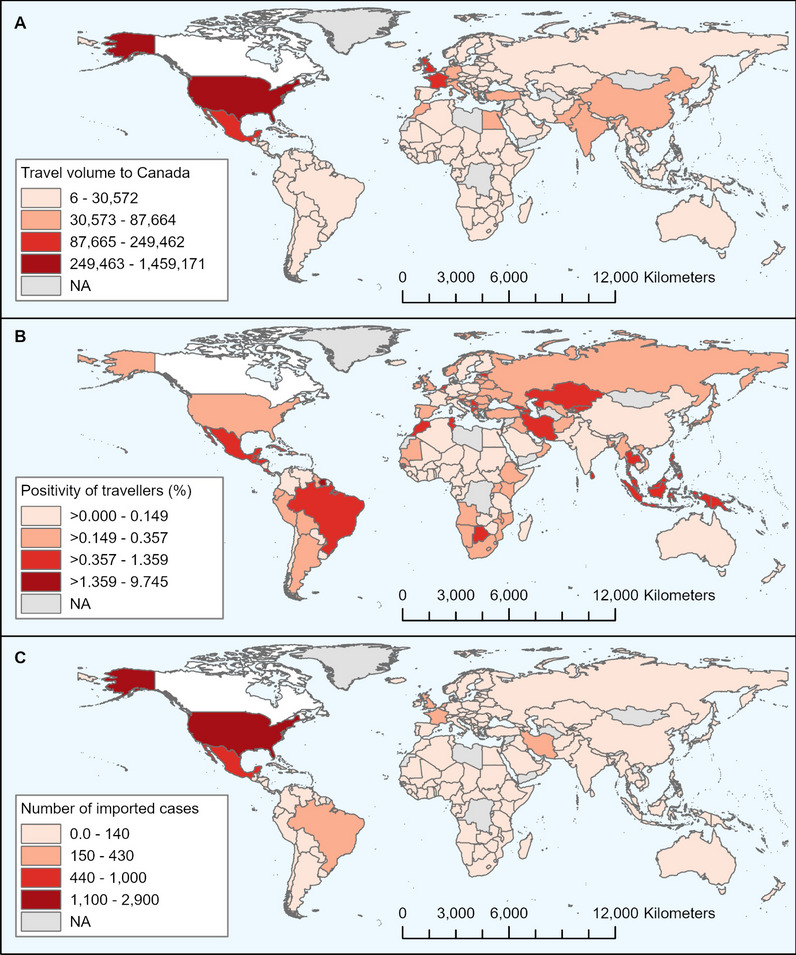
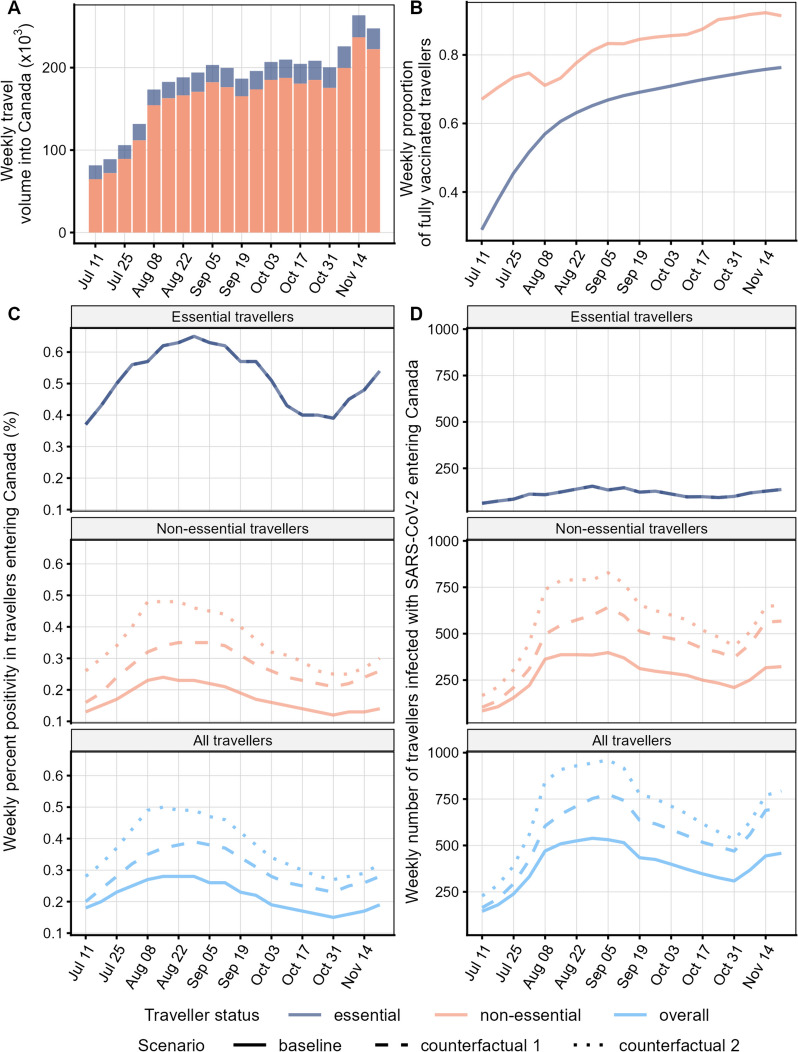
A mathematical model estimated the number of essential and non-essential air travellers infected with SARS-CoV-2, with the latter requiring a negative pre-departure test result. The number of travellers arriving infected (i.e. imported cases) depended on air travel volumes, SARS-CoV-2 exposure risk in the departure country, prior infection or vaccine acquired immunity, and, for non-essential travellers, screening from pre-departure molecular testing. Importation risk was estimated weekly from July to November 2021 as the number of imported cases and percent positivity (PP; i.e. imported cases normalised by travel volume). The impact of pre-departure testing was assessed by comparing three scenarios: baseline (pre-departure testing of all non-essential travellers; most probable importation risk given the pre-departure testing requirements), counterfactual scenario 1 (no pre-departure testing of fully vaccinated non-essential travellers), and counterfactual scenario 2 (no pre-departure testing of non-essential travellers).
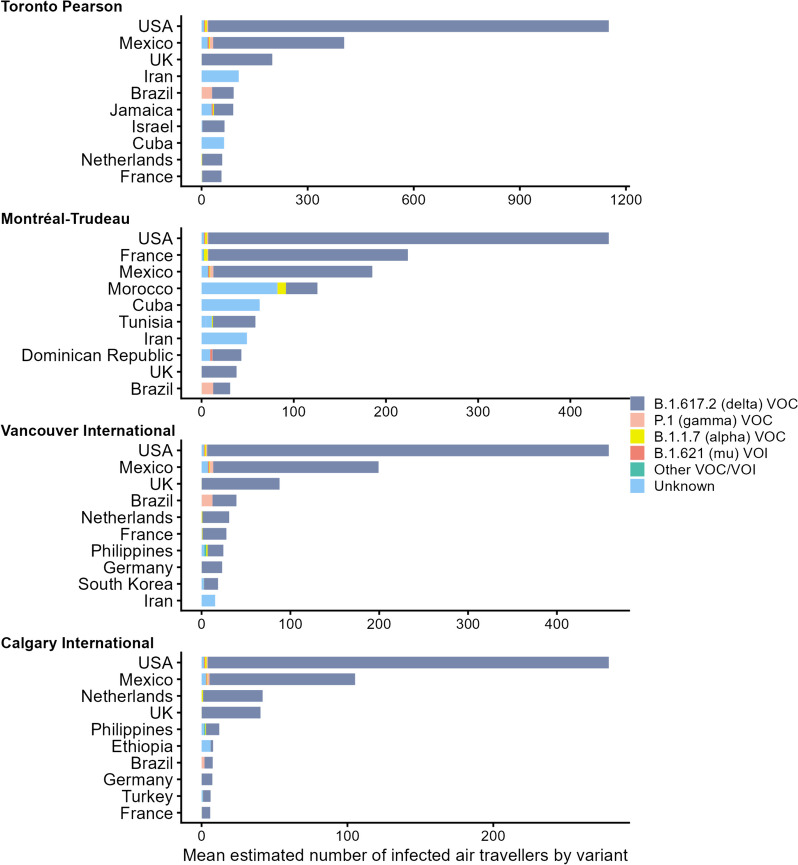
In the baseline scenario, weekly imported cases and PP varied over time, ranging from 145 to 539 cases and 0.15 to 0.28%, respectively. Most cases arrived from the USA, Mexico, the United Kingdom, and France. While modelling suggested that essential travellers had a higher weekly PP (0.37 - 0.65%) than non-essential travellers (0.12 - 0.24%), they contributed fewer weekly cases (62 - 154) than non-essential travellers (84 - 398 per week) given their lower travel volume. Pre-departure testing was estimated to reduce imported cases by one third (counterfactual scenario 1) to one half (counterfactual scenario 2).
The model results highlighted the weekly variation in importation by traveller group (e.g., reason for travel and country of departure) and enabled a framework for measuring the impact of pre-departure testing requirements. Quantifying the contributors of importation risk through mathematical simulation can support the design of appropriate public health policy on border measures.
估算旅行者输入疾病的发病率是评估传染病在世界其他地方出现对一个国家的风险以及边境措施有效性的关键活动。我们描述了一种用于估算 2021 年进入加拿大机场的感染 SARS-CoV-2 的旅行者人数的模型,并评估了出发前检测要求对输入风险的影响。
一个数学模型估算了感染 SARS-CoV-2 的必要和非必要航空旅行者的数量,后者需要阴性的出发前检测结果。感染旅行者的数量(即输入病例)取决于航空旅行量、出发国的 SARS-CoV-2 暴露风险、既往感染或疫苗获得的免疫力,以及对于非必要旅行者,通过出发前分子检测进行筛查。从 2021 年 7 月到 11 月,每周根据输入病例数和阳性率(即输入病例数除以旅行量的比例)估算输入风险。通过比较三种情况来评估出发前检测的影响:基线情况(对所有非必要旅行者进行出发前检测;根据出发前检测要求,最有可能的输入风险)、对照情况 1(完全接种疫苗的非必要旅行者出发前检测)和对照情况 2(非必要旅行者出发前检测)。
在基线情况下,每周输入病例数和阳性率随时间变化,范围分别为 145 至 539 例和 0.15 至 0.28%。大多数病例来自美国、墨西哥、英国和法国。虽然模型表明,必要旅行者的每周阳性率(0.37-0.65%)高于非必要旅行者(0.12-0.24%),但由于旅行量较低,他们每周输入的病例数较少(62-154 例),而非必要旅行者(每周 84-398 例)。出发前检测预计将输入病例减少三分之一(对照情况 1)至一半(对照情况 2)。
模型结果突出了旅行者群体(例如旅行目的和出发国)输入情况的每周变化,并为衡量出发前检测要求的影响提供了框架。通过数学模拟量化输入风险的贡献可以支持制定适当的边境措施公共卫生政策。