Kynast Jana, Quinque Eva Maria, Polyakova Maryna, Luck Tobias, Riedel-Heller Steffi G, Baron-Cohen Simon, Hinz Andreas, Witte A Veronica, Sacher Julia, Villringer Arno, Schroeter Matthias L
Department of Neurology, Max Planck Institute for Human Cognitive and Brain Sciences, Leipzig, Germany.
LIFE - Leipzig Research Center for Civilization Diseases, University of Leipzig, Leipzig, Germany.
Front Aging Neurosci. 2020 Oct 22;12:550416. doi: 10.3389/fnagi.2020.550416. eCollection 2020.
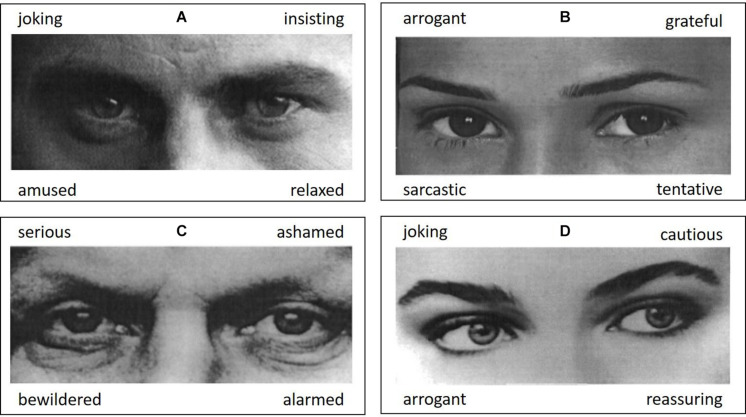
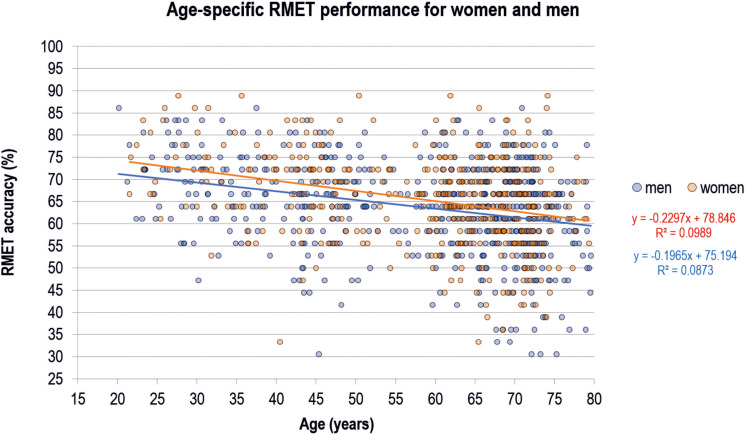
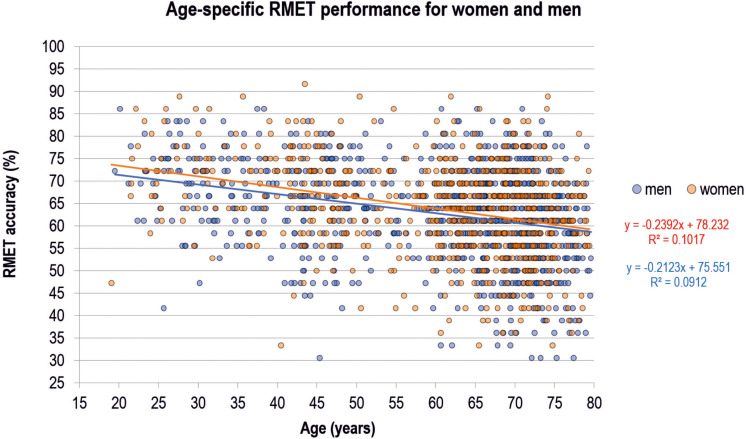
Social cognition, in particular mindreading, enables the understanding of another individual's feelings, intentions, desires, and mental states. The Reading the Mind in the Eyes Test (RMET) captures the ability to identify mental states from gaze. We investigated RMET accuracy in the context of age and cognition across the whole adult age-range (19-79 years) in a very large population-based sample ( = 1,603) with linear regression models accounting for cognitive abilities, neurological diseases, and psychiatric disorders. Higher age predicted lower RMET performance in women and men, suggesting difficulties to infer mental states from gaze at older age. Effects remained stable when taking other cognitive abilities and psychiatric disorders or neurological diseases into account. Our results show that RMET performance as a measure of social cognition declines with increasing age.
社会认知,尤其是读心术,能够让人理解他人的情感、意图、欲望和心理状态。眼睛解读心智测验(RMET)能够评估从眼神中识别心理状态的能力。我们在一个基于大规模人群的样本(n = 1603)中,通过线性回归模型研究了整个成年年龄范围(19 - 79岁)内年龄和认知背景下的RMET准确性,该模型考虑了认知能力、神经疾病和精神疾病。较高的年龄预示着女性和男性的RMET表现较低,这表明随着年龄增长,从眼神中推断心理状态存在困难。在考虑其他认知能力、精神疾病或神经疾病时,这种影响依然稳定。我们的结果表明,作为社会认知衡量指标的RMET表现会随着年龄增长而下降。