Yang Jingwen, Wu Xue, Sasaki Kyoshiro, Yamada Yuki
Graduate School of Human-Environment Studies, Kyushu University, Fukuoka, Japan.
Faculty of Informatics, Kansai University, Takatsuki, Japan.
PeerJ. 2020 Nov 2;8:e10318. doi: 10.7717/peerj.10318. eCollection 2020.
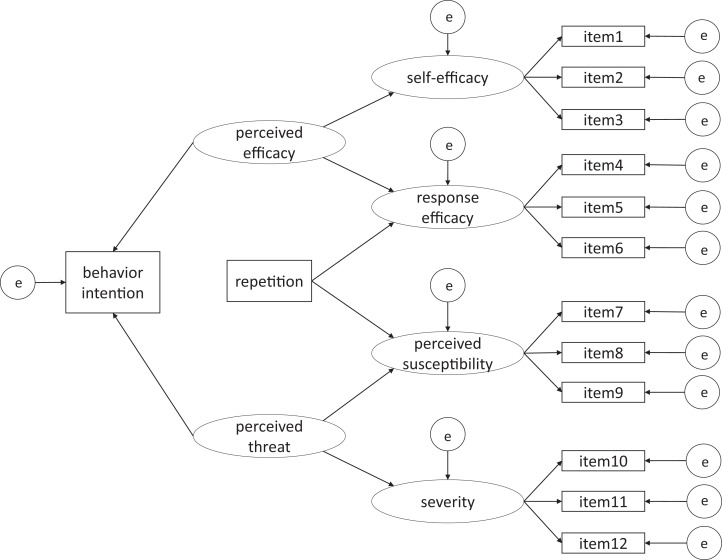
When people are confronted with health proposals during the coronavirus disease 2019 (COVID-19) pandemic, it has been suggested that fear of COVID-19 can serve protective functions and ensure public health compliance. However, health proposal repetition and its perceived efficacy also influence the behavior intention toward the proposal, which has not yet been confirmed in the COVID-19 context. The present study aims to examine whether the extended parallel process model (EPPM) can be generalized to a naturalistic context like the COVID-19 pandemic. Additionally, we will explore how repetition of a health proposal is involved with the EPPM. In this study, two groups of participants are exposed to the same health proposal related to COVID-19, where one group is exposed once and another group twice. They then fill out a questionnaire consisting of items concerning behavior intention and adapted from the Risk Behavior Diagnosis Scale. Structural equation modeling will be used to determine the multivariate associations between the variables. We predict that repetition of the health proposal will associate with response efficacy (i.e., a belief about the effectiveness of the health proposal in deterring the threat) and perceived susceptibility (i.e., a belief about the risk of experiencing the threat). It is also predicted that following the EPPM, behavior intention will associate with both perceived efficacy of the health proposal, which will underlie response efficacy, and perceived threat of COVID-19, which will underlie perceived susceptibility. We will discuss the process, based on the model, where health message repetition affects behavior intention during the COVID-19 pandemic.
在2019冠状病毒病(COVID-19)大流行期间,当人们面对健康建议时,有人提出对COVID-19的恐惧可以起到保护作用并确保公众遵守公共卫生要求。然而,健康建议的重复及其感知到的效果也会影响对该建议的行为意图,这在COVID-19背景下尚未得到证实。本研究旨在检验扩展平行过程模型(EPPM)是否可以推广到像COVID-19大流行这样的自然情境中。此外,我们将探讨健康建议的重复如何与EPPM相关联。在本研究中,两组参与者接触与COVID-19相关的相同健康建议,其中一组接触一次,另一组接触两次。然后他们填写一份问卷,问卷由与行为意图相关的项目组成,并改编自风险行为诊断量表。将使用结构方程模型来确定变量之间的多变量关联。我们预测健康建议的重复将与反应效能(即对健康建议在威慑威胁方面有效性的信念)和感知易感性(即对经历威胁风险的信念)相关联。还预测遵循EPPM,行为意图将与健康建议的感知效能(其将构成反应效能的基础)和COVID-19的感知威胁(其将构成感知易感性的基础)相关联。我们将基于该模型讨论在COVID-19大流行期间健康信息重复影响行为意图的过程。