Errante Fosca, Ledwoń Patrycja, Latajka Rafal, Rovero Paolo, Papini Anna Maria
Laboratory of Peptide and Protein Chemistry and Biology, Department of Neurosciences, Psychology, Drug Research and Child Health-Section of Pharmaceutical Sciences and Nutraceutics, University of Florence, Firenze, Italy.
Espikem S.r.l., Prato, Italy.
Front Chem. 2020 Oct 30;8:572923. doi: 10.3389/fchem.2020.572923. eCollection 2020.
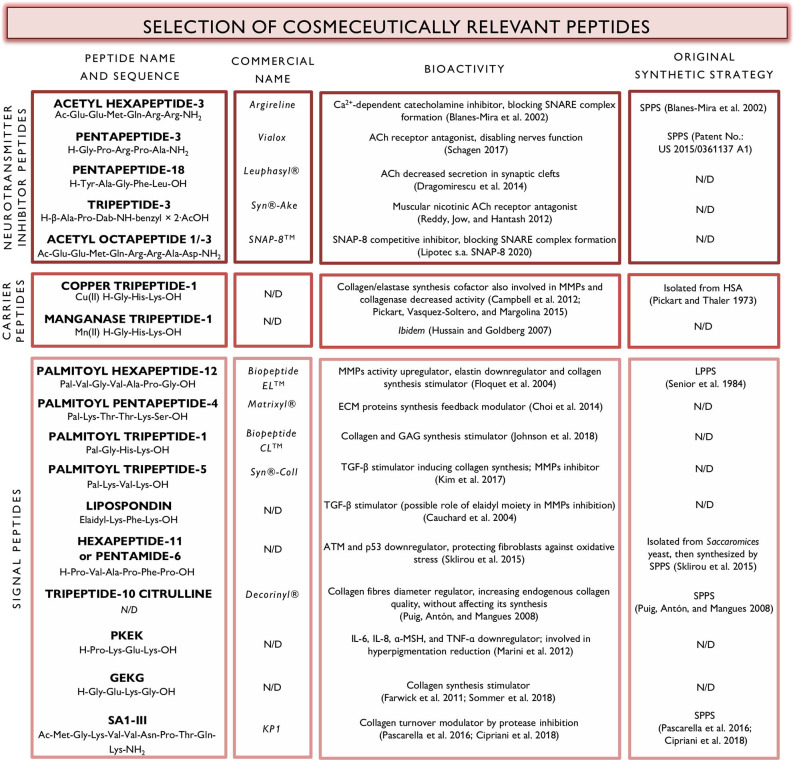
Among the many aspects that contribute to the wellness of each individual, healthy and younger-looking skin play a relevant role, as clearly shown by the important growth of the skin-care products market observed in recent years. In this scenario, the field of cosmeceuticals appears particularly promising, being based on cosmetic products containing active ingredients. Among these, several peptides were proposed for cosmeceutical applications, thanks to their specific interaction with biological targets. In this mini-review, we report some of the most investigated and used peptides for cosmetic formulations, taking into account that cosmeceutical peptides are basically divided into three main categories (i.e., neurotransmitter inhibitors, carriers, and signal peptides). Special attention was payed to the scientific studies supporting the claimed biological activity of these peptides, as a fundamental aspect that should underpin the growth of this field in the framework of a sustainable wellness economy.
在有助于每个人健康的诸多方面中,健康且看起来更年轻的皮肤发挥着重要作用,近年来护肤品市场的显著增长清楚地表明了这一点。在这种情况下,药妆品领域显得特别有前景,因为它基于含有活性成分的化妆品。其中,几种肽由于其与生物靶点的特定相互作用而被提议用于药妆应用。在这篇小型综述中,我们报告了一些用于化妆品配方的研究最多且使用最广泛的肽,同时考虑到药妆肽基本上分为三大类(即神经递质抑制剂、载体和信号肽)。我们特别关注支持这些肽所宣称的生物活性的科学研究,因为这是在可持续健康经济框架下药妆品领域发展的一个基本方面。