Pintea Andrada, Manea Andrei, Pintea Cezara, Vlad Robert-Alexandru, Bîrsan Magdalena, Antonoaea Paula, Rédai Emöke Margit, Ciurba Adriana
Medicine and Pharmacy Doctoral School, George Emil Palade University of Medicine, Pharmacy, Science, and Technology of Targu Mures, 540142 Targu Mures, Romania.
Pharmaceutical Technology and Cosmetology Department, Faculty of Pharmacy, George Emil Palade University of Medicine, Pharmacy, Science and Technology of Targu Mures, 540142 Targu Mures, Romania.
Biomolecules. 2025 Jan 9;15(1):88. doi: 10.3390/biom15010088.
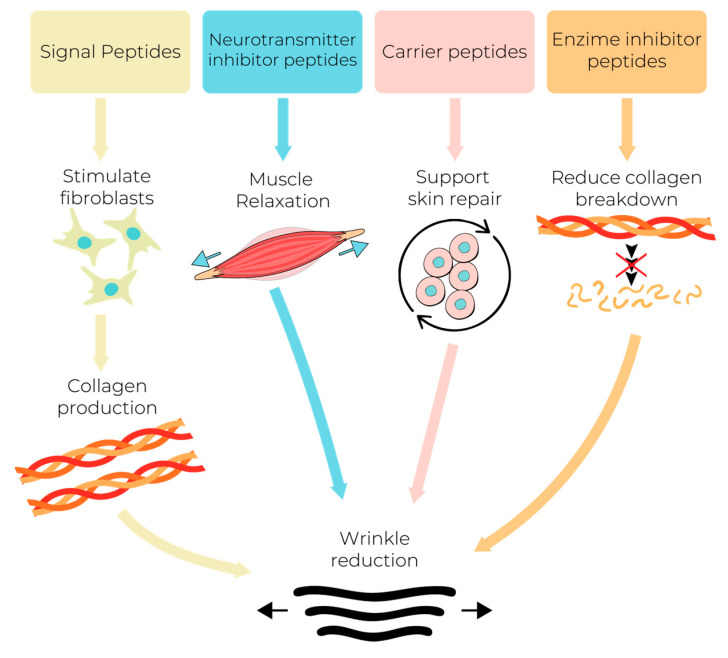
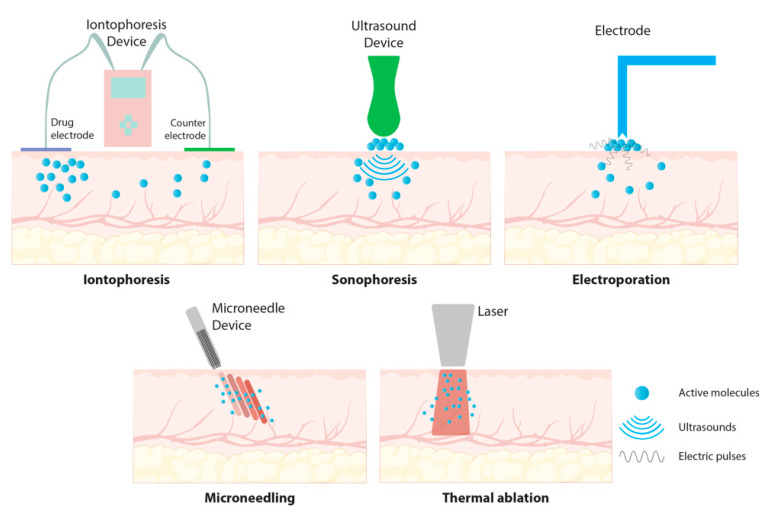
One class of cosmetic compounds that have raised interest of many experts is peptides. The search for ingredients with good biocompatibility and bioactivity has led to the use of peptides in cosmetic products. Peptides are novel active ingredients that improve collagen synthesis, enhance skin cell proliferation, or decrease inflammation. Based on their mechanism of action, they can be classified into signal peptides, carrier peptides, neurotransmitter inhibitor peptides, and enzyme inhibitor peptides. This review focuses on the main types of peptides and their application in the cosmetic field, underlining their main limitations. One of the most significant drawbacks of cosmetic peptides is their poor permeability through membranes, which limits their delivery and effectiveness. As a result, this review follows the methods used for improving permeability through the stratum corneum. Increasing peptide bioavailability and stability for enhanced delivery to the desired site of action and visible effects have become central points for the latest research due to their promising features. For this purpose, several methods have been identified and described. Physical techniques include thermal ablation (radiofrequency and laser), electrical methods (electroporation, iontophoresis), mechanical approach (microneedles), and ultrasounds. As an alternative, innovative formulations have been developed in nano-systems such as liposomes, niosomes, ethosomes, nanoemulsions, and other nanomaterials to reduce skin irritation and improve product effectiveness. The purpose of this review is to provide the latest information regarding these noteworthy molecules and the reasoning behind their use in cosmetic formulations.
一类引起众多专家关注的化妆品化合物是肽。对具有良好生物相容性和生物活性的成分的探索导致了肽在化妆品中的应用。肽是新型活性成分,可促进胶原蛋白合成、增强皮肤细胞增殖或减轻炎症。根据其作用机制,它们可分为信号肽、载体肽、神经递质抑制肽和酶抑制肽。本综述重点关注肽的主要类型及其在化妆品领域的应用,并强调其主要局限性。化妆品肽最显著的缺点之一是其透过膜的通透性差,这限制了它们的递送和有效性。因此,本综述介绍了用于提高透过角质层通透性的方法。由于其具有前景的特性,提高肽的生物利用度和稳定性以增强递送至所需作用部位并产生可见效果已成为最新研究的重点。为此,已确定并描述了几种方法。物理技术包括热消融(射频和激光)、电方法(电穿孔、离子导入)、机械方法(微针)和超声。作为替代方案,已在纳米系统如脂质体、非离子表面活性剂囊泡、醇质体、纳米乳液和其他纳米材料中开发创新配方,以减少皮肤刺激并提高产品有效性。本综述的目的是提供有关这些值得关注的分子的最新信息以及它们在化妆品配方中使用的背后原因。