Teixeira Júnior Antonio Augusto Lima, Neves Precil Diego Miranda de Menezes, Lages Joyce Santos, Cunha Kaile de Araújo, Muniz Monique Pereira Rêgo, Brito Dyego José de Araújo, Watanabe Andréia, Watanabe Elieser Hitoshi, Onuchic Luiz Fernando, Nunes Lucas Lobato Acatauassu, Coutinho Filho Antônio Fernando, Barcelos Flávia Lara, Gatto Giuseppe Cesare, Monteiro Antonio, Polido Diego do Amaral, Motta Douglas Rafanelle Moura de Santana, Leite Thaísa de Oliveira, Guedes Felipe Leite, Gomes Orlando Vieira, Valente Lucila Maria, Israel Karla Cristina Silva Petruccelli, Ladchumananandasivam Francisco Rasiah, de Farias Lígia Cristina Lopes, Marques Igor Denizarde Bacelar, Uliano Gustavo Lemos, Maramaldo Carlos Eduardo Campos, Neto Lídio Gonçalves Lima, Luchi Weverton Machado, Wanderley David Campos, Araújo Stanley de Almeida, Salgado Filho Natalino, Silva Gyl Eanes Barros
Postgraduate Program in Genetics, Ribeirão Preto Medical School, University of São Paulo (PGGEN-FMRP-USP), Ribeirão Preto, Brazil.
University Hospital, Federal University of Maranhão (HU-UFMA), São Luís, Brazil.
Front Med (Lausanne). 2020 Oct 23;7:584235. doi: 10.3389/fmed.2020.584235. eCollection 2020.
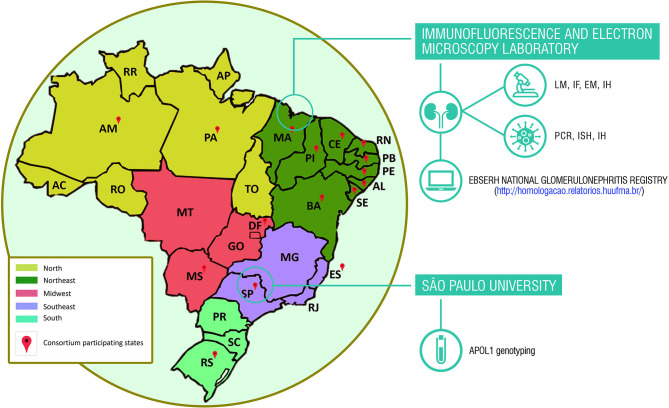
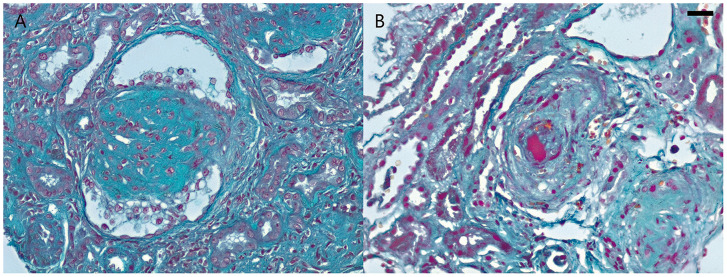
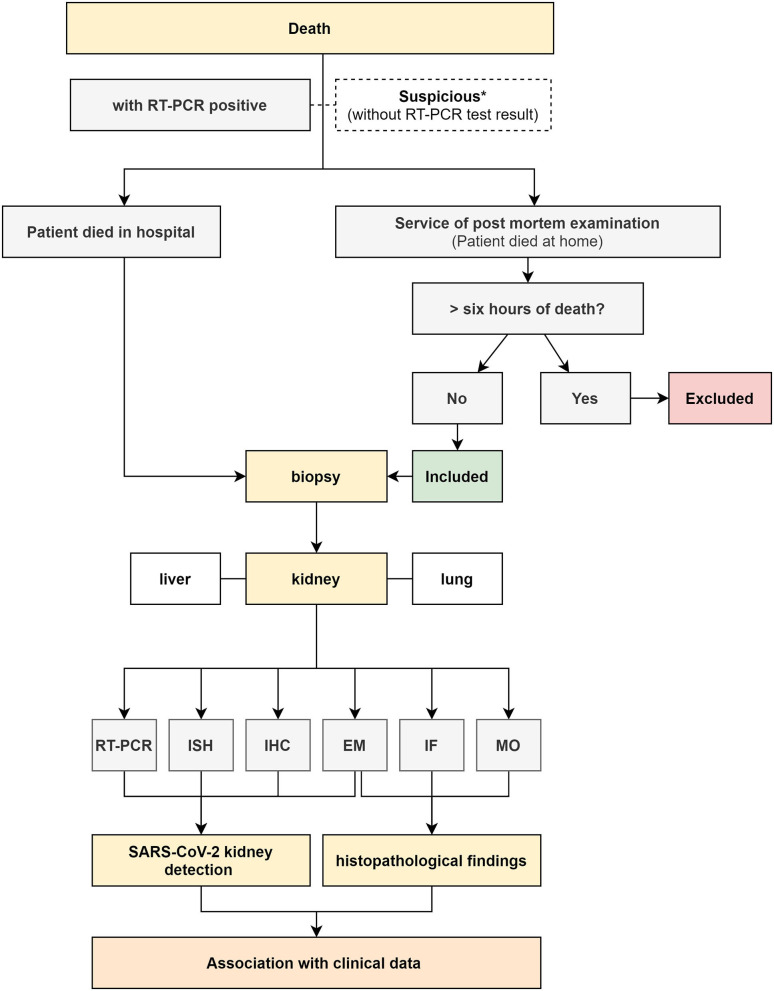
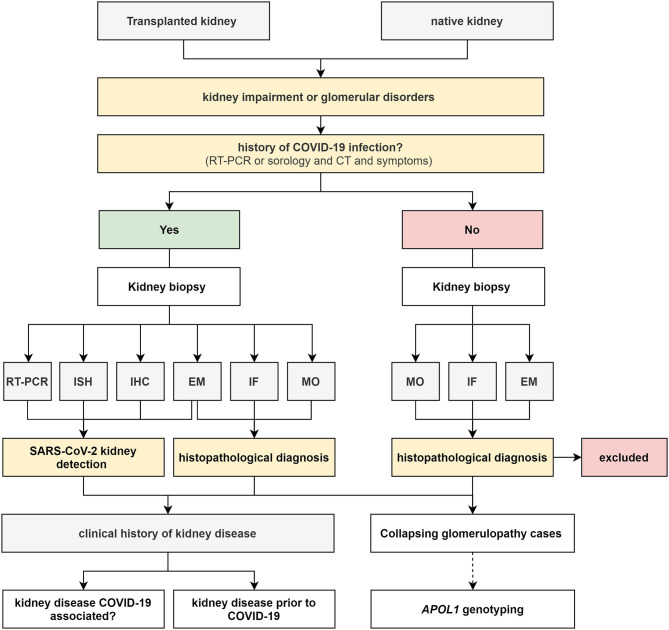
Kidney involvement appears to be frequent in coronavirus disease 2019 (COVID-19). Despite this, information concerning renal involvement in COVID-19 is still scarce. Several mechanisms appear to be involved in the complex relationship between the virus and the kidney. Also, different morphological patterns have been described in the kidneys of patients with COVID-19. For some authors, however, this association may be just a coincidence. To investigate this issue, we propose assessing renal morphology associated with COVID-19 at the renal pathology reference center of federal university hospitals in Brazil. Data will come from a consortium involving 17 federal university hospitals belonging to (EBSERH) network, as well as some state hospitals and an autopsy center. All biopsies will be sent to the referral center for renal pathology of the EBSERH network. The data will include patients who had coronavirus disease, both alive and deceased, with or without pre-existing kidney disease. Kidney biopsies will be analyzed by light, fluorescence, and electron microscopy. Furthermore, immunohistochemical (IHC) staining for various inflammatory cells (i.e., cells expressing CD3, CD20, CD4, CD8, CD138, CD68, and CD57) as well as angiotensin-converting enzyme 2 (ACE2) will be performed on paraffinized tissue sections. In addition to ultrastructural assays, hybridization (ISH), IHC and reverse transcription-polymerase chain reaction (RT-PCR) will be used to detect Severe Acute Respiratory Syndrome Coronavirus (SARS-CoV-2) in renal tissue. For the patients diagnosed with Collapsing Glomerulopathy, peripheral blood will be collected for apolipoprotein L-1 (APOL1) genotyping. For patients with thrombotic microangiopathy, thrombospondin type 1 motif, member 13 (ADAMTS13), antiphospholipid, and complement panel will be performed. The setting of this study is Brazil, which is second behind the United States in highest confirmed cases and deaths. With this complete approach, we hope to help define the spectrum and impact, whether immediate or long-term, of kidney injury caused by SARS-CoV-2.
肾脏受累在2019冠状病毒病(COVID-19)中似乎很常见。尽管如此,关于COVID-19肾脏受累的信息仍然很少。病毒与肾脏之间的复杂关系似乎涉及多种机制。此外,COVID-19患者的肾脏中已描述了不同的形态学模式。然而,对于一些作者来说,这种关联可能只是巧合。为了研究这个问题,我们建议在巴西联邦大学医院的肾脏病理参考中心评估与COVID-19相关的肾脏形态。数据将来自一个由17家隶属于巴西高等教育人员改进协调局(EBSERH)网络的联邦大学医院以及一些州立医院和一个尸检中心组成的联盟。所有活检组织将被送往EBSERH网络的肾脏病理转诊中心。数据将包括患有冠状病毒病的患者,无论其存活与否,有无既往肾病。肾脏活检将通过光学显微镜、荧光显微镜和电子显微镜进行分析。此外,将对石蜡包埋的组织切片进行各种炎性细胞(即表达CD3、CD20、CD4、CD8、CD138、CD68和CD57的细胞)以及血管紧张素转换酶2(ACE2)的免疫组织化学(IHC)染色。除了超微结构检测外,原位杂交(ISH)、IHC和逆转录聚合酶链反应(RT-PCR)将用于检测肾脏组织中的严重急性呼吸综合征冠状病毒(SARS-CoV-2)。对于诊断为塌陷性肾小球病的患者,将采集外周血进行载脂蛋白L-1(APOL1)基因分型。对于血栓性微血管病患者,将检测1型血小板反应蛋白基序成员13(ADAMTS13)、抗磷脂和补体指标。本研究的开展地点是巴西,该国的确诊病例和死亡人数仅次于美国,位居第二。通过这种全面的方法,我们希望有助于确定SARS-CoV-2引起的肾脏损伤的范围和影响,无论是短期还是长期的。