Okotto-Okotto Joseph, Wanza Peggy, Kwoba Emmah, Yu Weiyu, Dzodzomenyo Mawuli, Thumbi S M, da Silva Diogo Gomes, Wright Jim A
Victoria Institute for Research on Environment and Development (VIRED) International, off Nairobi Road, Rabour, P.O. Box 6423-40103, Kisumu, Kenya.
Centre for Global Health Research, Kenya Medical Research Institute, P.O. Box 1578-40100, Kisumu, Kenya.
Expo Health. 2020;12(4):809-822. doi: 10.1007/s12403-019-00339-3. Epub 2019 Dec 24.
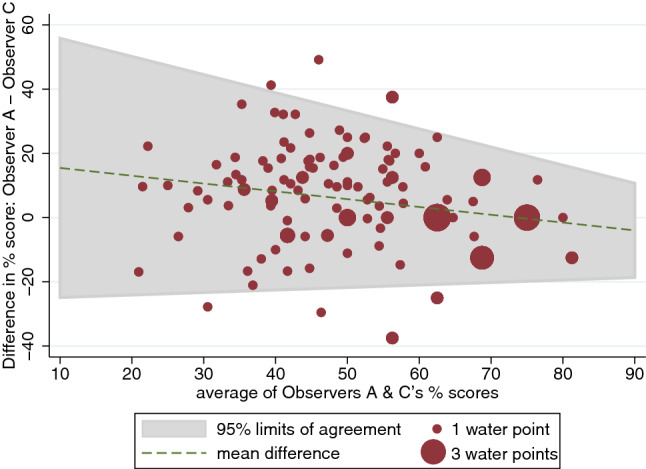
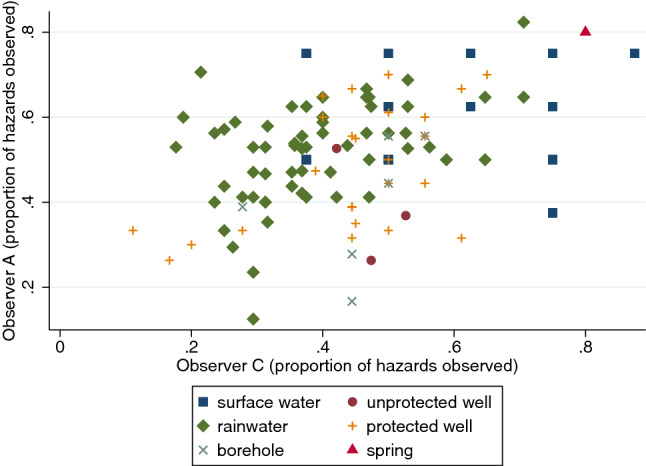
Sanitary risk inspection, an observation protocol for identifying contamination hazards around water sources, is promoted for managing rural water supply safety. However, it is unclear how far different observers consistently identify contamination hazards and consistently classify water source types using standard typologies. This study aimed to quantify inter-observer agreement in hazard identification and classification of rural water sources. Six observers separately visited 146 domestic water sources in Siaya County, Kenya, in wet and dry seasons. Each observer independently classified the source type and conducted a sanitary risk inspection using a standard protocol. Water source types assigned by an experienced observer were cross-tabulated against those of his colleagues, as were contamination hazards identified, and inter-observer agreement measures calculated. Agreement between hazards observed by the most experienced observer versus his colleagues was significant but low (intra-class correlation = 0.49), with inexperienced observers detecting fewer hazards. Inter-observer agreement in classifying water sources was strong (Cohen's kappa = 0.84). However, some source types were frequently misclassified, such as sources adapted to cope with water insecurity (e.g. tanks drawing on both piped and rainwater). Observers with limited training and experience thus struggle to consistently identify hazards using existing protocols, suggesting observation protocols require revision and their implementation should be supported by comprehensive training. Findings also indicate that field survey teams struggle to differentiate some water source types based on a standard water source classification, particularly sources adapted to cope with water insecurity. These findings demonstrate uncertainties underpinning international monitoring and analyses of safe water access via household surveys.
卫生风险检查是一种用于识别水源周围污染危害的观察方案,目前正在推广以管理农村供水安全。然而,尚不清楚不同的观察者在使用标准类型学一致识别污染危害和一致分类水源类型方面的程度如何。本研究旨在量化农村水源危害识别和分类中观察者间的一致性。六名观察者在雨季和旱季分别走访了肯尼亚锡亚县的146个家庭水源。每位观察者独立对水源类型进行分类,并使用标准方案进行卫生风险检查。将经验丰富的观察者指定的水源类型与其同事的进行交叉制表,对识别出的污染危害也进行同样处理,并计算观察者间的一致性指标。经验最丰富的观察者与其同事观察到的危害之间的一致性显著但较低(组内相关系数=0.49),经验不足的观察者检测到的危害较少。观察者在水源分类方面的一致性较强(科恩kappa系数=0.84)。然而,一些水源类型经常被错误分类,例如为应对水资源不安全状况而改造的水源(如同时取用管道水和雨水的水箱)。因此,训练和经验有限的观察者难以使用现有方案一致识别危害,这表明观察方案需要修订,其实施应得到全面培训的支持。研究结果还表明,实地调查团队难以根据标准的水源分类区分某些水源类型,特别是为应对水资源不安全状况而改造的水源。这些发现表明了通过家庭调查对安全用水获取情况进行国际监测和分析存在的不确定性。