Department of Paediatrics, University of Cambridge, Cambridge CB2 0QQ, UK.
MRC Department of Epidemiology, University of Cambridge, Cambridge CB2 0SL, UK.
Nutrients. 2020 Nov 12;12(11):3466. doi: 10.3390/nu12113466.
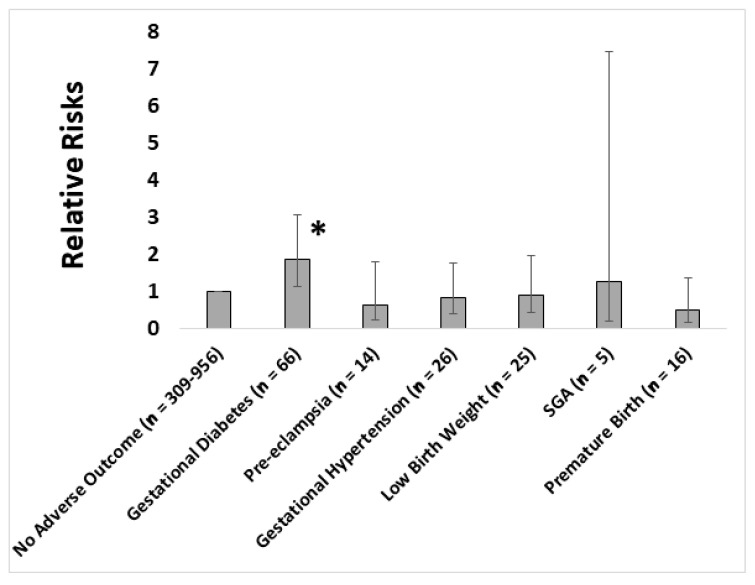
Multiple micronutrient supplementation (MMS) in pregnancy has previously been associated with positive effects on fetal growth, but its value in high-income countries remains controversial. In this study, we investigated effects of pregnancy MMS on offspring size at birth and adiposity, along with risks of various maternal outcomes of pregnancy, using the prospective Cambridge Baby Growth Study. Maternal MMS was reported in 528 out of 970 women who completed pregnancy questionnaires. Gestational diabetes (GDM) was assessed using results from 75 g oral glucose tolerance tests at week 28 of pregnancy. Offspring size at birth was assessed using standard anthropometric measurements and adiposity using skinfold calipers. MMS was associated with increased risk of developing GDM (risk ratio = 1.86 (1.13-3.08), = 0.02), as well as increased offspring size at birth in terms of weight ( = 0.03), head circumference ( = 0.04), and flank, and subscapular and triceps skinfold thicknesses ( = 0.04, 0.03, and 0.003, respectively). There was no association with quadriceps skinfold thickness ( = 0.2), suggesting that the increased adiposity was partially regionalized. In women who underwent oral glucose tolerance testing, nearly all of these associations were attenuated by adjusting for GDM. These results suggest that the increased offspring size at birth, including (regionalized) adiposity associated with pregnancy, and MMS may be partially related to the development of GDM.
孕期补充多种微量营养素(MMS)此前曾与胎儿生长的积极影响相关,但在高收入国家,其价值仍存在争议。在这项研究中,我们使用前瞻性剑桥婴儿生长研究调查了孕期 MMS 对出生时后代大小和肥胖的影响,以及各种妊娠母源性结局的风险。在完成妊娠问卷的 970 名女性中,有 528 名报告了孕期 MMS。妊娠期糖尿病(GDM)使用妊娠 28 周 75g 口服葡萄糖耐量试验的结果进行评估。使用标准人体测量学测量来评估后代出生时的大小,使用皮褶卡尺来评估肥胖程度。MMS 与 GDM 的发病风险增加相关(风险比=1.86(1.13-3.08), =0.02),以及出生时体重( =0.03)、头围( =0.04)、肋部、肩胛下角和肱三头肌皮褶厚度( =0.04、0.03 和 0.003,分别)的增加相关。与股四头肌皮褶厚度( =0.2)无关,这表明增加的肥胖程度部分是区域性的。在接受口服葡萄糖耐量试验的女性中,这些关联几乎都通过调整 GDM 而减弱。这些结果表明,与孕期 MMS 相关的后代出生时大小增加,包括(区域性)肥胖,可能部分与 GDM 的发生有关。