Kim Ji Hyun, Kang Seong Hee, Lee Minjong, Youn Gi Soo, Kim Tae Suk, Jun Baek Gyu, Kim Moon Young, Kim Young Don, Cheon Gab Jin, Kim Dong Joon, Baik Soon Koo, Choi Dae Hee, Suk Ki Tae
Department of Internal Medicine, Kangwon National University School of Medicine, Chuncheon 24289, Korea.
Department of Internal Medicine, Wonju Severance Christian Hospital, Yonsei University Wonju College of Medicine, Wonju 26426, Korea.
Cancers (Basel). 2020 Nov 12;12(11):3347. doi: 10.3390/cancers12113347.
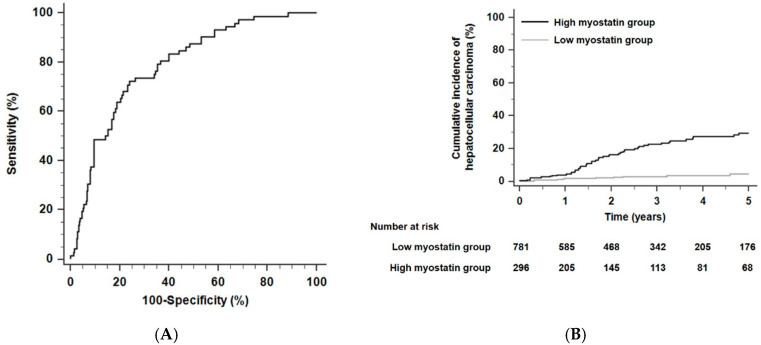
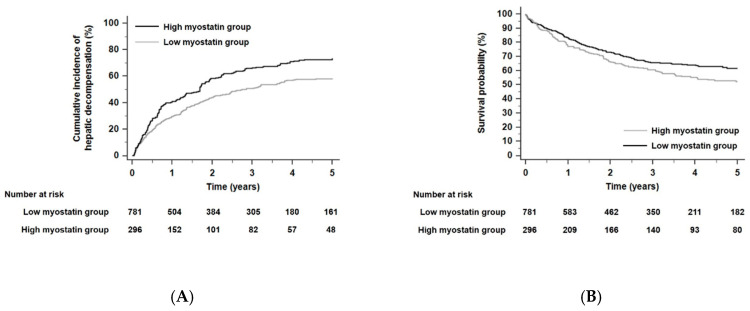
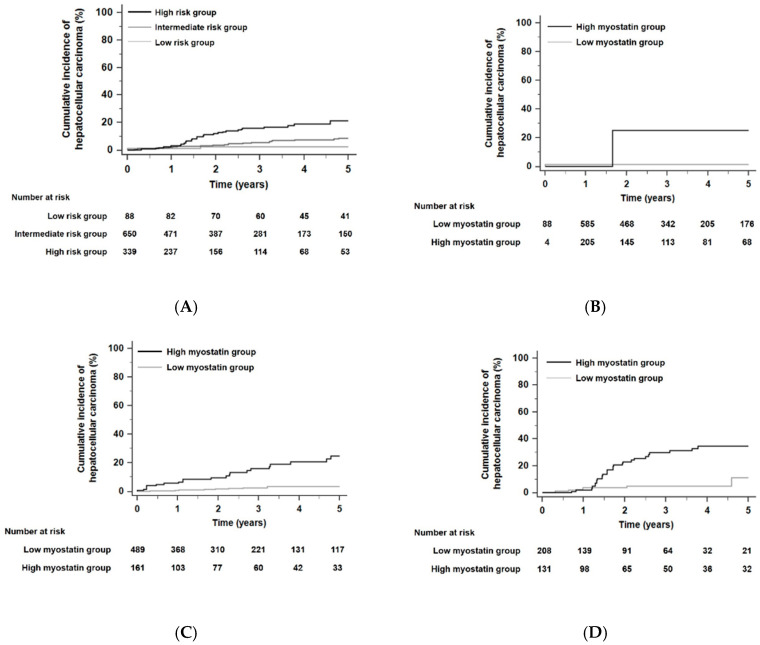
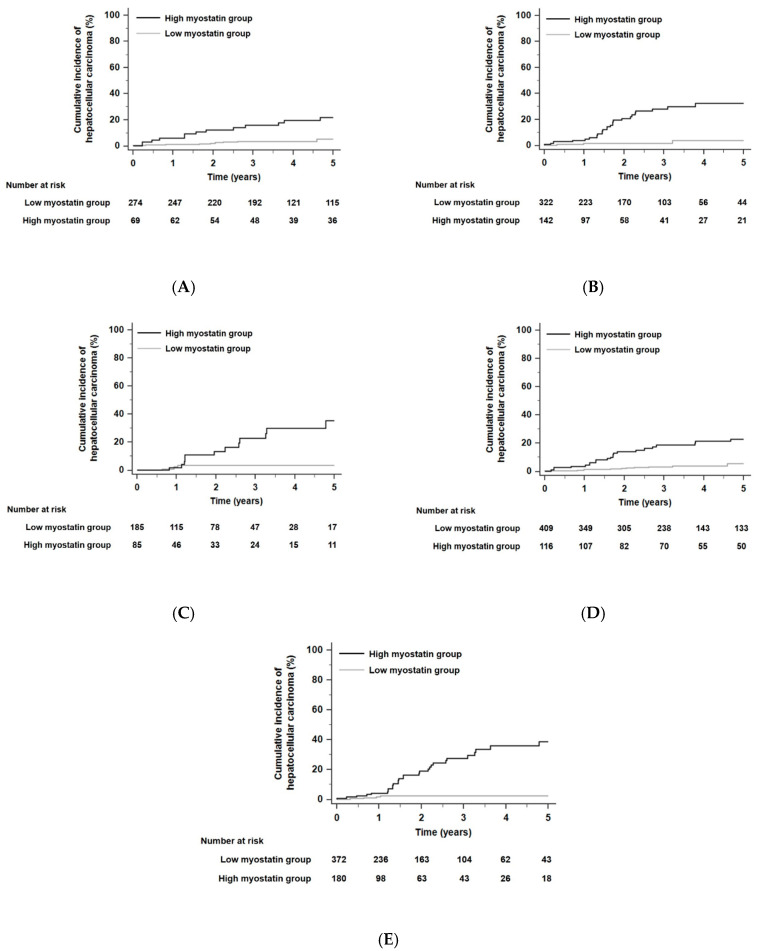
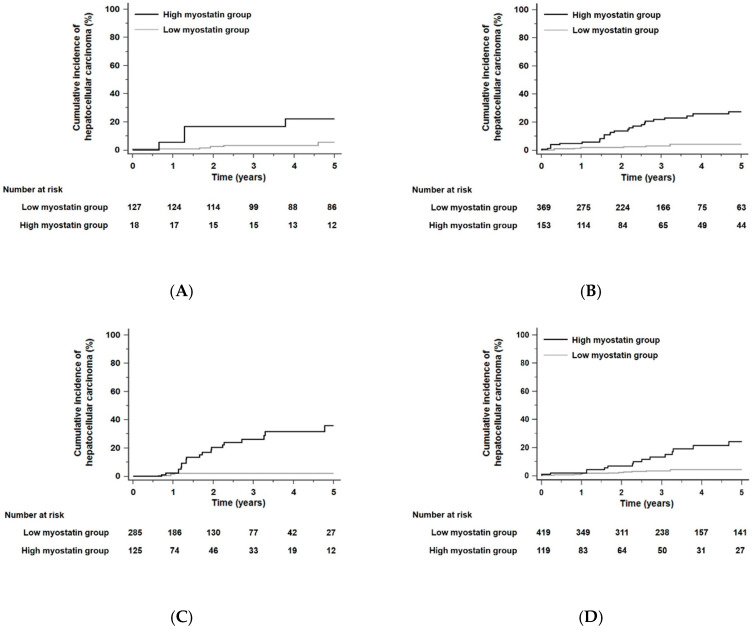
Previous studies reported that serum myostatin is associated with sarcopenia. We aimed to elucidate the association between serum myostatin levels and hepatocellular carcinoma (HCC) development in patients with alcoholic liver cirrhosis (ALC). This retrospective, multicenter study assessed 1077 Asian ALC patients enrolled from 2007 to 2017. The primary endpoint was the development of HCC within 5 years. Cox proportional hazards model analyses were used to assess the association of serum myostatin levels and HCC development. The time-dependent areas under the receiver operating characteristic curve (AUROC) of serum myostatin for 5-year HCC development were calculated. Serum myostatin levels were measured using an enzyme-linked immunosorbent assay with samples collected on the index date. During a median follow-up of 2.5 years, 5-year cumulative HCC incidence rates were 6.7% in the total population. The median level of serum myostatin was 3.3 ng/mL (interquartile, 2.1-5.2 ng/mL). The AUROC of serum myostatin for 5-year HCC development was 0.78 (95% confidence interval [CI], 0.76-0.81). In Cox proportional hazards model analyses, age, gender, platelet counts, and serum myostatin levels were independent risk factors for HCC development (adjusted hazard ratios [HRs] of age, male gender, platelet counts, and serum myostatin: 1.03, 2.79, 0.996, 1.18, respectively; all < 0.05). Patients with high myostatin levels had a significantly higher risk of 5-year HCC development than those with low myostatin levels (HR 7.53, < 0.001). Higher serum myostatin levels were significantly associated with a higher risk of developing HCC in ALC patients, which could identify high-risk patients who need stringent surveillance.
既往研究报道血清肌生成抑制素与肌肉减少症相关。我们旨在阐明酒精性肝硬化(ALC)患者血清肌生成抑制素水平与肝细胞癌(HCC)发生之间的关联。这项回顾性多中心研究评估了2007年至2017年纳入的1077例亚洲ALC患者。主要终点是5年内HCC的发生情况。采用Cox比例风险模型分析来评估血清肌生成抑制素水平与HCC发生之间的关联。计算血清肌生成抑制素预测5年HCC发生的受试者操作特征曲线(AUROC)下的时间依赖性面积。采用酶联免疫吸附测定法,在索引日期采集样本,测定血清肌生成抑制素水平。在中位随访2.5年期间,总人群中5年累积HCC发病率为6.7%。血清肌生成抑制素的中位水平为3.3 ng/mL(四分位间距,2.1 - 5.2 ng/mL)。血清肌生成抑制素预测5年HCC发生的AUROC为0.78(95%置信区间[CI],0.76 - 0.81)。在Cox比例风险模型分析中,年龄、性别、血小板计数和血清肌生成抑制素水平是HCC发生的独立危险因素(年龄、男性性别、血小板计数和血清肌生成抑制素的调整后风险比[HRs]分别为1.03、2.79、0.996、1.18;均P < 0.05)。肌生成抑制素水平高的患者5年发生HCC的风险显著高于肌生成抑制素水平低的患者(HR 7.53,P < 0.001)。较高的血清肌生成抑制素水平与ALC患者发生HCC的较高风险显著相关,这可以识别出需要严格监测的高危患者。