Alhamad Hamza, Donyai Parastou
Department of Pharmacy, University of Reading, Reading RG6 6AP, UK.
Department of Pharmacy, Zarqa University, Zarqa 132222, Jordan.
Pharmacy (Basel). 2020 Nov 12;8(4):213. doi: 10.3390/pharmacy8040213.
A range of pro-environmental behaviors are recognized, promoted, and investigated, but urgent action is also needed to tackle the direct and indirect environmental impact of medication waste. One solution is to reissue medicines, returned unused to pharmacies (i.e., reuse medicines). Yet, if medicines reuse is to be formally introduced in the UK, it is imperative also to understand people's willingness to take part in such a scheme and importantly, the underpinning drivers. This study aimed to develop, validate, and evaluate a Theory of Planned Behavior model aimed at predicting medicines reuse behavioral intentions.
The behavior of interest, medicines reuse, was defined according to its Target, Action, Context, and Time. Then themes from an existing qualitative study were used in order to draft, validate and pilot a Theory of Planned Behavior-based questionnaire before its completion by a representative sample ( = 1003) of participants from across the UK.
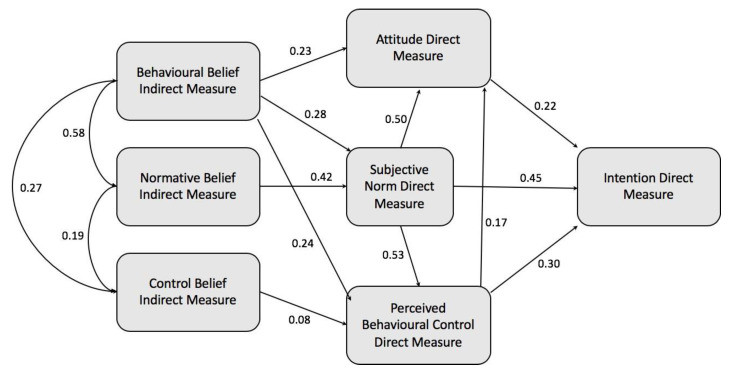
The majority expressed pro-medicines reuse intentions. The three direct measures accounted for 73.4% of the variance in relation to people's intention to reuse medicines in the future, which was statistically significant at < 0.001. People's specific beliefs about medicines reuse and how they evaluate other people's expectations of them had a substantial impact on their intentions to reuse medication in the future, mediated in an intricate way via attitudes, subjective norms and perceived behavioral control (PBC).
This study shows how people could embrace medicines reuse via practical measures that illustrate the safety and quality assurance of reissued medicines, educational interventions that bolster beliefs about the pro-environmental benefits, and norm-based interventions encouraging doctors and pharmacists to endorse the practice. The findings add to the emerging work on medicines reuse and, significantly, provide a theoretical framework to guide policymakers and other organizations looking to decrease the impact of medication waste through medicines reuse schemes.
一系列有利于环境的行为已得到认可、推广和研究,但应对药物废弃物的直接和间接环境影响也需要采取紧急行动。一种解决方案是重新发放未使用过并退回药房的药品(即再利用药品)。然而,如果要在英国正式引入药品再利用,就必须了解人们参与此类计划的意愿,重要的是,还要了解其潜在驱动因素。本研究旨在开发、验证和评估一个计划行为理论模型,以预测药品再利用行为意向。
根据其目标、行动、背景和时间对感兴趣的行为——药品再利用进行定义。然后,利用现有定性研究中的主题,起草、验证并试用一份基于计划行为理论的问卷,之后由来自英国各地的1003名代表性参与者完成该问卷。
大多数人表达了支持药品再利用的意向。这三项直接测量指标解释了人们未来再利用药品意向中73.4%的变异,在P < 0.001水平上具有统计学意义。人们对药品再利用的具体信念以及他们如何评估他人对自己的期望,通过态度、主观规范和感知行为控制(PBC)以复杂的方式介导,对他们未来再利用药品的意向产生了重大影响。
本研究表明,人们可以通过以下实际措施接受药品再利用:说明重新发放药品的安全性和质量保证的措施、增强对环境效益信念的教育干预措施,以及鼓励医生和药剂师认可该做法的基于规范的干预措施。这些发现为药品再利用方面正在开展的工作增添了内容,并且显著地提供了一个理论框架,以指导政策制定者和其他希望通过药品再利用计划减少药物废弃物影响的组织。