Department of Orthopedics and Tumor Orthopedics, University Hospital Muenster, Albert-Schweitzer-Campus 1, Building A1, 48149, Muenster, Germany.
Department of Orthopedic Oncology, University Hospital Essen, Hufelandstrasse 55, 45147, Essen, Germany.
J Orthop Surg Res. 2020 Nov 16;15(1):534. doi: 10.1186/s13018-020-02028-3.
Local treatment in pelvic Ewing sarcoma (ES) consists of operation, radiation therapy, or a combination of both. Reported outcomes vary depending on the treatment modality performed. It is the objective of this study to analyze surgical outcome and complications as well as oncological outcome and complications of chemo- and radiation therapy in this patient cohort and evaluate prognostic factors.
Retrospective review of 104 patients who underwent tumor resection for pelvic ES from 1988 to 2014.
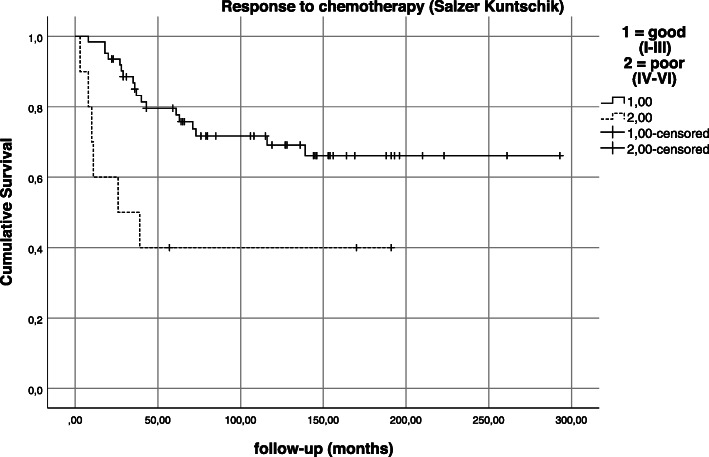
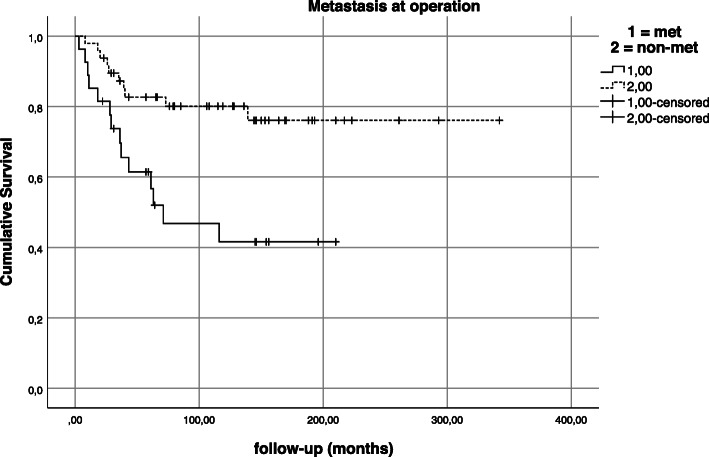
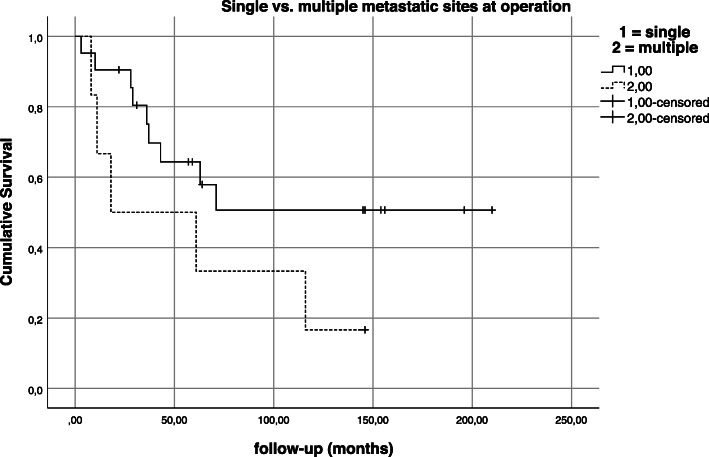
All patients underwent pelvic resection and radiation therapy was administered in 77.9%. Margins were clear in 94.2%. The response to chemotherapy was good in 78.8%. Local recurrence occurred in 7.7%. The presence of distant metastases at the time of operation was the most important negative predictor for overall survival (p = 0.003). The cumulative 5- and 10-year survival rates were 82.7% and 80.1% for non-metastasized and 61.4% and 41.6% for metastasized pelvic ES at operation. In the presence of a single-distant metastatic site at operation compared to multiple metastatic sites, the cumulative survival rates were 64.3% versus 50% at five and 50.7% versus 16.7% at 10 years.
A combined treatment approach of tumor resection and radiation therapy leads to a local control and overall survival rates comparable with those of extremity locations in this study's patient cohort with localized pelvic ES. Therefore, surgical tumor resection (combined with (neo-)adjuvant radiation therapy) in non-metastatic pelvic ES seems feasible. In metastatic patients, however, the significance of tumor resection as a part of local treatment remains less certain and improved outcomes of combined local treatment approaches need to be weighed against these patients' prognosis and quality of life.
骨盆尤文肉瘤(ES)的局部治疗包括手术、放疗或两者的联合。报道的结果因所采用的治疗方式而异。本研究的目的是分析该患者队列的手术结果和并发症,以及化疗和放疗的肿瘤学结果和并发症,并评估预后因素。
回顾性分析 1988 年至 2014 年期间 104 例接受骨盆 ES 肿瘤切除术的患者。
所有患者均行骨盆切除术,77.9%的患者行放疗。94.2%的患者切缘清晰。化疗反应良好的患者为 78.8%。局部复发率为 7.7%。手术时存在远处转移是总生存的最重要负预测因素(p = 0.003)。无远处转移的骨盆 ES 患者的 5 年和 10 年累积生存率分别为 82.7%和 80.1%,而有远处转移的骨盆 ES 患者分别为 61.4%和 41.6%。与多个远处转移部位相比,手术时存在单个远处转移部位的患者的累积生存率分别为 5 年时 64.3%和 10 年时 50%,5 年时 50.7%和 10 年时 16.7%。
在本研究的骨盆局部尤文肉瘤患者中,肿瘤切除术联合放疗的综合治疗方法可获得与四肢相似的局部控制率和总生存率。因此,对于非转移性骨盆 ES,手术肿瘤切除术(联合(新)辅助放疗)似乎是可行的。然而,对于转移性患者,肿瘤切除术作为局部治疗的一部分的意义仍然不太确定,需要权衡这些患者的预后和生活质量,以获得联合局部治疗方法的更好效果。