Max Planck UCL Centre for Computational Psychiatry and Ageing Research, University College London, London, United Kingdom.
Wellcome Centre for Human Neuroimaging, University College London, London, United Kingdom.
Elife. 2020 Nov 17;9:e57977. doi: 10.7554/eLife.57977.
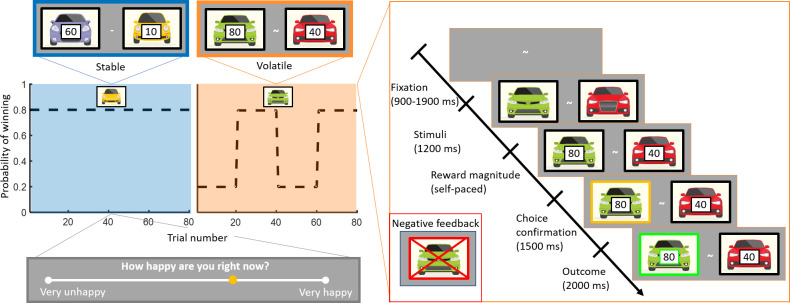
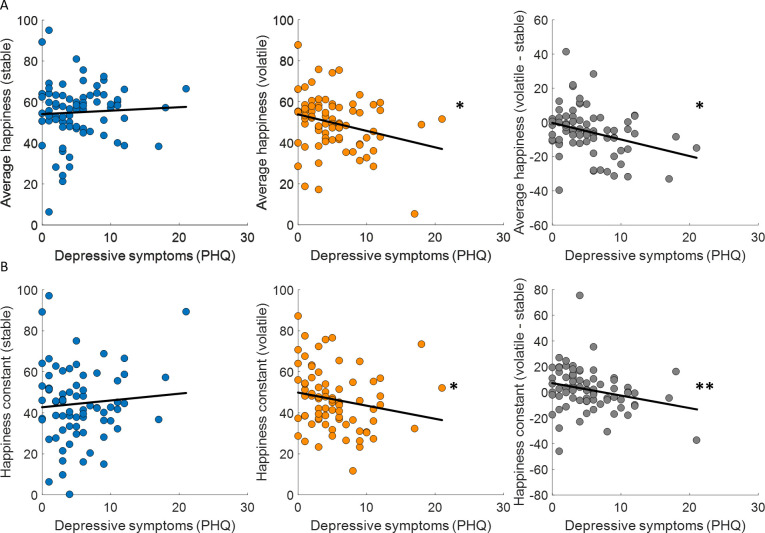
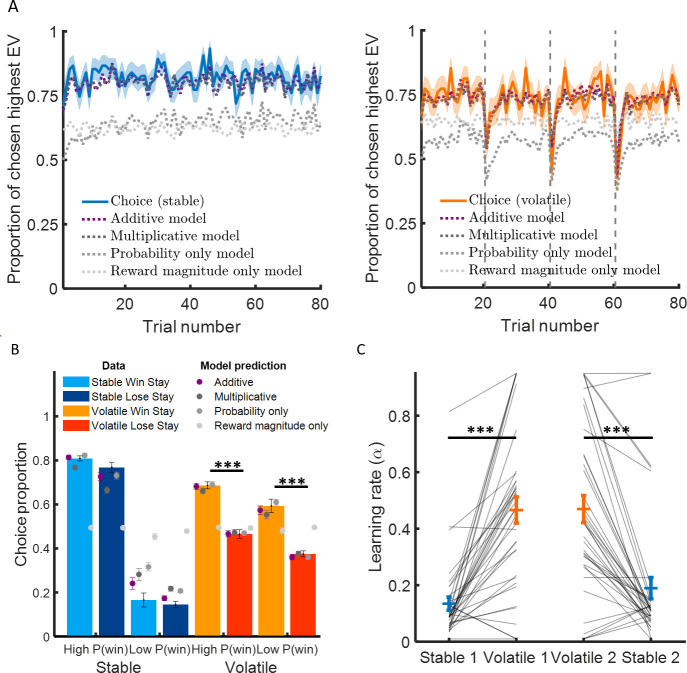
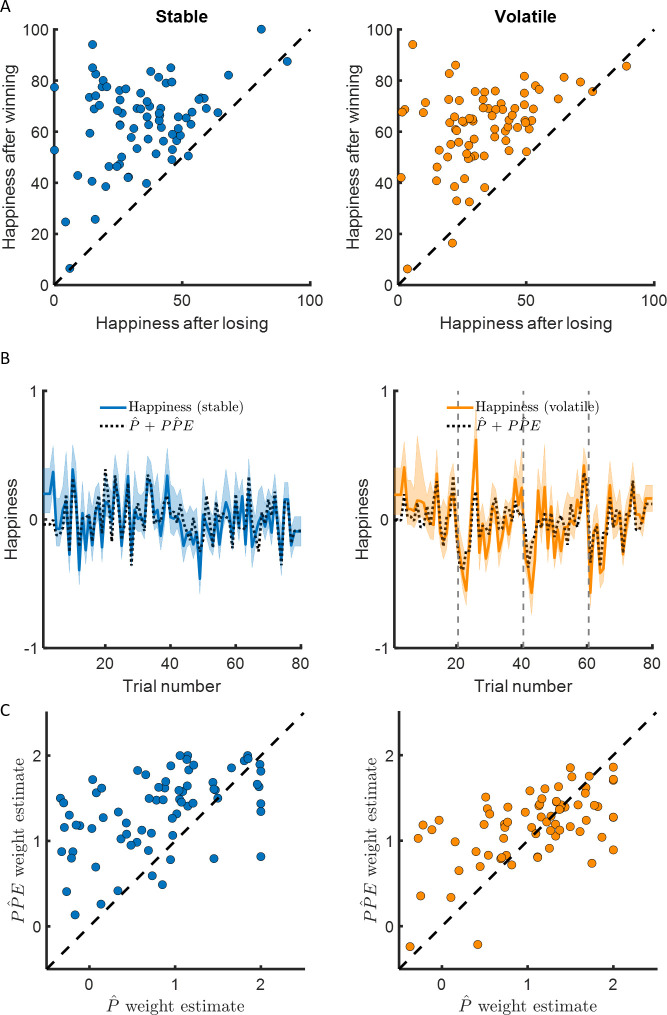
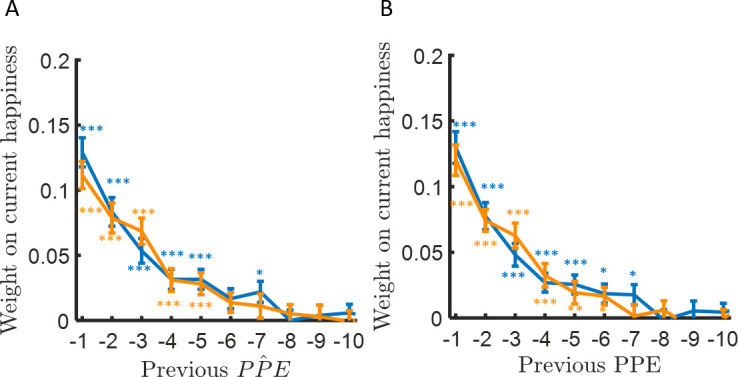
Subjective well-being or happiness is often associated with wealth. Recent studies suggest that momentary happiness is associated with reward prediction error, the difference between experienced and predicted reward, a key component of adaptive behaviour. We tested subjects in a reinforcement learning task in which reward size and probability were uncorrelated, allowing us to dissociate between the contributions of reward and learning to happiness. Using computational modelling, we found convergent evidence across stable and volatile learning tasks that happiness, like behaviour, is sensitive to learning-relevant variables (i.e. probability prediction error). Unlike behaviour, happiness is not sensitive to learning-irrelevant variables (i.e. reward prediction error). Increasing volatility reduces how many past trials influence behaviour but not happiness. Finally, depressive symptoms reduce happiness more in volatile than stable environments. Our results suggest that how we learn about our world may be more important for how we feel than the rewards we actually receive.
主观幸福感通常与财富有关。最近的研究表明,瞬间的幸福感与奖励预测误差有关,即体验到的奖励与预测的奖励之间的差异,这是适应性行为的关键组成部分。我们在一个强化学习任务中对受试者进行了测试,在这个任务中,奖励的大小和概率是不相关的,这使我们能够将奖励和学习对幸福感的贡献区分开来。通过计算建模,我们在稳定和不稳定的学习任务中都发现了一致的证据,表明幸福感与行为一样,对与学习相关的变量(即概率预测误差)敏感。与行为不同,幸福感对与学习无关的变量(即奖励预测误差)不敏感。增加波动性会减少过去的试验对行为的影响,但不会影响幸福感。最后,抑郁症状在不稳定的环境中比在稳定的环境中对幸福感的影响更大。我们的研究结果表明,我们对世界的学习方式可能比我们实际获得的奖励对我们的感受更重要。