Plant Nutrition and Resources Institute, Beijing Academy of Agriculture and Forestry Sciences, Beijing, China.
The Key Laboratory of Soil Environment and Plant Nutrition of Heilongjiang Province, Heilongjiang Academy of Agriculture and Science, Soil Fertilizer and Environment Resource Institute, Harbin, China.
PLoS One. 2020 Nov 17;15(11):e0238883. doi: 10.1371/journal.pone.0238883. eCollection 2020.
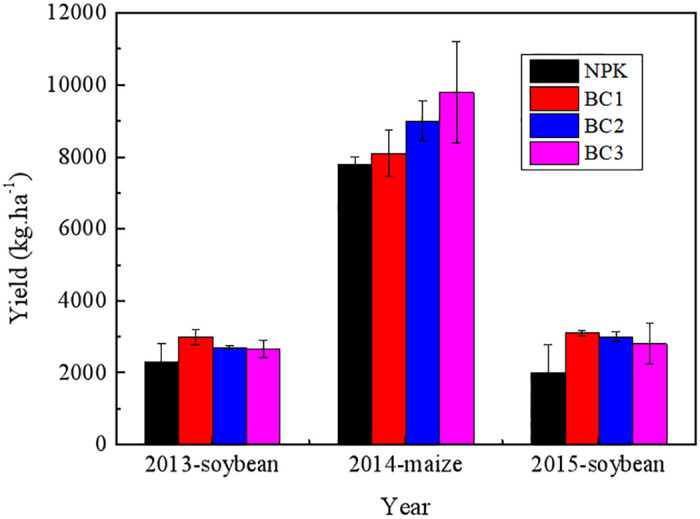
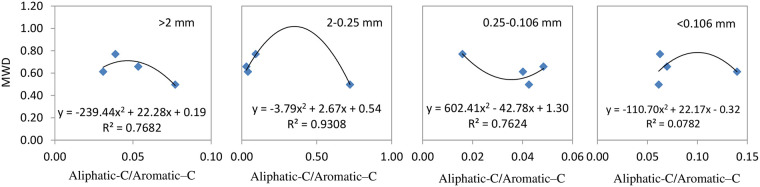
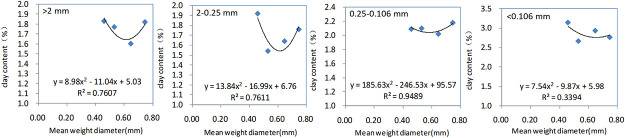
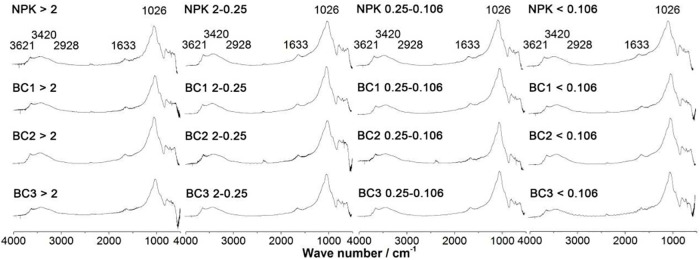
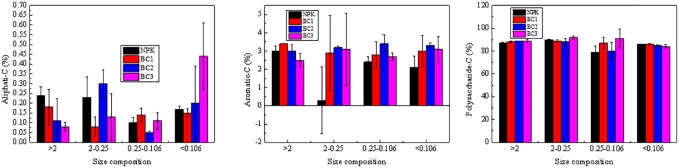
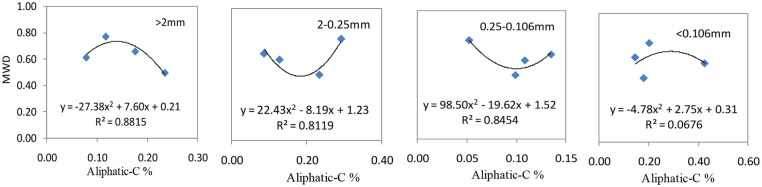
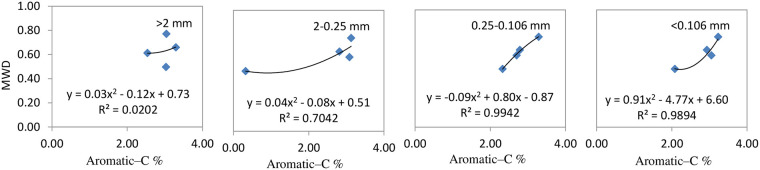
The combination of chemical fertilizer and biochar is regarded as a useful soil supplement for improving the properties of soil and crop yields, and this study describes how the biochar of maize straw can be used to improve the quality of the degraded black soil. This has been achieved by examining the effects of combining different amounts of biochar with chemical fertilizer on the porosities and aggregate formation of soil and exploring how these changes positively impact on crop yields. A field trial design combining different amounts of maize straw biochar [0 (NPK), 15.75 (BC1), 31.5 (BC2), and 47.25 t ha-1 (BC3)] with a chemical fertilizer (NPK) has been used to investigate changes in the formation of soil aggregate, clay content, soil organic carbon (SOC), and crop yields in Chinese black soil over a three year period from 2013 to 2015. The results of this study show that the addition of fertilizer and biochar in 2013 to black soil results in an increased soybean and maize yields from 2013 to 2015 for all the treatments, with BC1/BC2 affording improved crop yields in 2015, while BC3 gave a lower soybean yield in 2015. Total porosities and pore volumes were increased for BC1 and BC2 treatments but relatively decreased for BC3, which could be attributed to increased soil capillary caused by the presence of higher numbers of fine soil particles. The addition of biochar had a positive influence on the numbers and mean weight diameters (MWD) of soil macroaggregates (>0.25 mm) that were present, with the ratio of SOC to TN in soil macroaggregates found to be greater than in the microaggregates. The most significant amount of carbon present in macroaggregates (>2 mm and 0.25-2 mm) was observed when BC2 was applied as a soil additive. Increasing the levels of maze straw biochar to 47.25 t ha-1 led to an increase in the total organic carbon of soil, however, the overall amount of macroaggregates and MWD were decreased, which is possibly due to localized changes in microbial habitat. The supplementation of biochar increased in the amount of aromatic C present (most significant effect observed for BC2), with the ratio of aliphatic C to aromatic C found to be enhanced due to a relative reduction in the aliphatic C content with >2 mm particle fraction. These changes in organic carbon content and soil stability were analyzed using univariate quadratic equations to explain the relationship between the type of functional groups (polysaccharide C, aliphatic C, aromatic C, aliphatic C/aromatic C) present in the soil aggregates and their MWDs, which were found to vary significantly. Overall, the results of this study indicate that the use of controlled amounts of maize-straw biochar in black soil is beneficial for improving crop yields and levels of soil aggregation, however, the use of excessive amounts of biochar results in unfavorable aggregate formation which negatively impacts the yields of crop growth. The data produced suggest that aromatic C content can be used as a single independent variable to characterize the stability of soil aggregate when biochar/fertilizer mixtures are used as soil additives to boost growth yields. Analysis of soil and crop performance in black soil revealed that the application of maize-straw biochar at a rate of 15.75 and 31.5 t ha-1 had positive effects on crop yields, soil aggregation and accumulation of aromatic C in the aggregate fractions when a soybean-maize rotation system was followed over three years.
化肥和生物炭的组合被认为是一种有用的土壤补充物,可以改善土壤性质和作物产量,本研究描述了如何利用玉米秸秆生物炭来改善退化黑土的质量。通过研究不同数量的生物炭与化肥结合对土壤孔隙度和团聚体形成的影响,以及研究这些变化如何对作物产量产生积极影响,来实现这一目标。本研究采用田间试验设计,结合不同数量的玉米秸秆生物炭(0(NPK)、15.75(BC1)、31.5(BC2)和 47.25 t ha-1(BC3))与化肥(NPK),研究了 2013 年至 2015 年期间中国黑土中土壤团聚体形成、粘粒含量、土壤有机碳(SOC)和作物产量的变化。研究结果表明,2013 年向黑土中添加化肥和生物炭会导致 2013 年至 2015 年大豆和玉米产量增加,所有处理中 BC1/BC2 提高了 2015 年的作物产量,而 BC3 则降低了 2015 年的大豆产量。2013 年,BC1 和 BC2 处理的总孔隙度和孔隙体积增加,但 BC3 处理的相对减少,这可能是由于细土颗粒数量增加导致土壤毛细管增加。生物炭的添加对存在的土壤大团聚体(>0.25 毫米)的数量和平均重量直径(MWD)有积极影响,土壤大团聚体中 SOC 与 TN 的比值大于微团聚体。在添加生物炭的情况下,观察到大团聚体(>2 毫米和 0.25-2 毫米)中存在的碳量最多。当将玉米秸秆生物炭水平增加到 47.25 t ha-1 时,会增加土壤总有机碳,但总体上大团聚体和 MWD 的数量减少,这可能是由于微生物栖息地的局部变化。生物炭的补充增加了存在的芳香族 C 的量(在 BC2 中观察到最显著的效果),由于>2 毫米颗粒部分的脂肪族 C 含量相对减少,脂肪族 C 与芳香族 C 的比值增加。使用一元二次方程分析有机碳含量和土壤稳定性,以解释土壤团聚体中存在的功能基团(多糖 C、脂肪族 C、芳香族 C、脂肪族 C/芳香族 C)类型与其 MWD 之间的关系,发现它们的变化非常显著。总的来说,本研究结果表明,在黑土中使用适量的玉米秸秆生物炭有利于提高作物产量和土壤团聚体水平,然而,使用过多的生物炭会导致不利的团聚体形成,从而对作物生长产量产生负面影响。所产生的数据表明,芳香族 C 含量可用作单一独立变量,用于描述生物炭/肥料混合物作为土壤添加剂用于提高生长产量时土壤团聚体的稳定性。对黑土的土壤和作物性能的分析表明,在三年的大豆-玉米轮作系统中,当玉米秸秆生物炭施用量为 15.75 和 31.5 t ha-1 时,对作物产量、土壤团聚体和芳香族 C 在团聚体中的积累有积极影响。