Lee Jang-Seok, Kim Hee Yeon, Won Bomyi, Kang Sang Won, Kim Yong-Nyun, Jang Hyonchol
Research Institute, National Cancer Center, Goyang 10408, Korea.
Department of Life Science, Ewha Womans University, Seoul 03760, Korea.
Biomedicines. 2020 Nov 13;8(11):500. doi: 10.3390/biomedicines8110500.
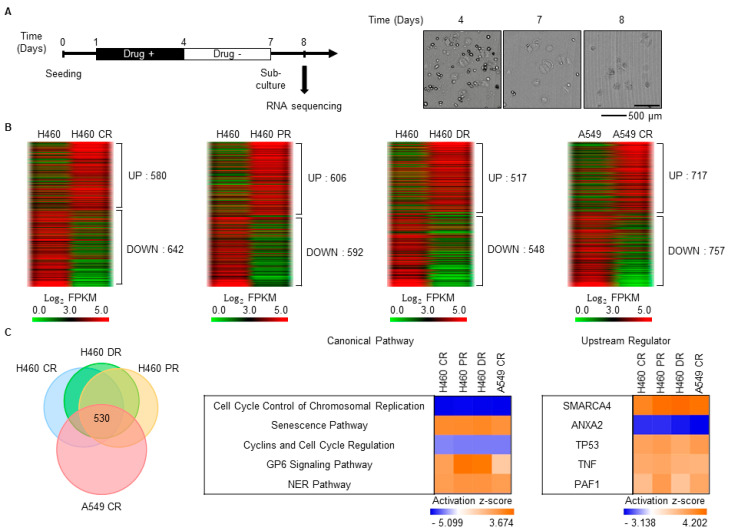
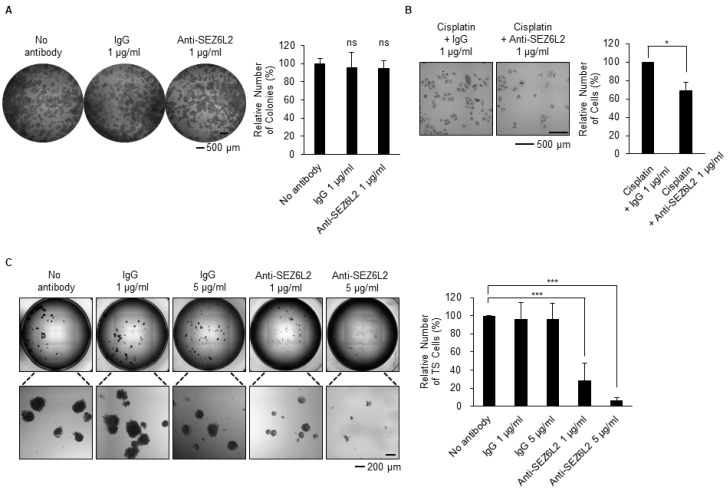
Many lung cancer deaths result from relapses in distant organs, such as the brain or bones, after standard chemotherapy. For cancer cells to spread to other organs, they must survive as circulating tumor cells (CTCs) in blood vessels. Thus, reducing distant recurrence after chemotherapy requires simultaneously inhibiting drug resistance and CTC survival. Here, we investigated the molecular pathways and genes that are commonly altered in drug-resistant lung cancer cells and lung tumor spheroid (TS) cells. First, RNA sequencing was performed in drug-resistant cells and TS cells originating from H460 and A549 lung cancer cells. Bioinformatic pathway analysis showed that cell cycle-related pathways were downregulated in drug-resistant cells, and cholesterol biosynthesis-related pathways were upregulated in TS cells. Seizure-related 6 homolog-like 2 () was selected as a gene that was commonly upregulated in both drug-resistant cells and TS cells, and that showed elevated expression in samples from lung adenocarcinoma patients. Second, the protein expression of SEZ6L2 was analyzed by flow cytometry. The proportions of SEZ6L2 positive cells among both drug-resistant cells and TS cells was increased. Finally, as SEZ6L2 is a transmembrane protein with an extracellular region, the function of SEZ6L2 was disrupted by treatment with an anti-SEZ6L2 antibody. Treatment with the anti-SEZ6L2 antibody reduced drug resistance and TS formation. Overall, our data showed that SEZ6L2 plays an important role in drug resistance and TS formation and may be a therapeutic target for reducing distant recurrence of lung adenocarcinoma.
许多肺癌死亡是由标准化疗后远处器官(如大脑或骨骼)的复发所致。癌细胞要扩散到其他器官,必须作为循环肿瘤细胞(CTC)在血管中存活。因此,降低化疗后的远处复发需要同时抑制耐药性和CTC存活。在此,我们研究了耐药肺癌细胞和肺肿瘤球体(TS)细胞中常见的分子途径和基因改变。首先,对源自H460和A549肺癌细胞的耐药细胞和TS细胞进行了RNA测序。生物信息通路分析表明,耐药细胞中与细胞周期相关的通路下调,而TS细胞中与胆固醇生物合成相关的通路上调。癫痫相关6同源样2(SEZ6L2)被选为在耐药细胞和TS细胞中均普遍上调且在肺腺癌患者样本中表达升高的基因。其次,通过流式细胞术分析SEZ6L2的蛋白表达。耐药细胞和TS细胞中SEZ6L2阳性细胞的比例均增加。最后,由于SEZ6L2是一种具有细胞外区域的跨膜蛋白,用抗SEZ6L2抗体处理可破坏SEZ6L2的功能。用抗SEZ6L2抗体处理可降低耐药性和TS形成。总体而言,我们的数据表明SEZ6L2在耐药性和TS形成中起重要作用,可能是降低肺腺癌远处复发的治疗靶点。