Department of Neurobiology and Acupuncture Research, The Third Clinical Medical College, Zhejiang Chinese Medical University, Key Laboratory of Acupuncture and Neurology of Zhejiang Province, Hangzhou, 310053, China.
Academy of Chinese Medical Sciences, Zhejiang Chinese Medical University, Hangzhou, 310053, China.
Theranostics. 2020 Oct 27;10(26):12189-12203. doi: 10.7150/thno.48028. eCollection 2020.
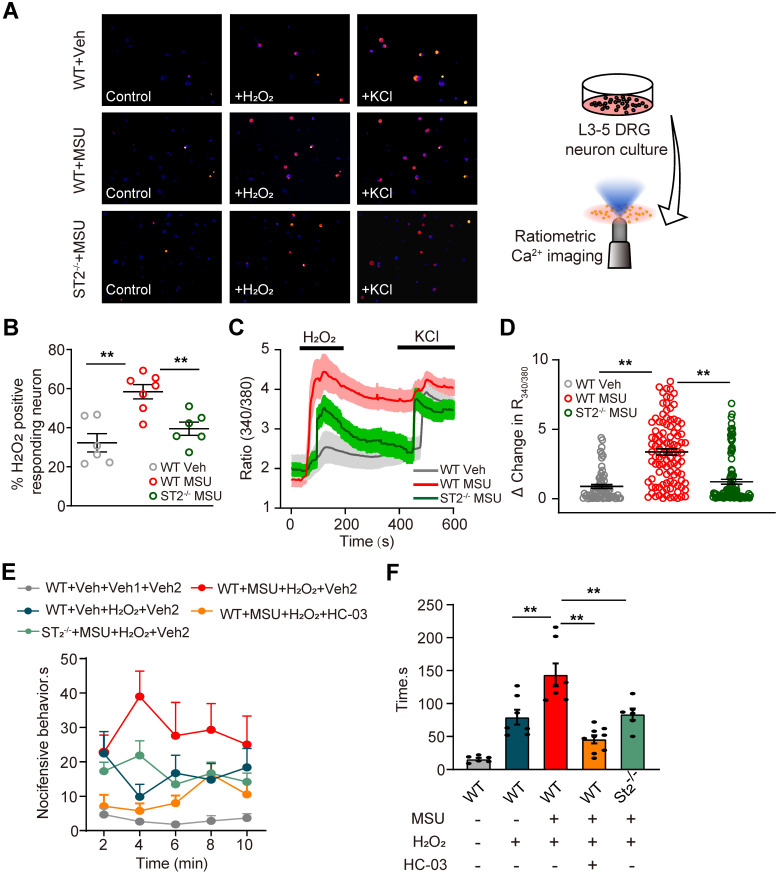
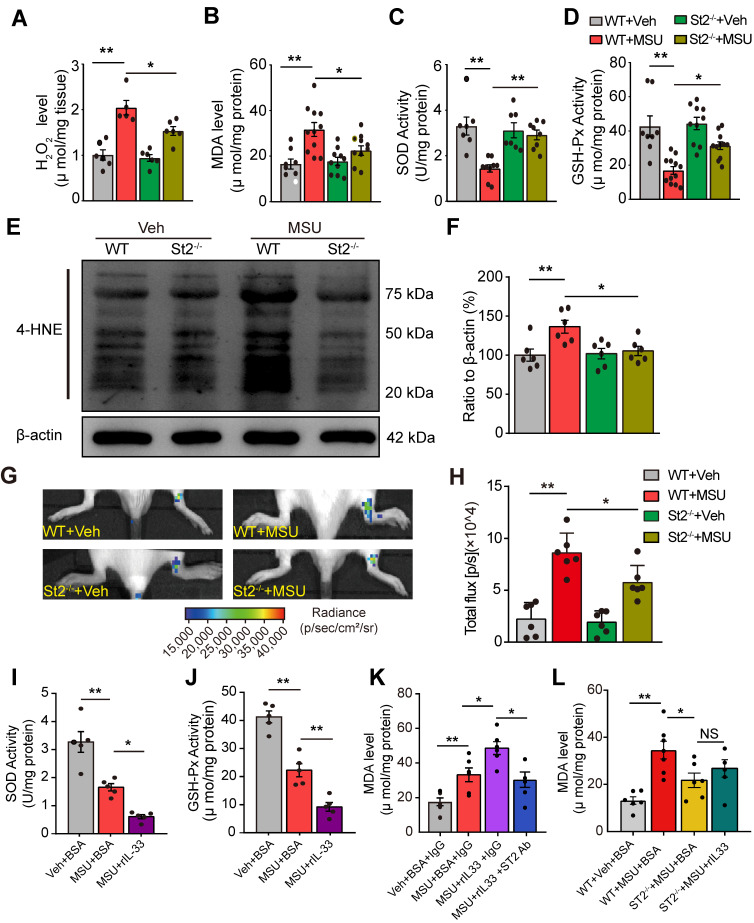
Gout, induced by monosodium urate (MSU) crystal deposition in joint tissues, provokes severe pain and impacts life quality of patients. However, the mechanisms underlying gout pain are still incompletely understood. We established a mouse gout model by intra-articularly injection of MSU crystals into the ankle joint of wild type and genetic knockout mice. RNA-Sequencing, molecular imaging, Ca imaging, reactive oxygen species (ROS) generation, neutrophil influx and nocifensive behavioral assays, etc. were used. We found interleukin-33 (IL-33) was among the top up-regulated cytokines in the inflamed ankle. Neutralizing or genetic deletion of IL-33 or its receptor ST2 (suppression of tumorigenicity) significantly ameliorated pain hypersensitivities and inflammation. Mechanistically, IL-33 was largely released from infiltrated macrophages in inflamed ankle upon MSU stimulation. IL-33 promoted neutrophil influx and triggered neutrophil-dependent ROS production via ST2 during gout, which in turn, activated transient receptor potential ankyrin 1 (TRPA1) channel in dorsal root ganglion (DRG) neurons and produced nociception. Further, TRPA1 channel activity was significantly enhanced in DRG neurons that innervate the inflamed ankle via ST2 dependent mechanism, which results in exaggerated nociceptive response to endogenous ROS products during gout. We demonstrated a previous unidentified role of IL-33/ST2 in mediating pain hypersensitivity and inflammation in a mouse gout model through promoting neutrophil-dependent ROS production and TRPA1 channel activation. Targeting IL-33/ST2 may represent a novel therapeutic approach to ameliorate gout pain and inflammation.
痛风是由单钠尿酸盐(MSU)晶体在关节组织中的沉积引起的,会引发剧烈疼痛并影响患者的生活质量。然而,痛风疼痛的机制仍不完全清楚。我们通过向野生型和基因敲除小鼠的踝关节内注射 MSU 晶体建立了小鼠痛风模型。使用了 RNA 测序、分子成像、钙成像、活性氧(ROS)生成、中性粒细胞浸润和伤害感受行为测定等方法。我们发现白细胞介素 33(IL-33)是炎症踝关节中上调最多的细胞因子之一。中和或基因敲除 IL-33 或其受体 ST2(抑制肿瘤发生)可显著改善疼痛过敏和炎症。在机制上,MSU 刺激后,炎症踝关节中浸润的巨噬细胞大量释放 IL-33。IL-33 通过 ST2 促进中性粒细胞浸润并引发中性粒细胞依赖性 ROS 生成,进而在痛风中激活背根神经节(DRG)神经元中的瞬时受体电位锚蛋白 1(TRPA1)通道并产生伤害感受。此外,通过 ST2 依赖性机制支配炎症踝关节的 DRG 神经元中 TRPA1 通道活性显著增强,导致痛风期间内源性 ROS 产物的伤害感受反应过度。我们证明了 IL-33/ST2 通过促进中性粒细胞依赖性 ROS 生成和 TRPA1 通道激活,在小鼠痛风模型中发挥了以前未被识别的作用,介导疼痛过敏和炎症。靶向 IL-33/ST2 可能代表一种改善痛风疼痛和炎症的新治疗方法。