Pradhan Ravi R, Sigdel Mahesh Raj
Department of Internal Medicine, Institute of Medicine (IOM), Tribhuvan University Teaching Hospital (TUTH), Kathmandu, Nepal.
Department of Nephrology, Institute of Medicine (IOM), Tribhuvan University Teaching Hospital (TUTH), Kathmandu, Nepal.
Int J Nephrol. 2020 Nov 1;2020:7401541. doi: 10.1155/2020/7401541. eCollection 2020.
Tuberculosis (TB) is a serious public health threat in low- and middle-income countries like Nepal. Chronic kidney disease (CKD) patients are at higher risk of developing new infection as well as reactivation of TB. We aimed to determine the prevalence, clinical presentations, and outcome of TB in patients with CKD in Nepal.
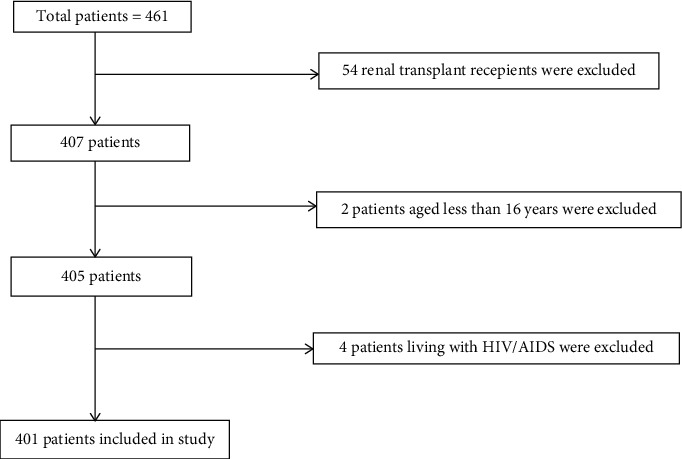
A hospital-based cross-sectional study was performed at Tribhuvan University Teaching Hospital (TUTH), a tertiary level referral centre in Kathmandu, Nepal. We included patients older than 16 years with the diagnosis of CKD stage 3, 4, 5, and 5D (CKD 5 on maintenance dialysis); renal transplant recipients and patients living with HIV/AIDS were excluded. Tuberculosis was diagnosed based on clinical, radiological, and laboratory findings. Prior written informed consent was obtained. Approval was obtained from the Institutional Review Board of the Institute of Medicine. Data entry and statistical analysis were performed using SPSS v21.
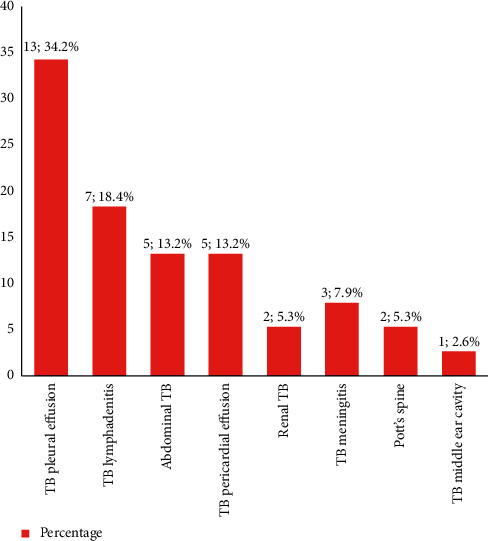
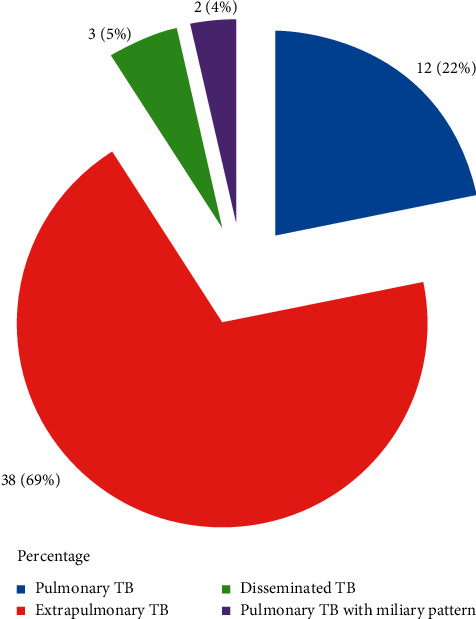
A total of 401 patients with CKD were included in the study (mean age, 50.92 ± 17.98 years; 64.8% male). The prevalence of TB in CKD patients was found to be 13.7% (55), out of which 49 were newly diagnosed cases. The most common clinical presentations of TB in CKD were anorexia (85.7%), fever (83.7%), weight loss (51%), and cough (49%). Thirty-eight patients (69.1%) had extrapulmonary TB (EPTB), 12 (21.8%) had pulmonary TB, 3 (5.5%) had disseminated TB, and 2 (3.6%) had miliary TB. Only 4.1% of cases were sputum smear positive. Pleural effusion (34.2%) was the most common EPTB. At 2 months of starting antitubercular therapy, 29 patients out of the 49 newly diagnosed cases of TB (59.2%) had responded to therapy. Mortality at 2 months was 28.6% (14 died amongst 49 patients). Four out of 49 patients (8.2%) did not improve, and 2 (4%) patients were lost to follow-up.
Prevalence and mortality of TB were higher in patients with CKD. Special attention must be given to these people for timely diagnosis and treatment as the presentation is different and diagnosis can be missed.
在尼泊尔等低收入和中等收入国家,结核病是严重的公共卫生威胁。慢性肾脏病(CKD)患者发生新感染以及结核病复发的风险更高。我们旨在确定尼泊尔CKD患者中结核病的患病率、临床表现及转归。
在尼泊尔加德满都的三级转诊中心特里布万大学教学医院(TUTH)进行了一项基于医院的横断面研究。我们纳入了年龄大于16岁、诊断为CKD 3、4、5及5D期(维持性透析的CKD 5期)的患者;排除肾移植受者及HIV/AIDS患者。根据临床、影像学和实验室检查结果诊断结核病。获得了事先的书面知情同意。获得了医学研究所机构审查委员会的批准。使用SPSS v21进行数据录入和统计分析。
共401例CKD患者纳入研究(平均年龄50.92±17.98岁;64.8%为男性)。CKD患者中结核病的患病率为13.7%(55例),其中49例为新诊断病例。CKD患者中结核病最常见的临床表现为厌食(85.7%)、发热(83.7%)、体重减轻(51%)和咳嗽(49%)。38例患者(69.1%)有肺外结核(EPTB),12例(21.8%)有肺结核,3例(5.5%)有播散性结核,2例(3.6%)有粟粒性结核。仅4.1%的病例痰涂片阳性。胸腔积液(34.2%)是最常见的EPTB。在开始抗结核治疗2个月时,49例新诊断的结核病患者中有29例(59.2%)对治疗有反应。2个月时的死亡率为28.6%(49例患者中有14例死亡)。49例患者中有4例(8.2%)病情未改善,2例(4%)患者失访。
CKD患者中结核病的患病率和死亡率较高。由于其表现不同且可能漏诊,必须对这些人给予特别关注以便及时诊断和治疗。