Boeckstaens Shari, Dewalheyns Sara, Heremans Ruben, Vikram Radhika, Timmerman Dirk, Van den Bosch Thierry, Verbakel Jan Y
Department of Obstetrics and Gynaecology, KU Leuven, Belgium.
Department of Obstetric Ultrasound and Fetal Medicine, University College London Hospital, United Kingdom.
Heliyon. 2020 Nov 4;6(11):e05372. doi: 10.1016/j.heliyon.2020.e05372. eCollection 2020 Nov.
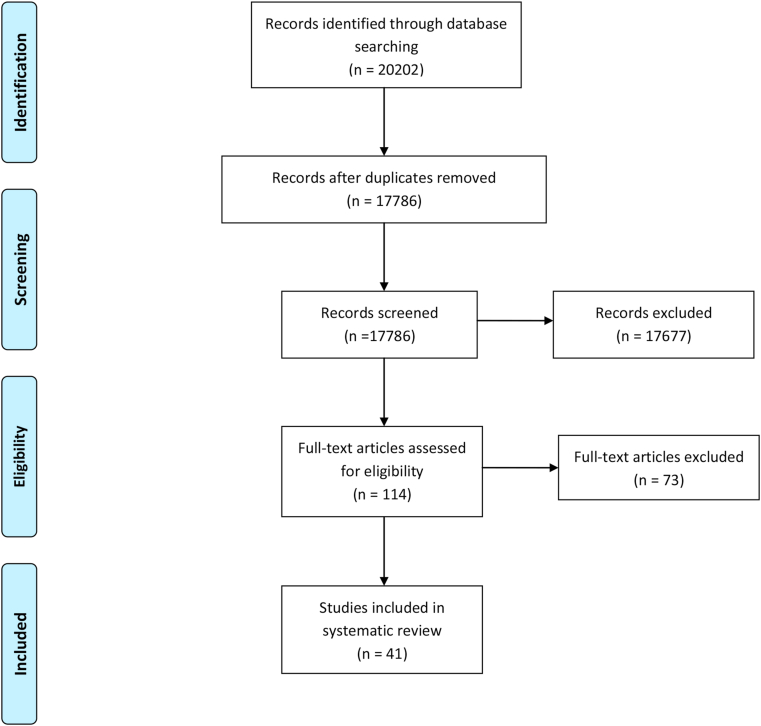
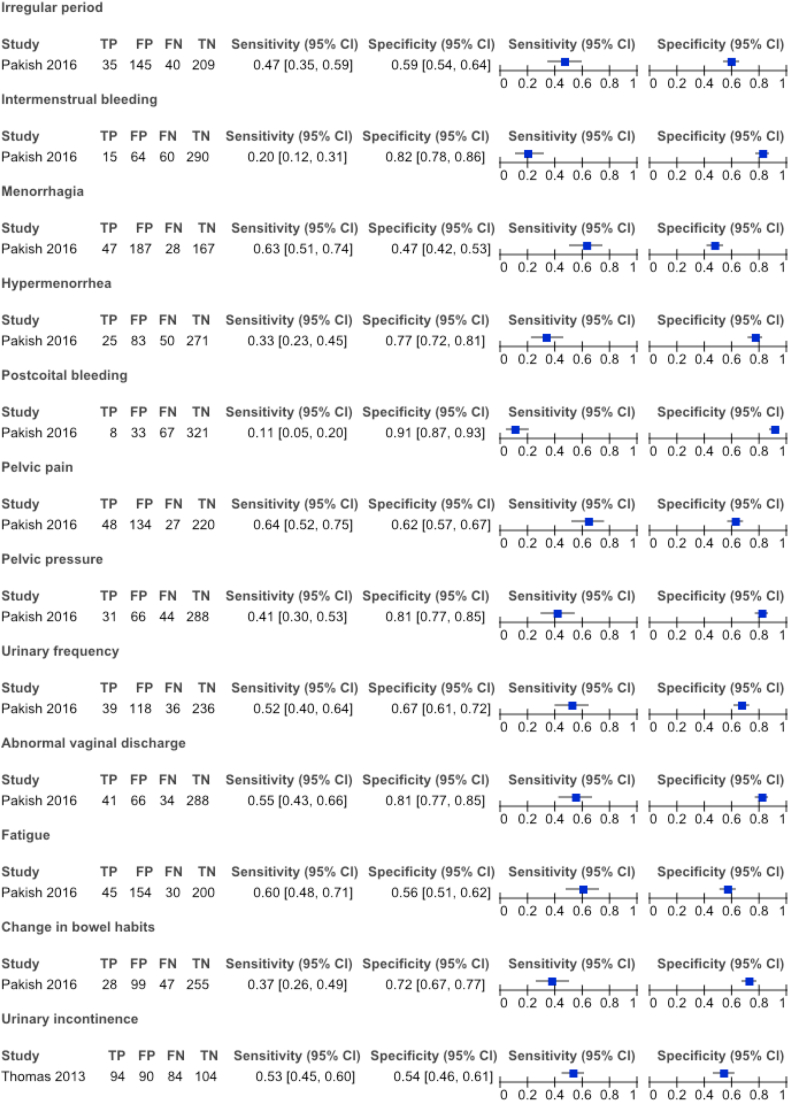
Uterine cancer is the most and second most common gynecological malignancy in developed and developing countries, respectively. The majority of endometrial cancers are diagnosed early due to the presence of abnormal uterine bleeding. The existing literature however contains only little data regarding the prevalence of such symptoms compared to patients with no or benign pathology. Therefore, a systematic review was conducted in order to determine the significance of various clinical signs and symptoms predicting uterine cancer. Embase, Web of Science and Medline databases were searched from inception until 18 June 2019. Studies eligible for selection inclusion assessed the diagnostic accuracy of clinical signs and symptoms in pre- and postmenopausal women aged 18-99 years old with uterine malignancy. Case reports, case series and studies of which full text was not available, were excluded. The risk of bias was assessed using the QUADAS-2 tool by two independent reviewers. Results were visualized by forest plots using RevMan(5.3). Forty-one studies were eventually included in this systematic review. Abnormal uterine bleeding occurring in pre-, post- and perimenopausal women was proven to be the most widely investigated symptom in relation to cancer of the uterus. Thirty-two articles examined patients with postmenopausal bleeding of which sensitivity and specificity varied between 0.28 to 0.86 and 0.63 to 0.84, respectively. Abnormal bleeding in pre- and perimenopausal women on the other hand showed a sensitivity ranging from 0.63 to 0.81. Its specificity could not be calculated due to missing data. Other symptoms appeared not sufficiently examined to assess their diagnostic accuracy range. This review highlights the current lack of knowledge regarding the diagnostic accuracy of several signs and symptoms for uterine cancer. After a thorough in-depth review of the literature, meta-analysis could not be performed due to the absence of control populations in the majority of articles. Further research is needed to establish the rule-in or rule-out value of specific clinical signs to identify patients at risk for uterine malignancy prompting further clinical assessment.
子宫癌分别是发达国家和发展中国家最常见和第二常见的妇科恶性肿瘤。由于子宫异常出血,大多数子宫内膜癌得以早期诊断。然而,与无病变或良性病变的患者相比,现有文献中关于此类症状发生率的数据很少。因此,进行了一项系统综述,以确定预测子宫癌的各种临床体征和症状的重要性。检索了Embase、科学网和Medline数据库,检索时间从建库至2019年6月18日。纳入的研究评估了18至99岁绝经前和绝经后患有子宫恶性肿瘤女性临床体征和症状的诊断准确性。排除病例报告、病例系列以及无法获取全文的研究。由两名独立评审员使用QUADAS-2工具评估偏倚风险。使用RevMan(5.3)通过森林图展示结果。最终有41项研究纳入该系统综述。绝经前、绝经后和围绝经期女性出现的子宫异常出血被证明是与子宫癌相关研究最广泛的症状。32篇文章研究了绝经后出血的患者,其敏感性和特异性分别在0.28至0.86和0.63至0.84之间。另一方面,绝经前和围绝经期女性的异常出血敏感性范围为0.63至0.81。由于数据缺失,无法计算其特异性。其他症状似乎未得到充分研究以评估其诊断准确性范围。本综述强调了目前关于子宫癌若干体征和症状诊断准确性方面的知识不足。在对文献进行全面深入审查后,由于大多数文章缺乏对照人群,无法进行荟萃分析。需要进一步研究以确定特定临床体征的纳入或排除值,以识别有子宫恶性肿瘤风险的患者,促使进行进一步的临床评估。