Kraal T, Lübbers J, van den Bekerom M P J, Alessie J, van Kooyk Y, Eygendaal D, Koorevaar R C T
Department of Orthopaedic Surgery, Spaarne Gasthuis, Hoofddorp, the Netherlands.
, Haarlem, The Netherlands.
J Exp Orthop. 2020 Nov 18;7(1):91. doi: 10.1186/s40634-020-00307-w.
The pathophysiology of frozen shoulders is a complex and multifactorial process. The purpose of this review is to scope the currently available knowledge of the pathophysiology of frozen shoulders.
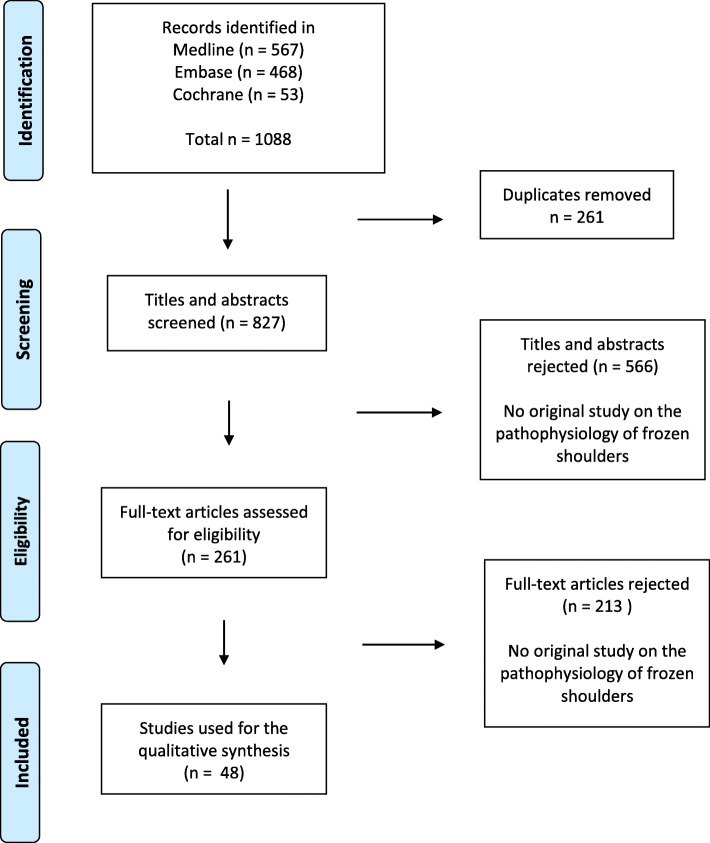
A systematic search was conducted in Medline, Embase and the Cochrane library. Original articles published between 1994 and October 2020 with a substantial focus on the pathophysiology of frozen shoulders were included.
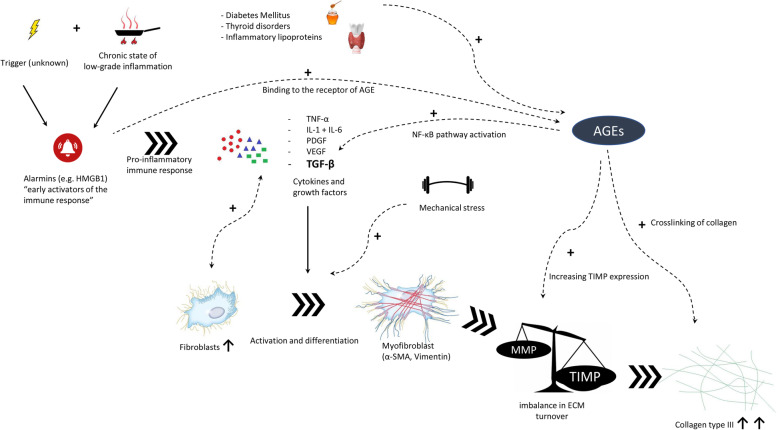
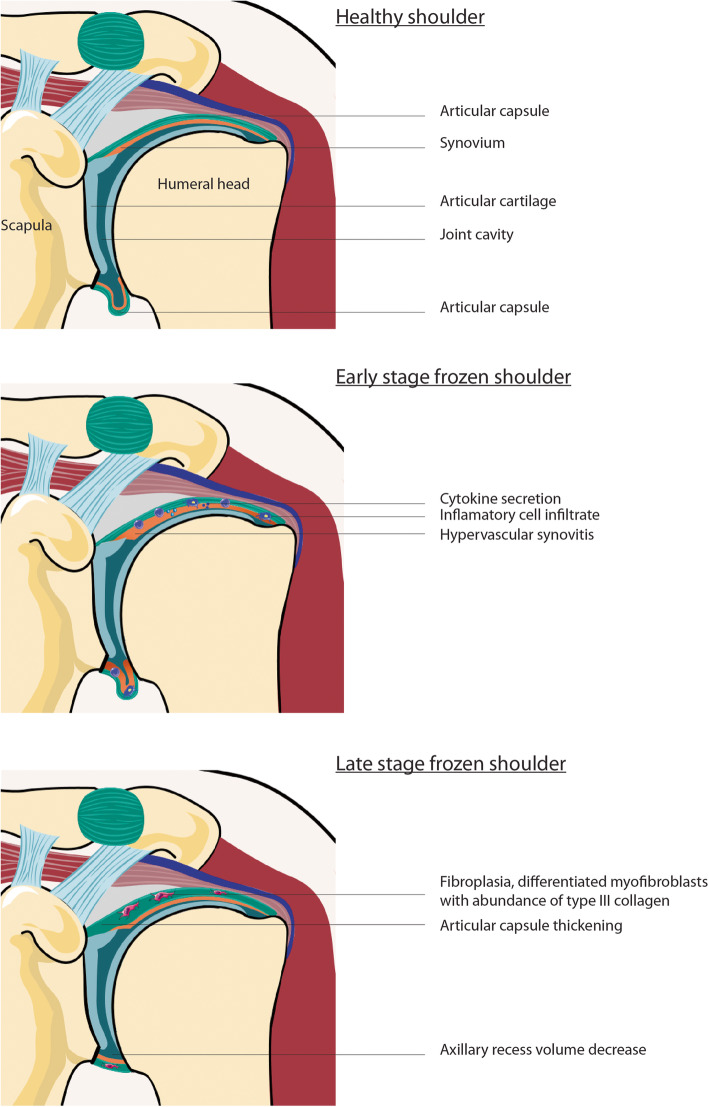
Out of 827 records, 48 original articles were included for the qualitative synthesis of this review. Glenohumeral capsular biopsies were reported in 30 studies. Fifteen studies investigated were classified as association studies. Three studies investigated the pathophysiology in an animal studies. A state of low grade inflammation, as is associated with diabetes, cardiovascular disease and thyroid disorders, predisposes for the development of frozen shoulder. An early immune response with elevated levels of alarmins and binding to the receptor of advance glycation end products is present at the start of the cascade. Inflammatory cytokines, of which transforming growth factor-β1 has a prominent role, together with mechanical stress stimulates Fibroblast proliferation and differentiation into myofibroblasts. This leads to an imbalance of extracellular matrix turnover resulting in a stiff and thickened glenohumeral capsule with abundance of type III collagen.
This scoping review outlines the complexity of the pathophysiology of frozen shoulder. A comprehensive overview with background information on pathophysiologic mechanisms is given. Leads are provided to progress with research for clinically important prognostic markers and in search for future interventions.
Level V.
肩周炎的病理生理学是一个复杂且多因素的过程。本综述的目的是梳理目前关于肩周炎病理生理学的现有知识。
在Medline、Embase和Cochrane图书馆进行了系统检索。纳入了1994年至2020年10月期间发表的、主要聚焦于肩周炎病理生理学的原创文章。
在827条记录中,48篇原创文章被纳入本综述的定性综合分析。30项研究报告了盂肱关节囊活检。15项研究被归类为关联研究。3项研究在动物研究中探究了病理生理学。与糖尿病、心血管疾病和甲状腺疾病相关的低度炎症状态易引发肩周炎。在级联反应开始时存在早期免疫反应,伴有警报素水平升高并与晚期糖基化终产物受体结合。炎症细胞因子(其中转化生长因子-β1起主要作用)与机械应力共同刺激成纤维细胞增殖并分化为肌成纤维细胞。这导致细胞外基质周转失衡,从而使盂肱关节囊僵硬、增厚,富含III型胶原蛋白。
本范围综述概述了肩周炎病理生理学的复杂性。给出了有关病理生理机制背景信息的全面概述。为临床重要预后标志物的研究进展以及寻找未来干预措施提供了线索。
V级。