Brix Bianca, Apich Gert, Roessler Andreas, Ure Christian, Schmid-Zalaudek Karin, Hinghofer-Szalkay Helmut, Goswami Nandu
Physiology Division, Otto Loewi Research Center, Gravitational Physiology and Medicine Research Unit, Medical University of Graz, 8036 Graz, Austria.
Physical Medicine and General Rehabilitation Department, KABEG, Wolfsberg Site, 9400 Wolfsberg, Austria.
J Clin Med. 2020 Nov 16;9(11):3678. doi: 10.3390/jcm9113678.
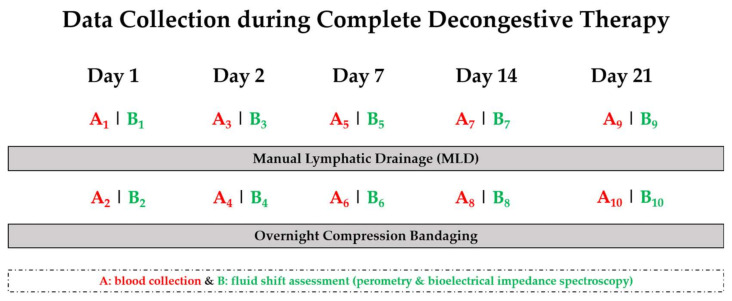
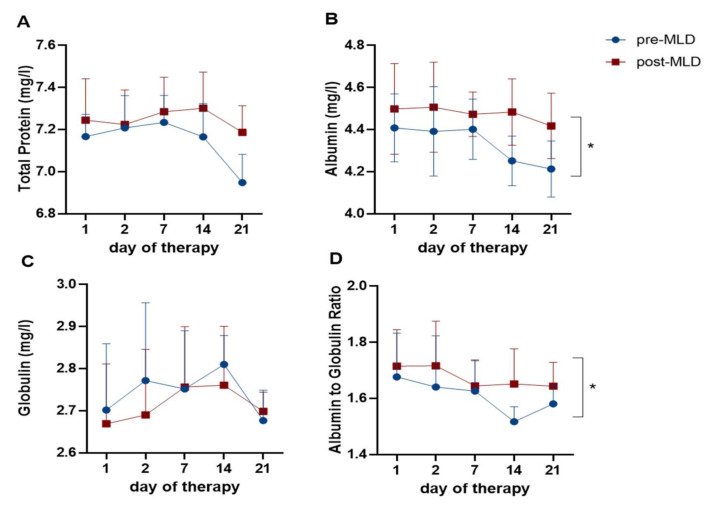
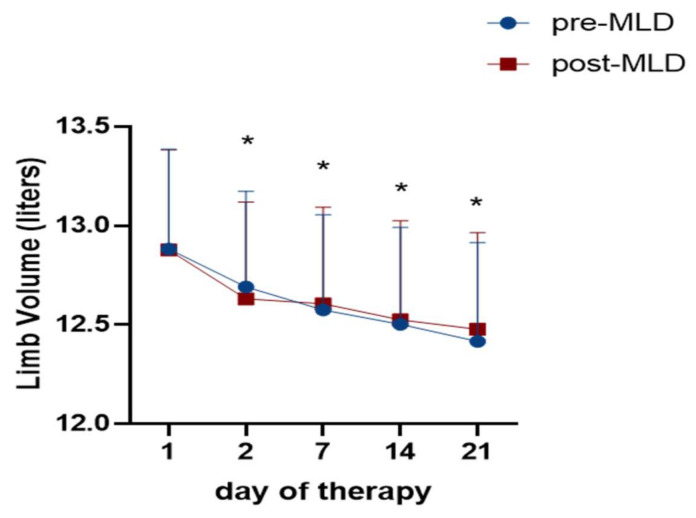
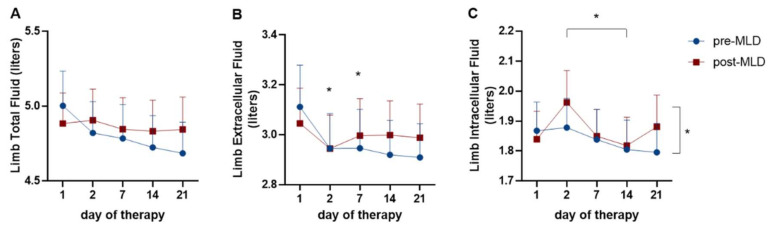
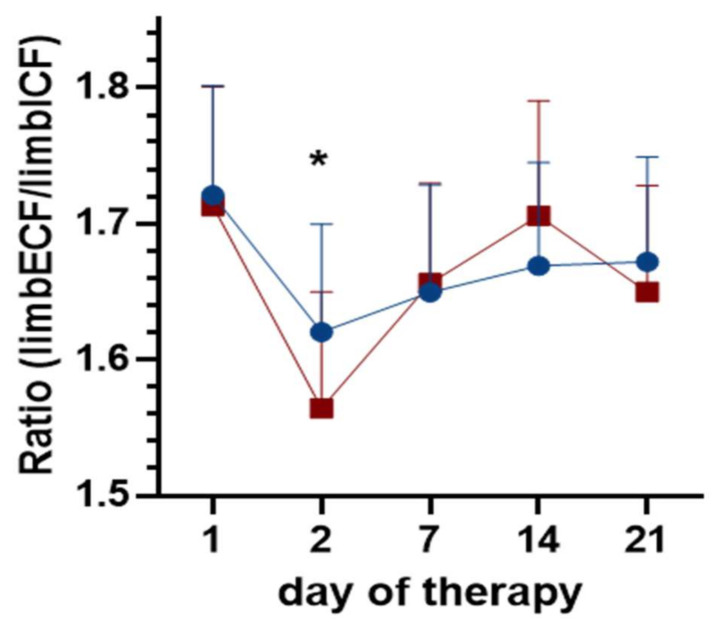
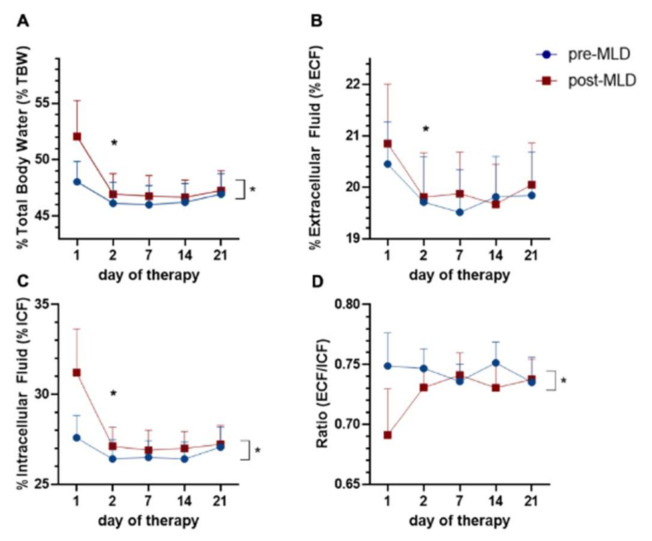
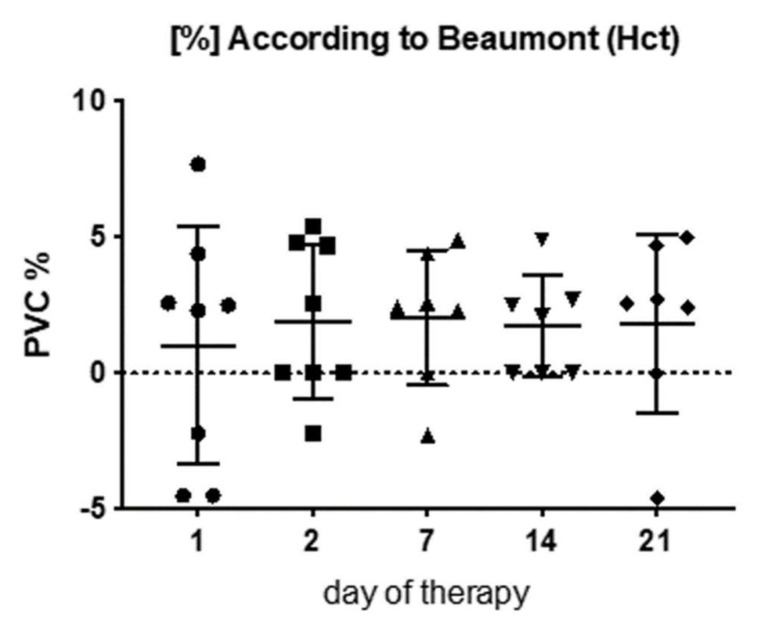
Complete decongestive therapy (CDT), a physical therapy including manual lymphatic drainage (MLD) and compression bandaging, is aimed at mobilizing fluid and reducing limb volume in lymphedema patients. Details of fluid shifts occurring in response to CDT are currently not well studied. Therefore, we investigated fluid shifts before, during and after CDT. Thirteen patients (3 males and 10 females, aged 57 ± 8.0 years, 167.2 ± 8.3 cm height, 91.0 ± 23.4 kg weight) diagnosed with stage II leg lymphedema participated. Leg volume, limb and whole-body fluid composition (total body water (limbTBW/%TBW), extracellular (limbECF/%ECF) and intracellular (limbICF/%ICF fluid), as well as ECF/ICF and limbECF/limbICF ratios were determined using perometry and bioelectrical impedance spectroscopy. Plasma volume, proteins, osmolality, oncotic pressure and electrolytes were assessed. Leg volume ( < 0.001), limbECF ( = 0.041), limbICF ( = 0.005) and limbECF/limbICF decreased over CDT. Total leg volume and limbTBW were correlated (r = 0.635). %TBW ( = 0.001) and %ECF ( = 0.007) decreased over time. The maximum effects were seen within one week of CDT. LimbICF ( = 0.017), %TBW ( = 0.009) and %ICF ( = 0.003) increased post-MLD, whereas ECF/ICF decreased due to MLD. Plasma volume increased by 1.5% post-MLD, as well as albumin and the albumin-to-globulin ratio ( = 0.005 and = 0.049, respectively). Our results indicate that physical therapy leads to fluid shifts in lymphedema patients, with the greatest effects occurring within one week of therapy. Fluid shifts due to physical therapy were also reflected in increased plasma volume and plasma protein concentrations. Perometry, in contrast to bioelectrical impedance analysis, does not seem to be sensitive enough to detect small fluid changes caused by manual lymphatic drainage.
完全减压疗法(CDT)是一种包括手法淋巴引流(MLD)和加压包扎的物理疗法,旨在促进淋巴水肿患者的液体流动并减少肢体体积。目前,对于CDT治疗过程中发生的液体转移细节研究尚不充分。因此,我们对CDT治疗前、治疗期间和治疗后的液体转移情况进行了调查。13例被诊断为II期腿部淋巴水肿的患者(3例男性,10例女性,年龄57±8.0岁,身高167.2±8.3厘米,体重91.0±23.4千克)参与了研究。使用体积描记法和生物电阻抗光谱法测定腿部体积、肢体和全身的液体成分(全身水(肢体TBW/%TBW)、细胞外液(肢体ECF/%ECF)和细胞内液(肢体ICF/%ICF)),以及ECF/ICF和肢体ECF/肢体ICF比率。评估血浆容量、蛋白质、渗透压(摩尔渗透压浓度)、胶体渗透压和电解质。在CDT治疗期间,腿部体积(<0.001)、肢体ECF(=0.041)、肢体ICF(=0.005)和肢体ECF/肢体ICF均有所下降。腿部总体积与肢体TBW相关(r = 0.635)。%TBW(=0.001)和%ECF(=0.007)随时间下降。在CDT治疗的一周内观察到最大效果。手法淋巴引流后,肢体ICF(=0.017)、%TBW(=0.009)和%ICF(=0.003)增加,而ECF/ICF因手法淋巴引流而降低。手法淋巴引流后血浆容量增加了1.5%,白蛋白以及白蛋白与球蛋白的比率也增加(分别为=0.005和=0.049)。我们的结果表明,物理疗法会导致淋巴水肿患者发生液体转移,在治疗的一周内效果最为显著。物理疗法引起的液体转移还表现为血浆容量和血浆蛋白浓度的增加。与生物电阻抗分析相比,体积描记法似乎对检测手法淋巴引流引起的微小液体变化不够敏感。