Michael Smith Laboratories, University of British Columbia, 2185 East Mall, Vancouver, BC, V6T 1Z4, Canada.
Department of Emergency Medicine, University of Washington, Seattle, USA.
Sci Rep. 2020 Nov 18;10(1):20116. doi: 10.1038/s41598-020-76782-z.
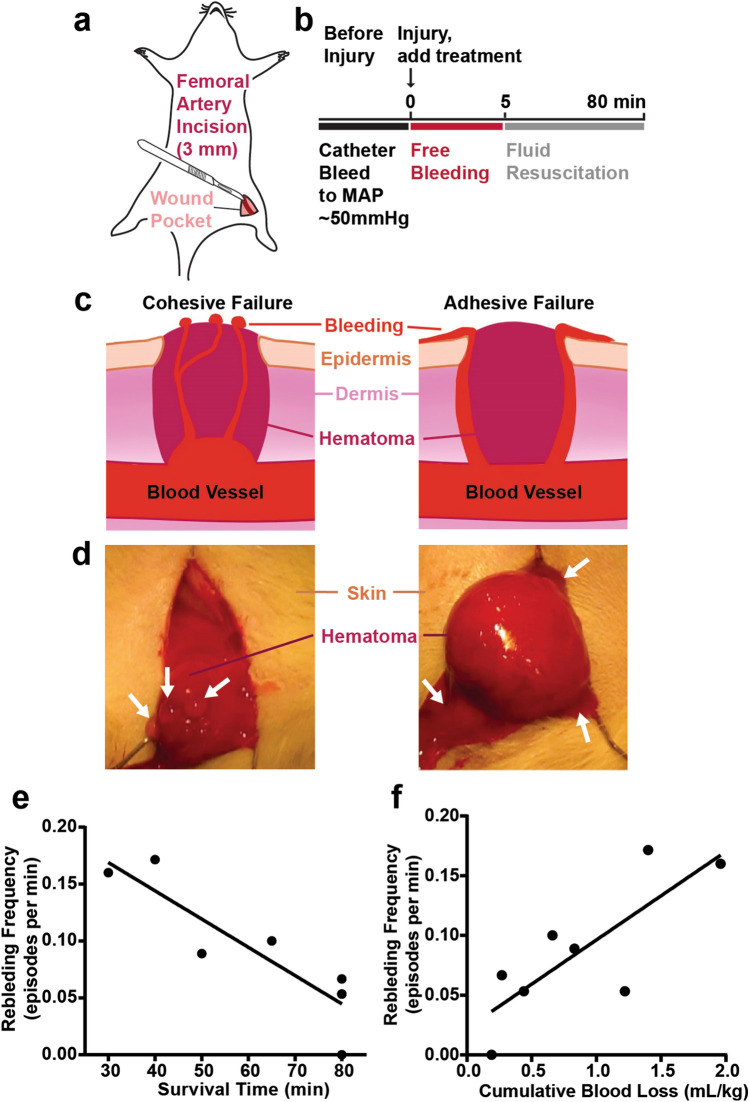
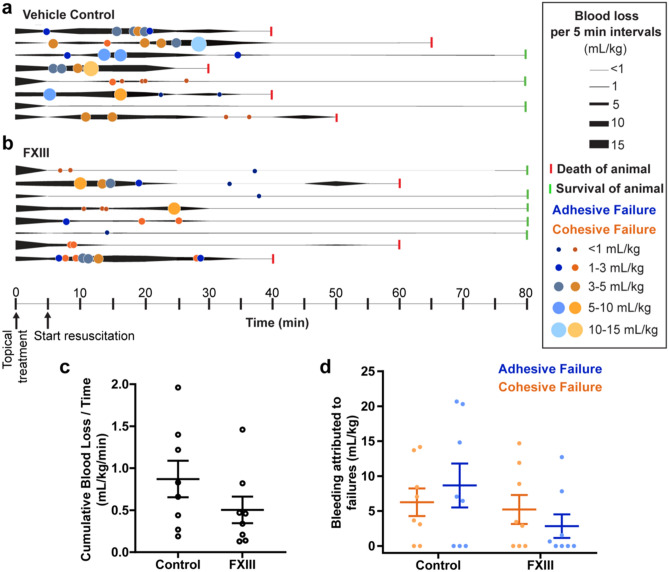
The adhesion of blood clots to wounds is necessary to seal injured vasculature and achieve hemostasis. However, it has not been specifically tested if adhesive failure of clots is a major contributor to rebleeding and what mechanisms prevent clot delamination. Here, we quantified the contribution of adhesive and cohesive failure to rebleeding in a rat model of femoral artery injury, and identified mechanisms that contribute to the adhesive strength of bulk clots in a lap-shear test in vitro. In the rat bleeding model, the frequency of clot failures correlated positively with blood loss (R = 0.81, p = 0.014) and negatively with survival time (R = - 0.89, p = 0.0030), with adhesive failures accounting for 51 ± 14% of rebleeds. In vitro, adhesion depended on fibrinogen and coagulation factor XIII (FXIII), and supraphysiological FXIII improved adhesive strength. Furthermore, when exogenous FXIII was topically applied into the wound pocket of rats, eleven adhesive failures occurred between eight rats, compared to seventeen adhesive failures between eight untreated rats, whereas the number of cohesive failures remained the same at sixteen in both groups. In conclusion, rebleeding from both adhesive and cohesive failure of clots decreases survival from hemorrhage in vivo. Both endogenous and exogenous FXIII improves the adhesive strength of clots.
血液凝块黏附于伤口对于封闭受损的脉管并实现止血是必要的。然而,尚未专门测试过凝块的黏附失败是否是再出血的主要原因,以及有哪些机制可以防止凝块分层。在这里,我们在大鼠股动脉损伤模型中定量评估了黏附失败和凝聚失败对再出血的贡献,并确定了体外层剪测试中 bulk clots 黏附强度的相关机制。在大鼠出血模型中,凝块失败的频率与失血量呈正相关(R=0.81,p=0.014),与存活时间呈负相关(R=−0.89,p=0.0030),黏附失败占再出血的 51±14%。在体外,黏附取决于纤维蛋白原和凝血因子 XIII(FXIII),且 FXIII 水平高于生理值时可以提高黏附强度。此外,当外源性 FXIII 局部应用于大鼠伤口口袋时,在 8 只大鼠中有 11 个黏附失败,而在 8 只未处理的大鼠中有 17 个黏附失败,而两组的凝聚失败数量均为 16。总之,体内凝块的黏附和凝聚失败都会导致出血时的存活率降低。内源性和外源性 FXIII 均可以提高凝块的黏附强度。