Leopold Anna V, Verkhusha Vladislav V
Medicum , Faculty of Medicine , University of Helsinki , Helsinki 00290 , Finland.
Department of Anatomy and Structural Biology and Gruss-Lipper Biophotonics Center , Albert Einstein College of Medicine , Bronx , NY 10461 , USA . Email:
Chem Sci. 2020 Sep 7;11(37):10019-10034. doi: 10.1039/d0sc03570j. eCollection 2020 Oct 7.
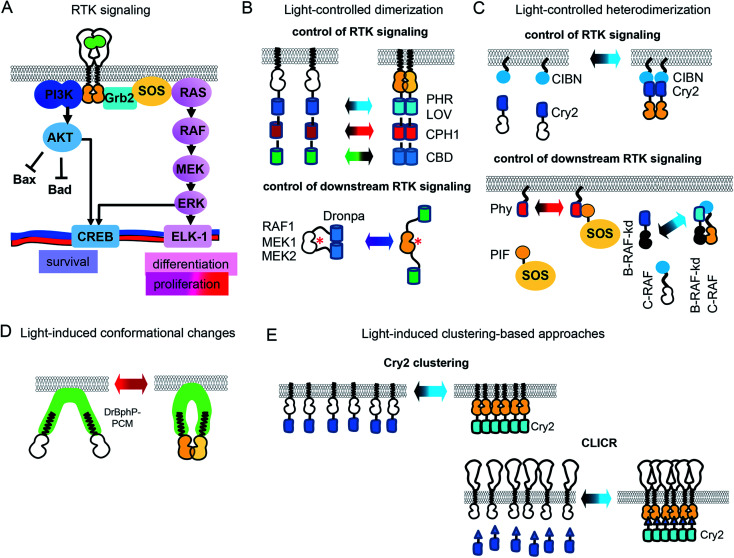
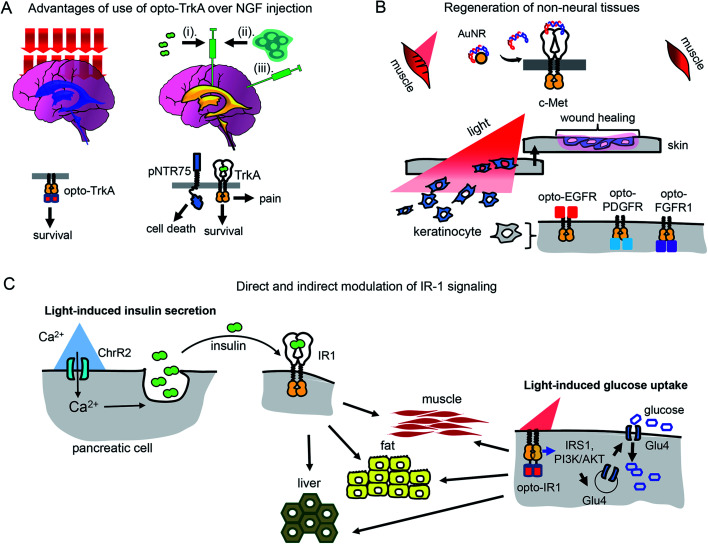
Inhibition of receptor tyrosine kinases (RTKs) by small molecule inhibitors and monoclonal antibodies is used to treat cancer. Conversely, activation of RTKs with their ligands, including growth factors and insulin, is used to treat diabetes and neurodegeneration. However, conventional therapies that rely on injection of RTK inhibitors or activators do not provide spatiotemporal control over RTK signaling, which results in diminished efficiency and side effects. Recently, a number of optogenetic and optochemical approaches have been developed that allow RTK inhibition or activation in cells and with light. Light irradiation can control RTK signaling non-invasively, in a dosed manner, with high spatio-temporal precision, and without the side effects of conventional treatments. Here we provide an update on the current state of the art of optogenetic and optochemical RTK technologies and the prospects of their use in translational studies and therapy.
小分子抑制剂和单克隆抗体对受体酪氨酸激酶(RTK)的抑制作用被用于治疗癌症。相反,用包括生长因子和胰岛素在内的配体激活RTK则被用于治疗糖尿病和神经退行性疾病。然而,依赖注射RTK抑制剂或激活剂的传统疗法无法对RTK信号传导进行时空控制,这导致效率降低和出现副作用。最近,已经开发出了一些光遗传学和光化学方法,可在细胞中用光实现RTK的抑制或激活。光照射可以以无创、定量的方式,在高时空精度下控制RTK信号传导,且没有传统治疗的副作用。在此,我们提供了关于光遗传学和光化学RTK技术的当前技术水平及其在转化研究和治疗中的应用前景的最新情况。