Department of Pathology, Beth Israel Deaconess Medical Center, Harvard Medical School, Boston, MA 02215, USA.
Mount Sinai Center for Therapeutics Discovery, Departments of Pharmacological Sciences and Oncological Sciences, Tisch Cancer Institute, Icahn School of Medicine at Mount Sinai, New York, NY 10029, USA.
Sci Adv. 2020 Feb 21;6(8):eaay5154. doi: 10.1126/sciadv.aay5154. eCollection 2020 Feb.
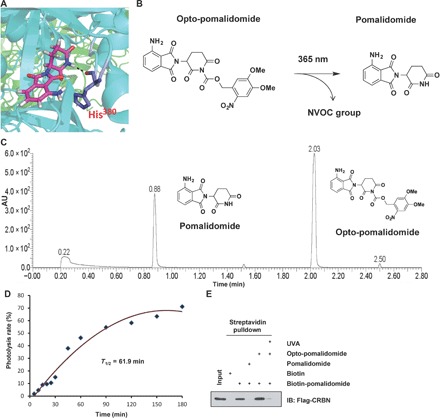
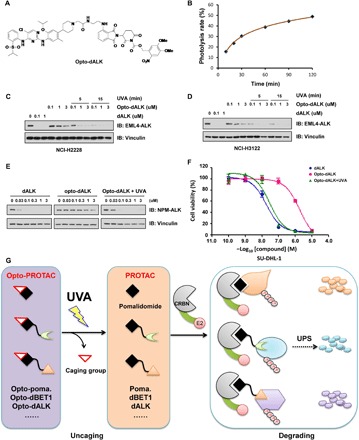
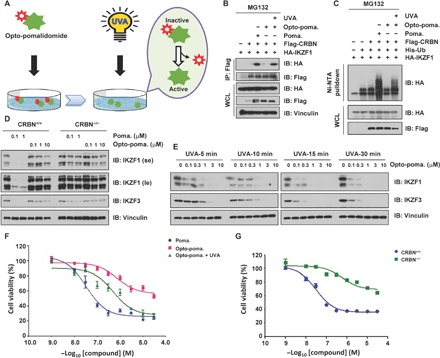
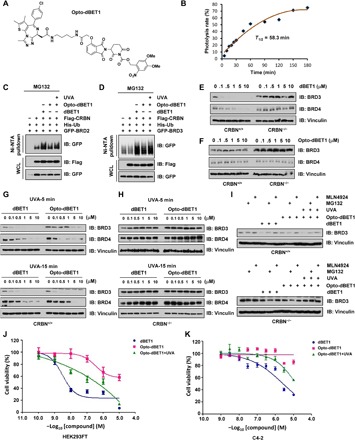
By hijacking endogenous E3 ligase to degrade protein targets via the ubiquitin-proteasome system, PROTACs (PRoteolysis TArgeting Chimeras) provide a new strategy to inhibit protein targets that were regarded as undruggable before. However, the catalytic nature of PROTAC potentially leads to uncontrolled degradation that causes systemic toxicity issues, limiting the application of PROTAC in the clinic. Here, we introduce a light-inducible switch on PROTACs, thereafter termed as opto-PROTAC, to enable the degradation of protein targets in a spatiotemporal manner. By adding a photolabile caging group on pomalidomide as a parental compound and two additional PROTACs, dBET1 and dALK, we demonstrated light-inducible protein degradation. These opto-PROTACs display no activities in the dark, while the restricted degradation can be induced at a specific time and rate by ultraviolet A irradiation. Our approach provides a generalizable platform for the development of light-controlled PROTACs and enables PROTAC to be a precision medicine.
通过劫持内源性 E3 连接酶,利用泛素-蛋白酶体系统降解蛋白质靶标,PROTAC(蛋白水解靶向嵌合体)为抑制以前被认为不可成药的蛋白质靶标提供了一种新策略。然而,PROTAC 的催化性质可能导致不受控制的降解,从而导致全身毒性问题,限制了 PROTAC 在临床上的应用。在这里,我们引入了一种光诱导开关 PROTAC,此后称为光 PROTAC,以实现蛋白质靶标的时空降解。通过在泊马度胺作为母体化合物上添加一个光不稳定的笼状基团和另外两个 PROTACs,dBET1 和 dALK,我们证明了光诱导的蛋白质降解。这些光 PROTAC 在黑暗中没有活性,而限制降解可以通过紫外线 A 照射在特定的时间和速率下诱导。我们的方法为光控 PROTAC 的开发提供了一个可推广的平台,并使 PROTAC 成为一种精准医学。