Otsuka Hiroyuki, Sakoda Naoki, Uehata Atsushi, Sato Toshiki, Sakurai Keiji, Aoki Hiromichi, Yamagiwa Takeshi, Iizuka Shinichi, Inokuchi Sadaki
Department of Emergency and Critical Care Medicine Tokai University School of Medicine Isehara City Japan.
Acute Med Surg. 2020 Nov 12;7(1):e593. doi: 10.1002/ams2.593. eCollection 2020 Jan-Dec.
This study aimed to evaluate the effect of plasma transfusion before urgent hemostasis initiation on in-hospital mortality in hemodynamically unstable patients with severe trauma.
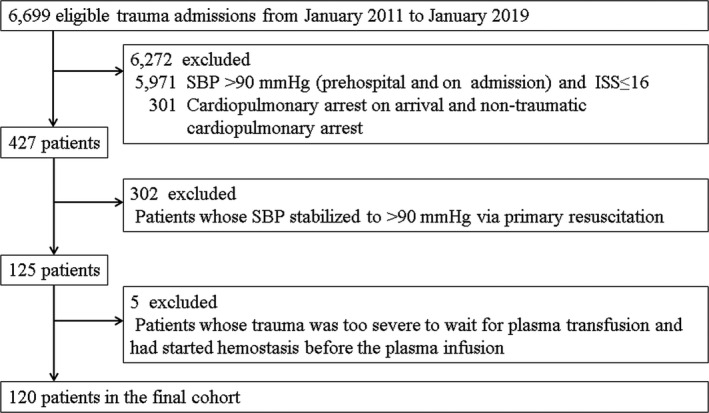
This retrospective observational study of patients admitted to hospital between January 2011 and January 2019 grouped patients according to whether plasma transfusion was initiated before (Before group) or after (After group) hemostasis initiation. Patients with severe trauma who were unable to wait for plasma transfusion and had started hemostasis before the plasma infusion were excluded. We used multivariable logistic regression analysis to determine the effect of plasma transfusion before the initiation of urgent hemostasis on in-hospital mortality.
We included 47 and 73 patients in the Before and After groups, respectively. Blunt trauma was more common, and the D-dimer levels and Injury Severity Score were significantly higher in the Before group than in the After group (median D-dimer, 57.5 versus 38.1 μg/mL; = 0.040; median Injury Severity Score, 50 versus 34; < 0.001). Plasma given before hemostasis initiation was associated with significantly lower in-hospital mortality (adjusted odds ratio, 0.27; 95% confidence interval, 0.078-0.900; = 0.033) in contrast with the total plasma volume given in the first 6 or 24 h.
Plasma transfusion before hemostasis initiation could be an important factor for improving outcomes in hemodynamically unstable patients with blunt trauma, high D-dimer levels, or a high Injury Severity Score.
本研究旨在评估在血流动力学不稳定的严重创伤患者中,在紧急止血开始前输注血浆对院内死亡率的影响。
这项对2011年1月至2019年1月期间入院患者的回顾性观察研究,根据在止血开始前(术前组)或之后(术后组)是否开始输注血浆对患者进行分组。排除了无法等待血浆输注且在输注血浆前已开始止血的严重创伤患者。我们使用多变量逻辑回归分析来确定在紧急止血开始前输注血浆对院内死亡率的影响。
术前组和术后组分别纳入了47例和73例患者。钝性创伤更为常见,术前组的D-二聚体水平和损伤严重程度评分显著高于术后组(D-二聚体中位数,57.5对38.1μg/mL;P = 0.040;损伤严重程度评分中位数,50对34;P < 0.001)。与最初6或24小时内输注的血浆总量相比,在止血开始前输注血浆与显著降低的院内死亡率相关(调整后的优势比,0.27;95%置信区间,0.078 - 0.900;P = 0.033)。
在止血开始前输注血浆可能是改善血流动力学不稳定的钝性创伤、高D-二聚体水平或高损伤严重程度评分患者预后的一个重要因素。