Wang Wenjun, Du Xiumei, Ye Lu, Wang Xiaoli, Zhang Guoyun
Department of Optometry Center, Xi'an People's Hospital (Xi'an Fourth Hospital), Xi'an, China.
Transl Pediatr. 2020 Oct;9(5):636-644. doi: 10.21037/tp-20-216.
Allergic conjunctivitis (AC) is predominantly caused by serum specific-IgE (sIgE)-mediated type I allergy. This study aims to analyze the distribution of sIgE in children with AC, and the concomitant allergic diseases.
The clinical data from 310 children, diagnosed with AC and admitted to our hospital from January 2017 to January 2019 were retrospectively collected. The children were divided into three groups: infant group (2 months to 1 year old, 91 cases), child group (1 to 3 years old, 112 cases), and preschool group (3 to 6 years old, 107 cases). Children in every group were analyzed for positive rates, the number of positive sIgE types, the distribution of positive inhaling and ingesting allergens and concomitant allergic diseases.
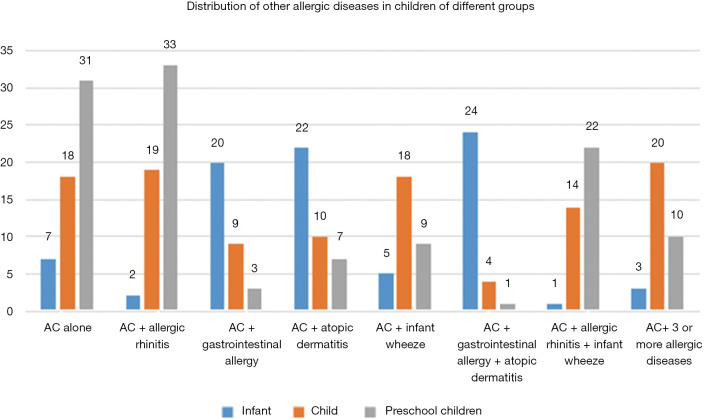
The sIgE positive rate of infant was significantly lower than that of the other two groups, and the number of 18.75% sIgE positive species was 1. The number of sIgE positive species in the child group and preschool group was more than 2 (78.30%, 71.15%). The positive rate of sIgE to dust mites, house dust, animal dander, eggs, beef, mutton and mango in the preschool group was significantly higher than the other groups (P<0.05). The positive rate of sIgE to milk in infant group was significantly higher than the other two groups (P<0.05). Children in the preschool group showed the highest incidence of AC, AC + allergic rhinitis, AC + allergic rhinitis + wheezing, while those in the infant group displayed the lowest incidence (P<0.05). AC + gastrointestinal allergy, AC + atopic dermatitis, AC + gastrointestinal allergy + atopic dermatitis in infant group was significantly higher than the other two groups (P<0.05). Patients in the child group displayed a significantly higher incidence of AC + infant wheezing than the other two groups (P<0.05).
We correlated children's age with the positive rate and gradual increase in types of AC allergens. Concomitant allergic diseases of children with AC at different ages conform to the natural course of allergic diseases. In clinic, improving the diagnostic efficiency of AC in children, and early interventional treatment will positively contribute to their prognosis, and reduce the risk of other allergic diseases.
过敏性结膜炎(AC)主要由血清特异性免疫球蛋白E(sIgE)介导的Ⅰ型过敏反应引起。本研究旨在分析AC患儿中sIgE的分布情况以及合并的过敏性疾病。
回顾性收集2017年1月至2019年1月在我院确诊为AC并住院的310例患儿的临床资料。将患儿分为三组:婴儿组(2个月至1岁,91例)、儿童组(1至3岁,112例)和学龄前组(3至6岁,107例)。分析每组患儿的sIgE阳性率、阳性sIgE种类数、吸入性和食入性过敏原阳性分布情况以及合并的过敏性疾病。
婴儿组的sIgE阳性率显著低于其他两组,18.75%的sIgE阳性种类数为1种。儿童组和学龄前组的sIgE阳性种类数多于2种(分别为78.30%、71.15%)。学龄前组对尘螨、屋尘、动物皮屑、鸡蛋、牛肉、羊肉和芒果的sIgE阳性率显著高于其他组(P<0.05)。婴儿组对牛奶的sIgE阳性率显著高于其他两组(P<0.05)。学龄前组患儿AC、AC + 过敏性鼻炎、AC + 过敏性鼻炎 + 喘息的发病率最高,而婴儿组最低(P<0.05)。婴儿组AC + 胃肠道过敏、AC + 特应性皮炎、AC + 胃肠道过敏 + 特应性皮炎的发病率显著高于其他两组(P<0.05)。儿童组患儿AC + 婴儿喘息的发病率显著高于其他两组(P<0.05)。
我们发现儿童年龄与AC过敏原的阳性率及种类逐渐增加相关。不同年龄段AC患儿合并的过敏性疾病符合过敏性疾病的自然病程。临床上,提高儿童AC的诊断效率并进行早期干预治疗将对其预后产生积极影响,并降低其他过敏性疾病的风险。