Department of Obstetrics and Gynecology, Hokkaido University Graduate School of Medicine, Sapporo, Japan.
Department of General Internal Medicine, Shonan Kamakura General Hospital, Kamakura, Japan.
J Occup Health. 2020 Jan;62(1):e12180. doi: 10.1002/1348-9585.12180.
In Japan, the prevalence of irregular menstrual cycles and its association with the frequency of night shifts have scarcely assessed. The present study aimed to evaluate the relationship between irregular menstrual cycles and the frequency of night shifts in Japanese female nurses.
We conducted a cross-sectional web-based self-administered questionnaire survey in 2019. An irregular menstrual cycle was defined as a cycle length of ≤21 days or ≥39 days at least a few times over the past year or amenorrhea for at least 3 months. We used Poison regression analysis with a robust error variance to calculate the prevalence ratios adjusted for age, body mass index, hospital size, and the department in which they worked.
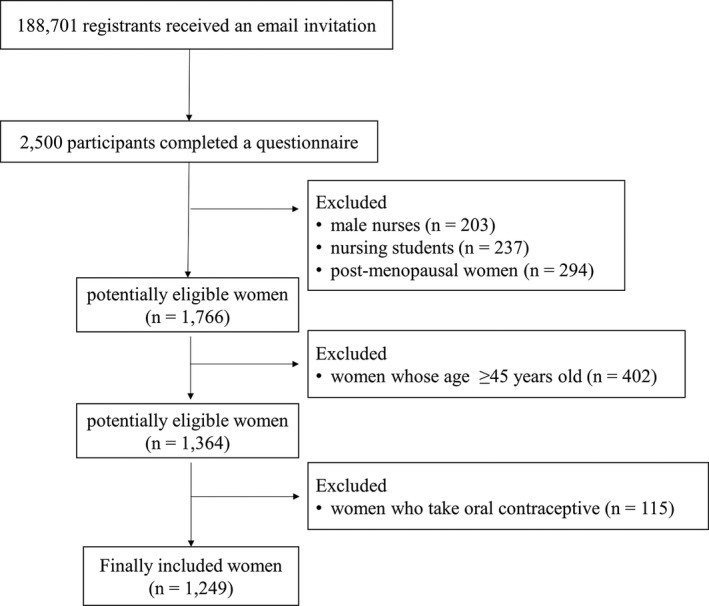
A total of 1249 women were included, and 679 (54.4%) and 195 (15.6%) of them worked under two and three rotating shifts. The prevalence of irregular menstrual cycles was 24.8%, 37.4%, and 35.9% in the no night, two rotating, and three rotating shifts groups, respectively. While the frequency of night shifts had a dose-responsive relationship with irregular menstrual cycles in the two rotating shifts group, it was not observed in the three rotating shifts group. However, the risk of work getting affected by dysmenorrhea or premenstrual symptoms increased in the three rotating shifts group.
Over 30% of Japanese female nurses working under night shifts had irregular menstrual cycles. The high frequency of night shifts increased the risk of irregular menstrual cycles and secondary amenorrhea in the two rotating shifts group.
在日本,不规则月经周期的流行情况及其与夜班频率的关系尚未得到充分评估。本研究旨在评估日本女性护士中不规则月经周期与夜班频率之间的关系。
我们于 2019 年进行了一项基于网络的横断面自我管理问卷调查。不规则月经周期定义为过去一年中至少几次出现周期长度≤21 天或≥39 天或闭经至少 3 个月。我们使用带有稳健误差方差的 Poison 回归分析来计算调整年龄、体重指数、医院规模和工作部门后调整后的患病率比。
共纳入 1249 名女性,其中 679 名(54.4%)和 195 名(15.6%)分别从事两轮和三轮轮班工作。无夜班、两轮和三轮轮班组的不规则月经周期患病率分别为 24.8%、37.4%和 35.9%。虽然夜班频率与两轮轮班组不规则月经周期呈剂量反应关系,但在三轮轮班组中未观察到这种关系。然而,在三轮轮班组中,月经不规律或经前症状影响工作的风险增加。
超过 30%的日本女性护士上夜班时存在月经不规律。夜班频率高会增加两轮轮班组不规则月经周期和继发性闭经的风险。