IRCCS Centro Neurolesi "Bonino-Pulejo", Via Provinciale Palermo, Contrada Casazza, 98124 Messina, Italy.
Int J Mol Sci. 2020 Nov 17;21(22):8662. doi: 10.3390/ijms21228662.
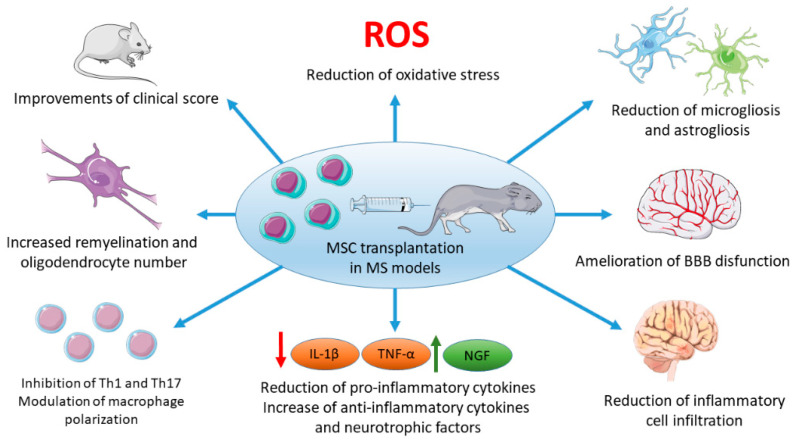
Multiple sclerosis (MS) is an autoimmune, demyelinating disease of the central nervous system. Nowadays, available therapies for MS can help to manage MS course and symptoms, but new therapeutic approaches are required. Stem cell therapy using mesenchymal stem cells (MSCs) appeared promising in different neurodegenerative conditions, thanks to their beneficial capacities, including the immunomodulation ability, and to their secretome. The secretome is represented by growth factors, cytokines, and extracellular vesicles (EVs) released by MSCs. In this review, we focused on studies performed on in vivo MS models involving the administration of MSCs and on clinical trials evaluating MSCs administration. Experimental models of MS evidenced that MSCs were able to reduce inflammatory cell infiltration and disease score. Moreover, MSCs engineered to express different genes, preconditioned with different compounds, differentiated or in combination with other compounds also exerted beneficial actions in MS models, in some cases also superior to native MSCs. Secretome, both conditioned medium and EVs, also showed protective effects in MS models and appeared promising to develop new approaches. Clinical trials highlighted the safety and feasibility of MSC administration and reported some improvements, but other trials using larger cohorts of patients are needed.
多发性硬化症(MS)是一种中枢神经系统的自身免疫性脱髓鞘疾病。如今,针对 MS 的可用疗法可帮助控制 MS 的病程和症状,但仍需要新的治疗方法。间充质干细胞(MSCs)的干细胞疗法在不同的神经退行性疾病中显示出良好的应用前景,这要归功于其有益的能力,包括免疫调节能力和其分泌组。分泌组由 MSCs 释放的生长因子、细胞因子和细胞外囊泡(EVs)组成。在这篇综述中,我们重点关注了涉及 MSCs 给药的体内 MS 模型研究和评估 MSCs 给药的临床试验。MS 的实验模型表明,MSCs 能够减少炎症细胞浸润和疾病评分。此外,表达不同基因的工程 MSC、用不同化合物预处理、分化或与其他化合物联合使用,在 MS 模型中也发挥了有益作用,在某些情况下甚至优于天然 MSC。分泌组,包括条件培养基和 EVs,在 MS 模型中也显示出保护作用,有希望开发新的方法。临床试验强调了 MSC 给药的安全性和可行性,并报告了一些改善,但仍需要使用更大患者队列的其他试验。