Institute of Fundamental Medicine and Biology, Kazan Federal University, Kazan, Russia.
M.M. Shemyakin-Yu.A. Ovchinnikov Institute of Bioorganic Chemistry of the Russian Academy of Sciences, Moscow, Russia.
Front Immunol. 2019 Nov 15;10:2663. doi: 10.3389/fimmu.2019.02663. eCollection 2019.
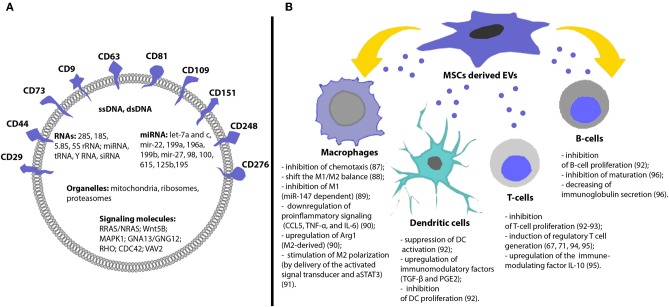
The immunosuppressive potential of mesenchymal stem cells has been extensively investigated in many studies and . In recent years, a variety preclinical and clinical studies have demonstrated that mesenchymal stem cells ameliorate immune-mediated disorders, including autoimmune diseases. However, to date mesenchymal stem cells have not become a widely used therapeutic agent due to safety challenges, high cost and difficulties in providing long term production. A key mechanism underpinning the immunomodulatory effect of MSCs is the production of paracrine factors including growth factors, cytokines, chemokines, and extracellular vesicles (EVs). MSCs derived EVs have become an attractive therapeutic agent for immunomodulation and treatment of immune-mediated disorders. In addition to many preclinical studies of MSCs derived EVs, their beneficial effects have been observed in patients with both acute graft-vs.-host disease and chronic kidney disease. In this review, we discuss the current findings in the field of MSCs derived EVs-based therapies in immune-mediated disorders and approaches to scale EV production for clinical use.
间充质干细胞的免疫抑制潜力已在许多研究中得到广泛研究。近年来,各种临床前和临床研究表明,间充质干细胞可改善免疫介导的疾病,包括自身免疫性疾病。然而,迄今为止,由于安全性挑战、高成本和难以长期生产,间充质干细胞尚未成为广泛使用的治疗剂。间充质干细胞发挥免疫调节作用的一个关键机制是产生旁分泌因子,包括生长因子、细胞因子、趋化因子和细胞外囊泡 (EV)。MSC 衍生的 EV 已成为免疫调节和治疗免疫介导疾病的有吸引力的治疗剂。除了许多关于 MSC 衍生 EV 的临床前研究外,在急性移植物抗宿主病和慢性肾病患者中也观察到了它们的有益作用。在这篇综述中,我们讨论了免疫介导疾病中基于 MSC 衍生 EV 的治疗方法的当前研究结果以及用于临床使用的 EV 生产规模的方法。