Mavridi-Printezi Alexandra, Guernelli Moreno, Menichetti Arianna, Montalti Marco
Department of Chemistry "Giacomo Ciamician", University of Bologna, Via Selmi 2, 40126 Bologna, Italy.
Tecnopolo di Rimini, Via Campana 71, 47922 Rimini, Italy.
Nanomaterials (Basel). 2020 Nov 17;10(11):2276. doi: 10.3390/nano10112276.
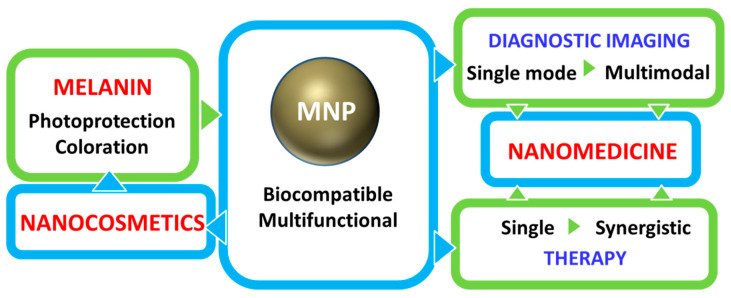
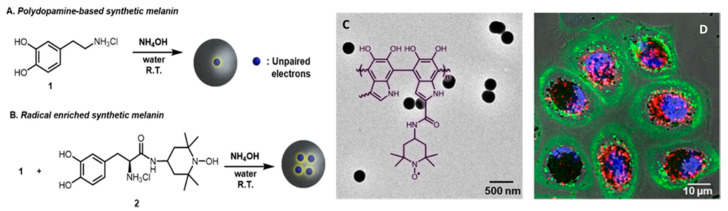
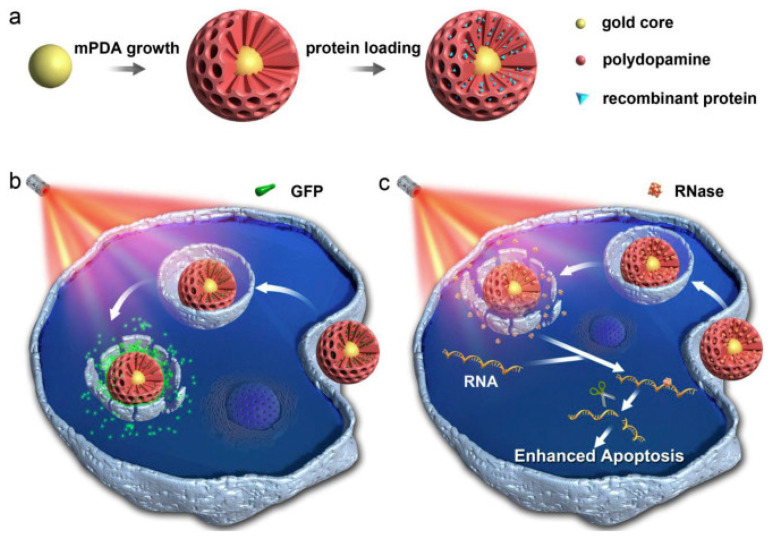
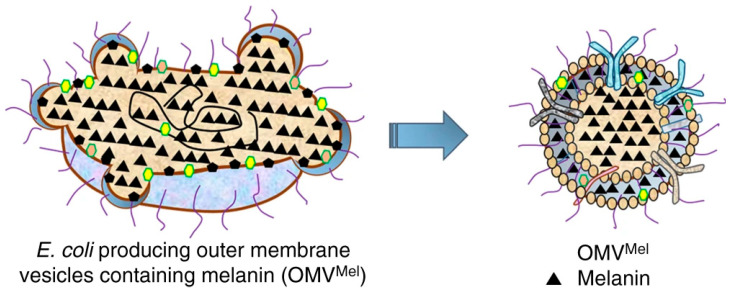
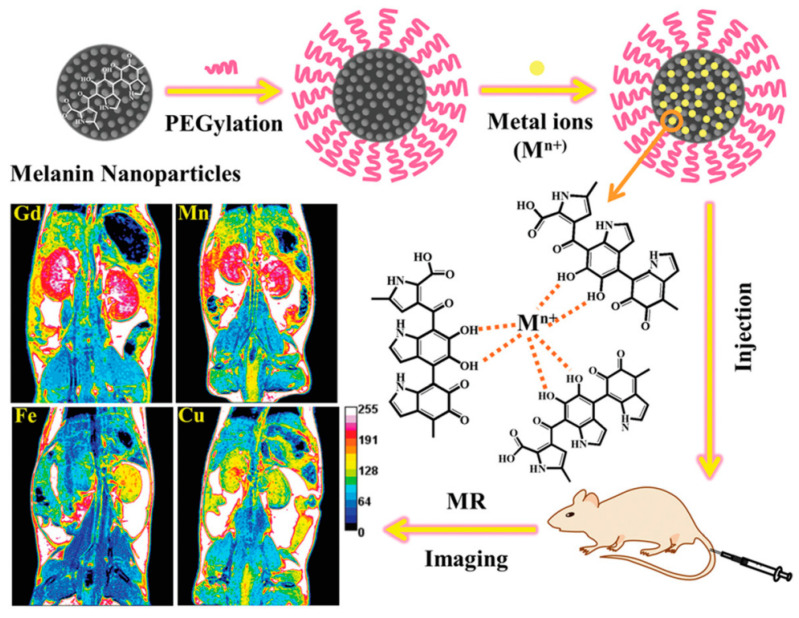
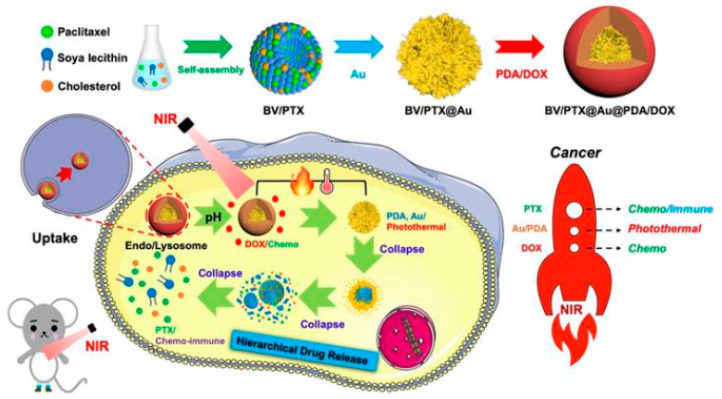
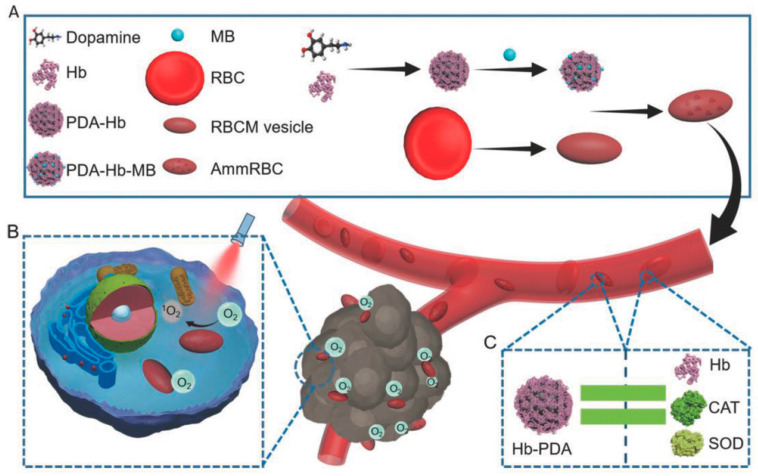
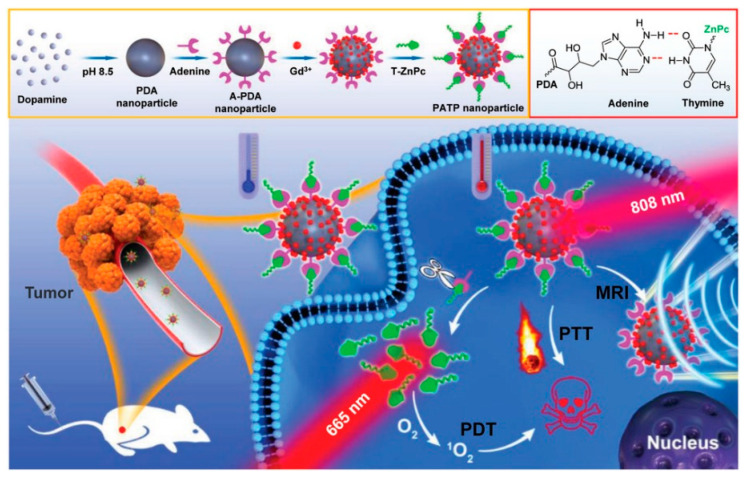
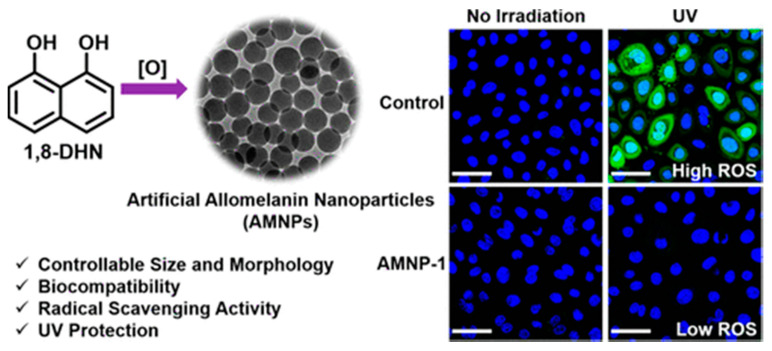
Bioinspired nanomaterials are ideal components for nanomedicine, by virtue of their expected biocompatibility or even complete lack of toxicity. Natural and artificial melanin-based nanoparticles (MNP), including polydopamine nanoparticles (PDA NP), excel for their extraordinary combination of additional optical, electronic, chemical, photophysical, and photochemical properties. Thanks to these features, melanin plays an important multifunctional role in the design of new platforms for nanomedicine where this material works not only as a mechanical support or scaffold, but as an active component for imaging, even multimodal, and simple or synergistic therapy. The number of examples of bio-applications of MNP increased dramatically in the last decade. Here, we review the most recent ones, focusing on the multiplicity of functions that melanin performs in theranostics platforms with increasing complexity. For the sake of clarity, we start analyzing briefly the main properties of melanin and its derivative as well as main natural sources and synthetic methods, moving to imaging application from mono-modal (fluorescence, photoacoustic, and magnetic resonance) to multi-modal, and then to mono-therapy (drug delivery, anti-oxidant, photothermal, and photodynamic), and finally to theranostics and synergistic therapies, including gene- and immuno- in combination to photothermal and photodynamic. Nanomedicine aims not only at the treatment of diseases, but also to their prevention, and melanin in nature performs a protective action, in the form of nanopigment, against UV-Vis radiations and oxidants. With these functions being at the border between nanomedicine and cosmetics nanotechnology, recently examples of applications of artificial MNP in cosmetics are increasing, paving the road to the birth of the new science of nanocosmetics. In the last part of this review, we summarize and discuss these important recent results that establish evidence of the interconnection between nanomedicine and cosmetics nanotechnology.
受生物启发的纳米材料是纳米医学的理想组成部分,因为它们具有预期的生物相容性,甚至完全没有毒性。天然和人工合成的基于黑色素的纳米颗粒(MNP),包括聚多巴胺纳米颗粒(PDA NP),因其具有额外的光学、电子、化学、光物理和光化学特性的非凡组合而表现出色。由于这些特性,黑色素在纳米医学新平台的设计中发挥着重要的多功能作用,在这些平台中,这种材料不仅作为机械支撑或支架,还作为成像(甚至多模态)以及简单或协同治疗的活性成分。在过去十年中,MNP生物应用的例子数量急剧增加。在这里,我们回顾了最新的例子,重点关注黑色素在日益复杂的治疗诊断平台中所发挥的多种功能。为了清晰起见,我们首先简要分析黑色素及其衍生物的主要特性、主要天然来源和合成方法,接着从单模态(荧光、光声和磁共振)成像应用到多模态成像应用,然后是单治疗(药物递送、抗氧化、光热和光动力),最后是治疗诊断和协同治疗,包括与光热和光动力相结合的基因和免疫治疗。纳米医学不仅旨在治疗疾病,还旨在预防疾病,自然界中的黑色素以纳米色素的形式对紫外 - 可见辐射和氧化剂起到保护作用。由于这些功能处于纳米医学和化妆品纳米技术的交叉领域,最近人工MNP在化妆品中的应用例子不断增加,为纳米化妆品这一新兴科学的诞生铺平了道路。在本综述的最后一部分,我们总结并讨论了这些重要的近期研究结果,这些结果证明了纳米医学与化妆品纳米技术之间的相互联系。