Fahy Stephen, Moore Joss, Kelly Michael, Flannery Olivia, Kenny Paddy
Connolly Hospital Blanchardstown, Blanchardstown, Ireland.
Cappagh National Orthopaedic Hospital Orthopaedic Department, Dublin, Ireland.
Bone Jt Open. 2020 Nov 1;1(6):261-266. doi: 10.1302/2046-3758.16.BJO-2020-0040.R1. eCollection 2020 Jun.
Europe has found itself at the epicentre of the COVID-19 pandemic. Naturally, this has placed added strain onto healthcare systems internationally. It was feared that the impact of the COVID-19 pandemic could overrun the Irish healthcare system. As such, the Irish government opted to introduce a national lockdown on the 27 March 2020 in an attempt to stem the flow of admissions to hospitals. Similar lockdowns in the UK and New Zealand have resulted in reduced emergency department presentations and trauma admissions. The aim of this study is to assess the effect of the national lockdown on trauma presentations to a model-3 hospital in Dublin, Ireland.
A retrospective study was conducted. All emergency department presentations between 27 March 2019 to 27 April 2020 and 27 March 2020 to 27 April 2020 were cross-referenced against the National Integrated Medical Imaging System-Picture Archiving Communication System (NIMIS-PACS) radiology system to identify those with radiologically proven skeletal trauma. These patients were grouped according to sex, age, discharge outcome, mechanism of injury, and injury location.
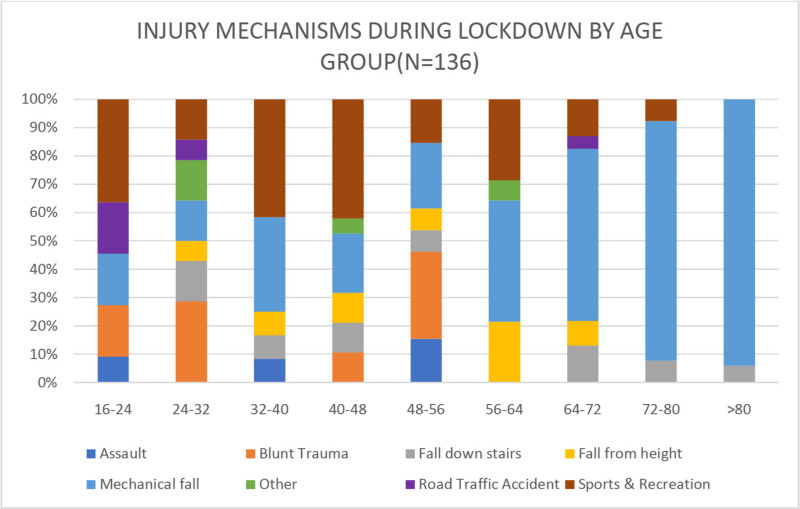
A 21% decrease in radiologically proven trauma was observed on comparison with the same time-period last year. Additionally, a 40% reduction in trauma admissions was observed during the COVID-19 lockdown. A 60% reduction in sports-related injuries and road traffic accident-related injuries was noted during the national lockdown. However, a 17% increase was observed in patients sustaining trauma because of domestic accidents.
Variation was observed in both the volume and nature of trauma presentations during the COVID-19 lockdown. As would be expected, a reduction was seen in the number of injuries resulting from outdoor activities. Interestingly, increased rates of domestic injuries were seen during this period which could represent an unintended consequence of the prolonged period of lockdown.Cite this article: 2020;1-6:261-266.
欧洲处于新冠疫情的中心。自然而然地,这给国际医疗系统带来了额外压力。人们担心新冠疫情的影响可能使爱尔兰医疗系统不堪重负。因此,爱尔兰政府于2020年3月27日选择实施全国封锁,试图遏制医院的入院人数。英国和新西兰实施的类似封锁已导致急诊科就诊人数和创伤入院人数减少。本研究的目的是评估全国封锁对爱尔兰都柏林一家三级医院创伤就诊情况的影响。
进行了一项回顾性研究。将2019年3月27日至2020年4月27日与2020年3月27日至2020年4月27日期间所有急诊科就诊情况与国家综合医学影像系统-图像存档与通信系统(NIMIS-PACS)放射学系统进行交叉比对,以确定那些经放射学证实有骨骼创伤的患者。这些患者根据性别、年龄、出院结果、损伤机制和损伤部位进行分组。
与去年同期相比,经放射学证实的创伤减少了21%。此外,在新冠疫情封锁期间,创伤入院人数减少了40%。在全国封锁期间,与运动相关的损伤和与道路交通事故相关的损伤减少了60%。然而,因家庭事故而受伤的患者增加了17%。
在新冠疫情封锁期间,创伤就诊的数量和性质都出现了变化。正如预期的那样,户外活动导致的受伤数量有所减少。有趣的是,在此期间家庭受伤率有所上升,这可能是长期封锁带来的意外后果。引用本文:2020;1-6:261-266。