PeaRL Perinatal Research Laboratory, University of Florence, Prato, Italy.
CiaoLapo Foundation for Perinatal Health, Prato, Italy.
Arch Womens Ment Health. 2020 Dec;23(6):783-786. doi: 10.1007/s00737-020-01086-0. Epub 2020 Nov 20.
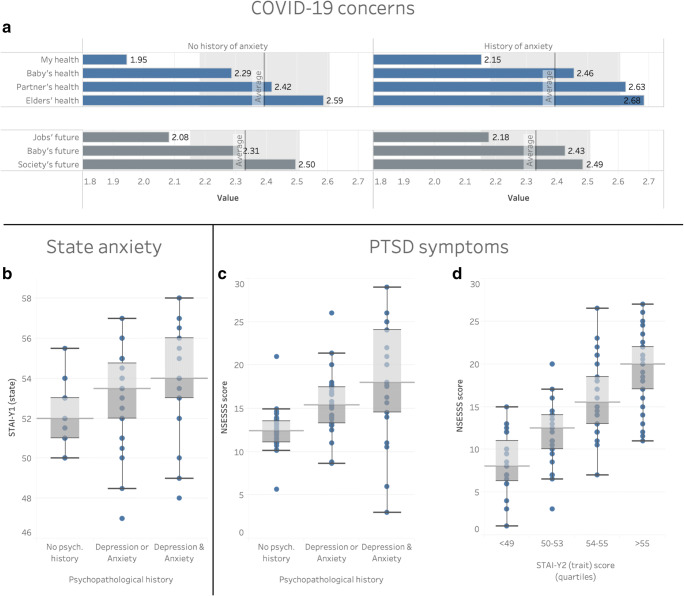
Italy was the first COVID-19 pandemic epicenter among European countries and established a period of full "lockdown", consisting of travel bans, mandatory staying at home, and temporary closure of nonessential businesses. Similar measures are known risk factors for psychological disturbances in the general population; still, little is known about their impact on pregnant women's mental health during COVID-19 pandemic. The cross-sectional, web-based, national survey "COVID-19 related Anxiety and StreSs in prEgnancy, poSt-partum and breaStfeeding" (COVID-ASSESS) was conducted during the first month of full "lockdown" in Italy. Participants were recruited via social networks with a snowball technique. The questionnaire was specifically developed to examine COVID-19 concerns and included the psychometric tests National Stressful Events Survey (NSESSS) for posttraumatic stress disorder (PTSD) and State-Trait Anxiety Inventory. A multivariable logistic regression model was fitted to explore the association of the concern, anxiety and PTSD symptoms with age, gestational weeks, parity, days of "lockdown", assisted reproductive technology use, psychopathological history, and previous perinatal losses. Out of 1015 pregnant women reached, 737 (72.6%) fully answered the questionnaire; no woman reported a COVID-19 infection. Median age was 34.4 years [quartiles 31.7, 37.2], median days in "lockdown" were 13.1 [11.0, 17.0], median gestational weeks were 27.8 [19.8, 34.0]. Clinically significant PTSD symptoms were present in 75 women (10.2%, NSESSS cutoff 24) and clinically significant anxiety symptoms were present in 160 women (21.7%, STAI-Y1 cutoff 50). Women were particularly worried about the health of their baby and of their elderly relatives, as well as of the possible impact of pandemic in the future of society. Previous anxiety predicted higher concern and PTSD symptoms; previous depression and anxiety were independently associated with current PTSD symptoms.
意大利是欧洲国家中首个 COVID-19 大流行的震中,实施了全面的“封锁”措施,包括旅行禁令、强制居家和暂时关闭非必要的商业场所。类似的措施被认为是普通人群中出现心理困扰的风险因素;然而,对于 COVID-19 大流行期间这些措施对孕妇心理健康的影响知之甚少。横断面、基于网络的全国性调查“COVID-19 相关焦虑和压力对妊娠、产后和哺乳期的影响”(COVID-ASSESS)是在意大利全面“封锁”的第一个月进行的。参与者通过社交网络和滚雪球技术招募。问卷是专门为研究 COVID-19 担忧而开发的,包括心理测试创伤后应激障碍(PTSD)国家应激事件调查(NSESSS)和状态特质焦虑量表(STAI-Y1)。使用多变量逻辑回归模型来探讨担忧、焦虑和 PTSD 症状与年龄、妊娠周数、产次、“封锁”天数、辅助生殖技术的使用、精神病史和以前的围产期损失的关联。在联系到的 1015 名孕妇中,有 737 名(72.6%)完全回答了问卷;没有孕妇报告 COVID-19 感染。中位年龄为 34.4 岁[四分位距 31.7、37.2],“封锁”中位数为 13.1 天[11.0、17.0],中位妊娠周数为 27.8 周[19.8、34.0]。75 名妇女(10.2%,NSESSS 截距 24)存在有临床意义的 PTSD 症状,160 名妇女(21.7%,STAI-Y1 截距 50)存在有临床意义的焦虑症状。孕妇特别担心婴儿和老年亲属的健康,以及大流行对社会未来的可能影响。以前的焦虑预测更高的担忧和 PTSD 症状;以前的抑郁和焦虑与当前的 PTSD 症状独立相关。