Environment Agency Austria, Spittelauer Lände 5, 1090, Vienna, Austria.
Institute of Medical Genetics, Center for Pathobiochemistry and Genetics, Medical University of Vienna, 1090, Vienna, Austria.
Anal Bioanal Chem. 2021 Jan;413(3):865-876. doi: 10.1007/s00216-020-03041-5. Epub 2020 Nov 19.
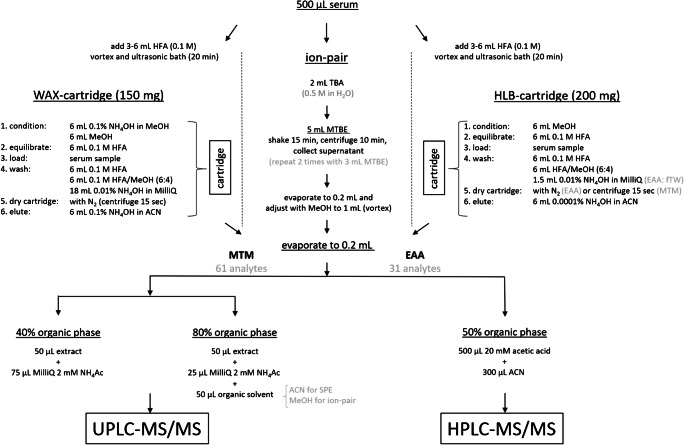
Since the detection of per- and polyfluoroalkyl substances (PFAS) in humans and different environmental media in the last two decades, this substance group has attracted a lot of attention as well as increasing concerns. The fluorine mass balance approach, by comparing the levels of targeted PFAS after conversion to fluorine equivalents with those of extractable organic fluorine (EOF), showed the presence of unidentified organofluorine in different environmental samples. Out of the thousands of PFAS in existence, only a very small fraction is included in routine analysis. In recent years, liquid chromatography coupled with tandem-mass spectrometry (LC-MS/MS) has demonstrated the ability to analytically cover a wide spectrum of PFAS. In contrast, conventional extraction methods developed 10 to 15 years ago were only evaluated for a limited number of PFAS. The aim of the present study was to evaluate the advantages and disadvantages of three different extraction methods, adapted from the literatures without further optimization (ion-pair liquid-liquid extraction, solid-phase extraction (SPE), using hydrophilic-lipophilic (HLB) or weak anion exchange (WAX) sorbents), for human biomonitoring of 61 PFAS in serum and placental tissue samples. In addition, levels of EOF were compared among these extraction methods via spiked samples. Results showed that performance, in terms of recovery, differed between the extraction methods for different PFAS; different extraction methods resulted in different EOF concentrations indicating that the choice of extraction method is important for target PFAS and EOF analysis. Results of maternal serum samples, analyzed in two different laboratories using two different extraction methods, showed an accordance of 107.6% (± 21.3); the detected perfluoroalkyl acids (PFAAs) in maternal and cord serum samples were in the range of 0.076 to 2.9 ng/mL.Graphical abstract.
自过去二十年在人类和不同环境介质中检测到全氟和多氟烷基物质(PFAS)以来,该物质组因其受到了广泛关注和日益增加的担忧。氟质量平衡方法通过将目标 PFAS 转化为氟当量后的水平与可提取有机氟(EOF)的水平进行比较,表明在不同的环境样品中存在未识别的有机氟。在存在的数千种 PFAS 中,只有一小部分被包括在常规分析中。近年来,液相色谱-串联质谱(LC-MS/MS)已证明能够分析涵盖广泛的 PFAS。相比之下,10 至 15 年前开发的传统提取方法仅针对有限数量的 PFAS 进行了评估。本研究的目的是评估三种不同提取方法的优缺点,这些方法是从文献中直接借鉴而来,并未进一步优化(离子对液-液萃取、固相萃取(SPE),使用亲水亲脂(HLB)或弱阴离子交换(WAX)吸附剂),用于血清和胎盘组织样本中 61 种 PFAS 的人体生物监测。此外,还通过加标样品比较了这些提取方法之间的 EOF 水平。结果表明,在不同的 PFAS 中,回收方面的表现因提取方法而异;不同的提取方法导致 EOF 浓度不同,这表明对于目标 PFAS 和 EOF 分析,选择提取方法很重要。使用两种不同的提取方法在两个不同的实验室分析的母体血清样本的结果表明,107.6%(±21.3)的一致性;母体和脐带血清样本中检测到的全氟烷基酸(PFAAs)在 0.076 至 2.9ng/mL 之间。