Centre for Epidemiology and Biostatistics, Melbourne School of Population and Global Health, University of Melbourne, Melbourne, Australia.
Faculty of Medical and Health Sciences, University of Auckland, Auckland, New Zealand.
PLoS Med. 2020 Nov 20;17(11):e1003427. doi: 10.1371/journal.pmed.1003427. eCollection 2020 Nov.
Front-of-pack nutrition labelling (FoPL) of packaged foods can promote healthier diets. Australia and New Zealand (NZ) adopted the voluntary Health Star Rating (HSR) scheme in 2014. We studied the impact of voluntary adoption of HSR on food reformulation relative to unlabelled foods and examined differential impacts for more-versus-less healthy foods.
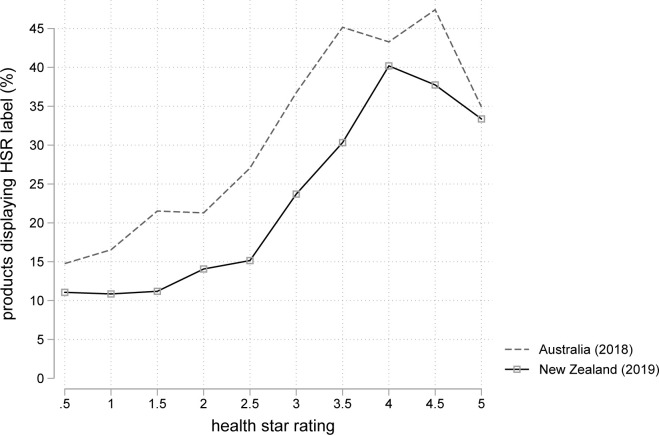
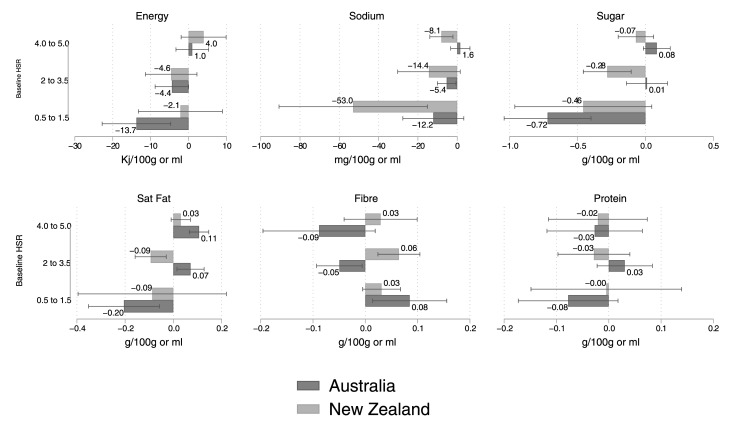
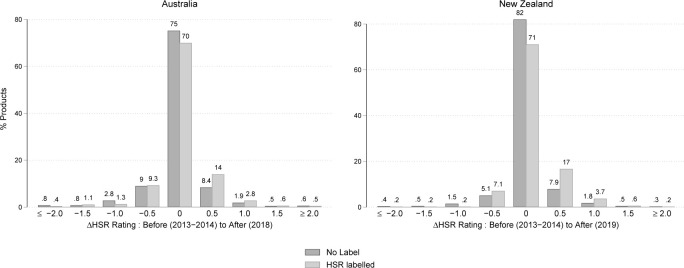
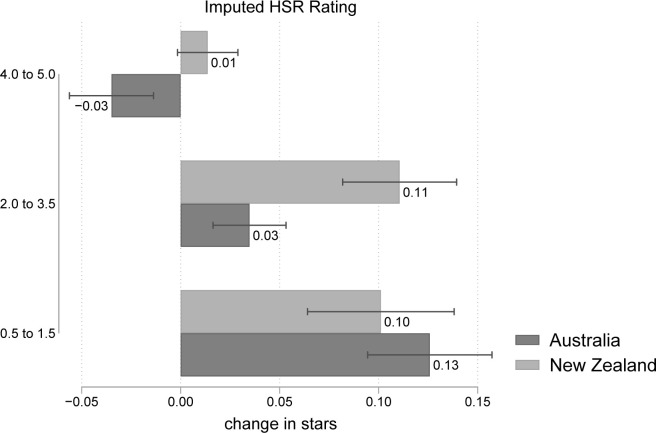
Annual nutrition information panel data were collected for nonseasonal packaged foods sold in major supermarkets in Auckland from 2013 to 2019 and in Sydney from 2014 to 2018. The analysis sample covered 58,905 unique products over 14 major food groups. We used a difference-in-differences design to estimate reformulation associated with HSR adoption. Healthier products adopted HSR more than unhealthy products: >35% of products that achieved 4 or more stars displayed the label compared to <15% of products that achieved 2 stars or less. Products that adopted HSR were 6.5% and 10.7% more likely to increase their rating by ≥0.5 stars in Australia and NZ, respectively. Labelled products showed a -4.0% [95% confidence interval (CI): -6.4% to -1.7%, p = 0.001] relative decline in sodium content in NZ, and there was a -1.4% [95% CI: -2.7% to -0.0%, p = 0.045] sodium change in Australia. HSR adoption was associated with a -2.3% [-3.7% to -0.9%, p = 0.001] change in sugar content in NZ and a statistically insignificant -1.1% [-2.3% to 0.1%, p = 0.061] difference in Australia. Initially unhealthy products showed larger reformulation effects when adopting HSR than healthier products. No evidence of a change in protein or saturated fat content was observed. A limitation of our study is that results are not sales weighted. Thus, it is not able to assess changes in overall nutrient consumption that occur because of HSR-caused reformulation. Also, participation into labelling and reformulation is jointly determined by producers in this observational study, impacting its generalisability to settings with mandatory labelling.
In this study, we observed that reformulation changes following voluntary HSR labelling are small, but greater for initially unhealthy products. Initially unhealthy foods were, however, less likely to adopt HSR. Our results, therefore, suggest that mandatory labelling has the greatest potential for improving the healthiness of packaged foods.
包装食品的营养标签可促进更健康的饮食。澳大利亚和新西兰(NZ)于 2014 年采用了自愿的星级营养评级(HSR)计划。我们研究了自愿采用 HSR 对食品配方改变的影响,相对于未贴标签的食品,并考察了对更健康和不太健康食品的不同影响。
从 2013 年到 2019 年,我们在奥克兰的主要超市收集了非季节性包装食品的年度营养信息面板数据,从 2014 年到 2018 年在悉尼收集了数据。分析样本涵盖了 14 个主要食品组的 58905 个独特产品。我们使用差异中的差异设计来估计与 HSR 采用相关的配方改变。更健康的产品比不健康的产品更有可能采用 HSR:在获得 4 星或以上的产品中,超过 35%显示了标签,而在获得 2 星或以下的产品中,这一比例不到 15%。在澳大利亚和 NZ,采用 HSR 的产品分别增加 0.5 星或以上的可能性分别高出 6.5%和 10.7%。在 NZ,贴标签的产品的钠含量相对下降了 4.0%(95%置信区间[CI]:-6.4%至-1.7%,p = 0.001),而在澳大利亚,钠含量变化为-1.4%(95%CI:-2.7%至-0.0%,p = 0.045)。HSR 采用与 NZ 的糖含量变化-2.3%[-3.7%至-0.9%,p = 0.001]相关,在澳大利亚,统计学上没有显著差异-1.1%[-2.3%至 0.1%,p = 0.061]。最初不健康的产品在采用 HSR 时显示出比更健康的产品更大的配方改变效果。没有观察到蛋白质或饱和脂肪含量的变化。我们研究的一个限制是结果不是销售加权的。因此,它无法评估由于 HSR 引起的配方改变而导致的整体营养摄入的变化。此外,在这项观察性研究中,生产者共同决定了参与标签和配方的情况,这影响了它在强制性标签设置中的可推广性。
在这项研究中,我们观察到,自愿 HSR 标签后配方改变很小,但对最初不健康的产品影响更大。最初不健康的食品采用 HSR 的可能性较小。因此,我们的结果表明,强制性标签最有可能改善包装食品的健康状况。