West African Center for Cell Biology of Infectious Pathogens (WACCBIP), Department of Biochemistry, Cell and Molecular Biology, University of Ghana, Accra 00233, Ghana.
Department of Electron Microscopy and Histopathology, Noguchi Memorial Institute for Medical Research, College of Health Sciences, University of Ghana, Accra 00233, Ghana.
Viruses. 2020 Nov 18;12(11):1321. doi: 10.3390/v12111321.
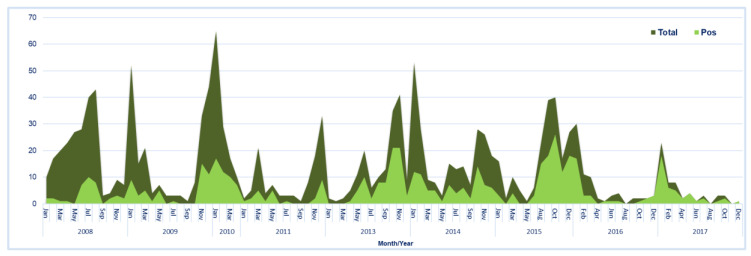
Understanding the epidemiology of human norovirus infection in children within Ghana and the entire sub-Saharan African region, where future norovirus vaccines would have the greatest impact, is essential. We analyzed 1337 diarrheic stool samples collected from children <5 years from January 2008 to December 2017 and found 485 (36.2%) shedding the virus. GII.4 (54.1%), GII.3 (7.7%), GII.6 (5.3%), GII.17 (4.7%), and GII.5 (4.7%) were the most common norovirus genotypes. Although norovirus GII.4 remained the predominant capsid genotype throughout the study period, an increase in GII.6 and GII.3 capsid genotypes was observed in 2013 and 2014, respectively. The severity of clinical illness in children infected with GII.4 norovirus strains was similar to illness caused by non-GII.4 strains. Since the epidemiology of norovirus changes rapidly, establishment of systematic surveillance within sentinel sites across the country would enhance the monitoring of circulating norovirus strains and allow continuous understanding of norovirus infection in Ghana.
了解加纳和整个撒哈拉以南非洲地区儿童中人类诺如病毒感染的流行病学情况至关重要,因为未来的诺如病毒疫苗将在这些地区产生最大的影响。我们分析了 2008 年 1 月至 2017 年 12 月期间采集的 1337 份 5 岁以下腹泻粪便样本,发现 485 份(36.2%)样本中存在病毒。GII.4(54.1%)、GII.3(7.7%)、GII.6(5.3%)、GII.17(4.7%)和 GII.5(4.7%)是最常见的诺如病毒基因型。虽然诺如病毒 GII.4 在整个研究期间仍然是主要的衣壳基因型,但在 2013 年和 2014 年分别观察到 GII.6 和 GII.3 衣壳基因型的增加。感染 GII.4 诺如病毒株的儿童的临床疾病严重程度与非 GII.4 株引起的疾病相似。由于诺如病毒的流行病学变化迅速,在全国哨点建立系统监测将有助于监测循环诺如病毒株,并不断了解加纳的诺如病毒感染情况。