Department of Quantitative Biomedicine, University of Zurich, Zurich, Switzerland.
Institute of Molecular Health Sciences, ETH Zurich, Zurich, Switzerland.
Cell Rep Med. 2020 Dec 26;2(1):100166. doi: 10.1016/j.xcrm.2020.100166. eCollection 2021 Jan 19.
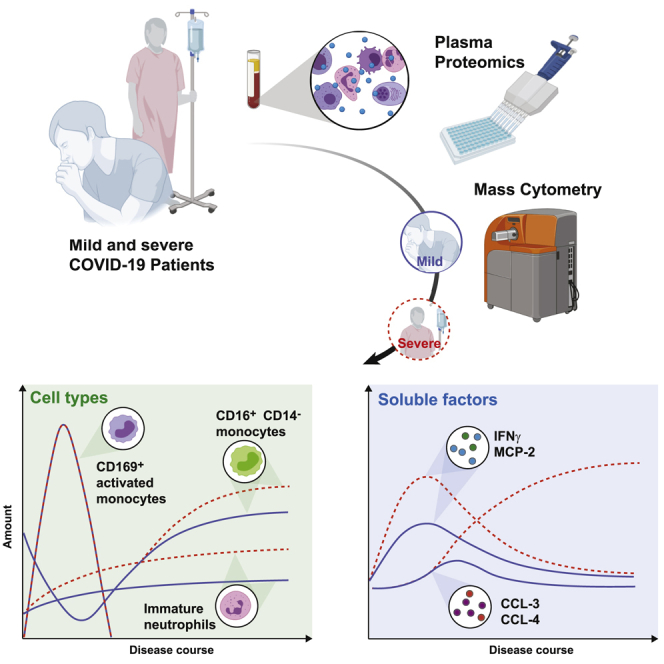
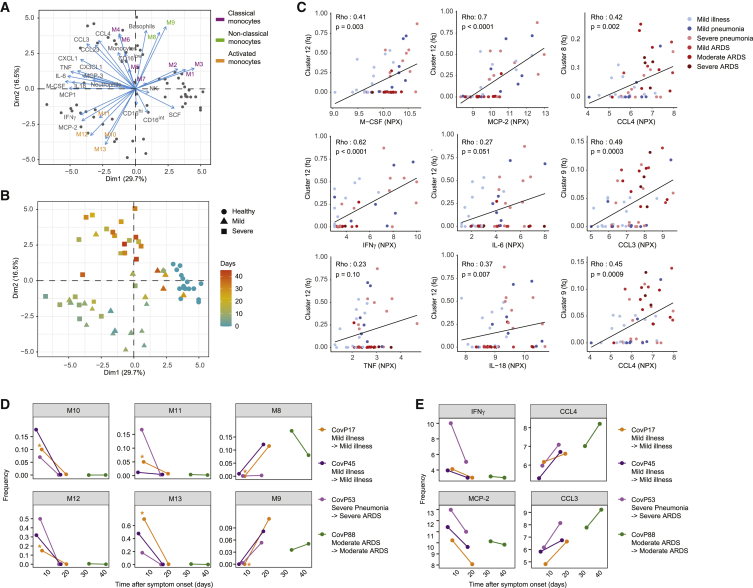
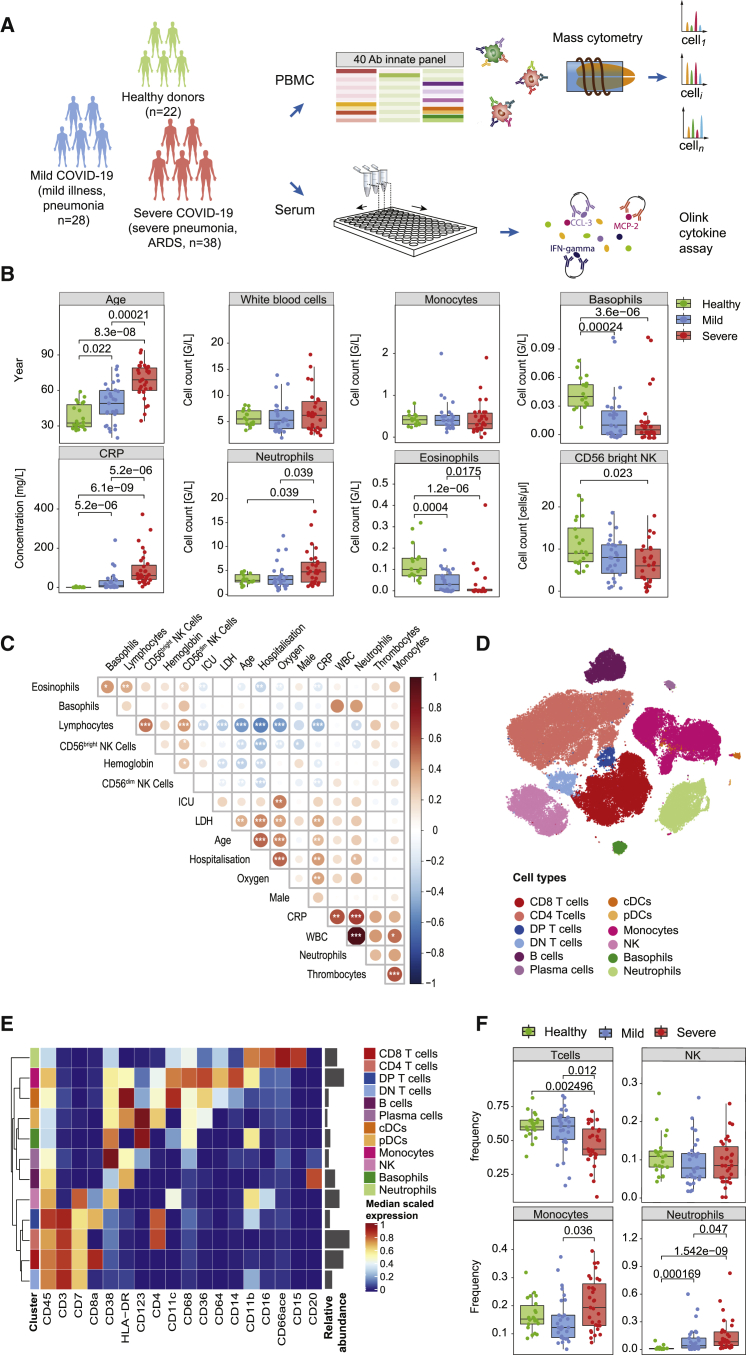
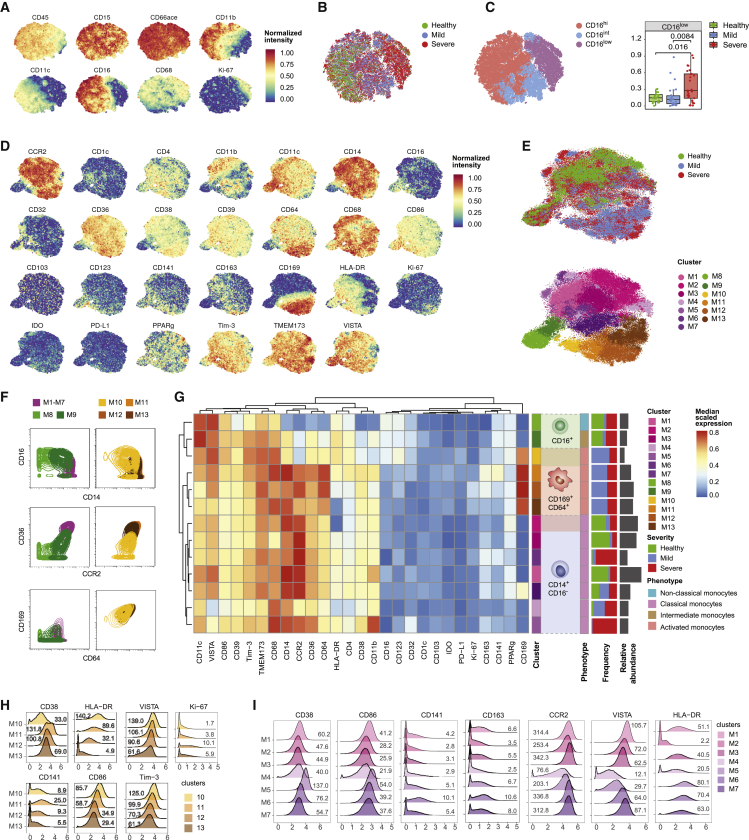
Coronavirus disease 2019 (COVID-19) manifests with a range of severities, but immune signatures of mild and severe disease are still not fully understood. Here, we use mass cytometry and targeted proteomics to profile the innate immune response of patients with mild or severe COVID-19 and of healthy individuals. Sampling at different stages allows us to reconstruct a pseudo-temporal trajectory of the innate response. A surge of CD169 monocytes associated with an IFN-γMCP-2 signature rapidly follows symptom onset. At later stages, we observe a persistent inflammatory phenotype in patients with severe disease, dominated by high CCL3 and CCL4 abundance correlating with the re-appearance of CD16 monocytes, whereas the response of mild COVID-19 patients normalizes. Our data provide insights into the dynamic nature of inflammatory responses in COVID-19 patients and identify sustained innate immune responses as a likely mechanism in severe patients, thus supporting the investigation of targeted interventions in severe COVID-19.
新型冠状病毒病 2019(COVID-19)表现出多种严重程度,但对轻症和重症疾病的免疫特征仍不完全了解。在这里,我们使用液质联用和靶向蛋白质组学来描绘轻症和重症 COVID-19 患者以及健康个体的固有免疫反应。在不同阶段采样,使我们能够重建固有反应的拟时间轨迹。与 IFN-γMCP-2 特征相关的 CD169 单核细胞激增,迅速跟随症状出现。在后期,我们观察到重症患者中持续存在的炎症表型,以高 CCL3 和 CCL4 丰度为主,与 CD16 单核细胞的再次出现相关,而轻症 COVID-19 患者的反应则恢复正常。我们的数据提供了对 COVID-19 患者炎症反应动态性质的深入了解,并确定持续的固有免疫反应是重症患者的一个可能机制,从而支持对重症 COVID-19 的靶向干预研究。