Cardiology Department, Heart Center Segeberger Kliniken, Bad Segeberg, Germany.
Cardiology Department, Heart Center Leipzig at the University of Leipzig, Leipzig, Germany.
J Interv Cardiol. 2020 Nov 11;2020:9740938. doi: 10.1155/2020/9740938. eCollection 2020.
To analyze the impact of different techniques of lesion preparation of severely calcified coronary bifurcation lesions.
The impact of different techniques of lesion preparation of severely calcified coronary bifurcation lesions is poorly investigated.
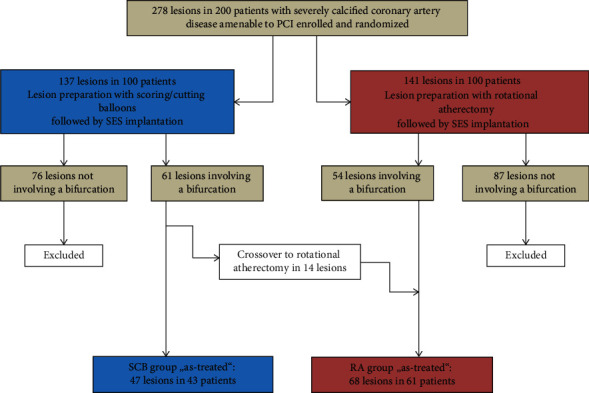
We performed an as-treated analysis on 47 calcified bifurcation lesions treated with scoring/cutting balloons (SCB) and 68 lesions treated with rotational atherectomy (RA) in the PREPARE-CALC trial. Compromised side branch (SB) as assessed in the final angiogram was the primary outcome measure and was defined as any significant stenosis, dissection, or thrombolysis in myocardial infarction flow <3.
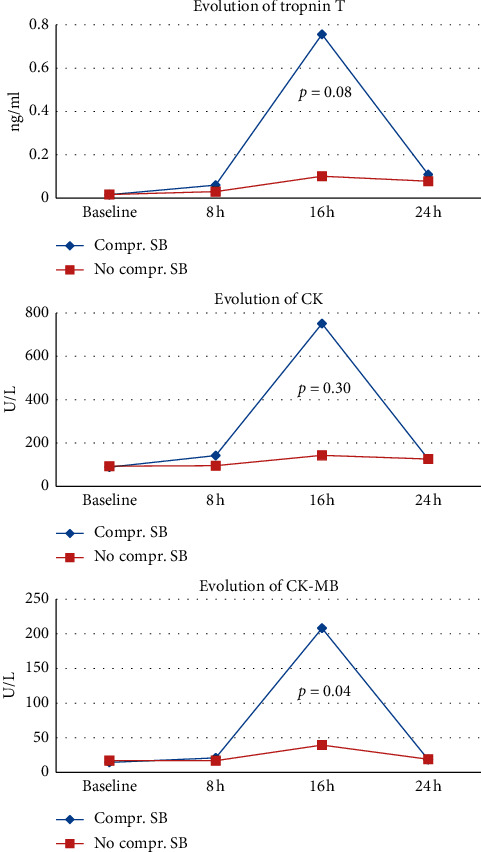
True bifurcation lesions were present in 49% vs. 43% of cases in the SCB and RA groups, respectively. After stent implantation, SB balloon dilatation was necessary in around one-third of cases (36% vs. 38%; = 0.82), and a two-stent technique was performed in 21.3% vs. 25% ( = 0.75). At the end of the procedure, the SB remained compromised in 15 lesions (32%) in the SCB group and 5 lesions (7%) in the RA group ( = 0.001). Large coronary dissections were more frequently observed in the SCB group (13% vs. 2%; = 0.02). Postprocedural levels of cardiac biomarkers were significantly higher in patients with a compromised SB at the end of the procedure.
In the PREPARE-CALC trial, side branch compromise was more frequently observed after lesion preparation with SCB as compared with RA. Consequently, in calcified bifurcation lesions, an upfront debulking with an RA-based strategy might optimize the result in the side branch.
分析不同技术在严重钙化冠状动脉分叉病变病变准备中的影响。
不同技术在严重钙化冠状动脉分叉病变病变准备中的影响研究甚少。
我们对 PREPARE-CALC 试验中 47 例使用切割球囊(SCB)和 68 例使用旋磨术(RA)治疗的钙化分叉病变进行了按治疗分析。以最终血管造影评估的受影响的边支(SB)为主要终点,并定义为任何明显狭窄、夹层或心肌梗死溶栓血流 <3。
SCB 和 RA 组的真性分叉病变分别占 49%和 43%。支架植入后,约三分之一的病例需要 SB 球囊扩张(36%比 38%; = 0.82),21.3%比 25%采用双支架技术( = 0.75)。在手术结束时,SB 仍有 15 例(32%)在 SCB 组和 5 例(7%)在 RA 组病变( = 0.001)受损。SCB 组更常出现大的冠状动脉夹层(13%比 2%; = 0.02)。在手术结束时 SB 受损的患者术后心脏标志物水平明显升高。
在 PREPARE-CALC 试验中,与 RA 相比,SCB 病变准备后 SB 更常受损。因此,在钙化分叉病变中,基于 RA 的初始消蚀策略可能会优化边支的结果。