Huang Jin-Feng, Wu Qi-Nan, Zheng Xuan-Qi, Sun Xiao-Lei, Wu Chen-Yu, Wang Xiao-Bing, Wu Chen-Wei, Wang Bin, Wang Xiang-Yang, Bergman Michael, Wu Ai-Min
Department of Orthopaedics, The Second Affiliated Hospital and Yuying Children's Hospital of Wenzhou Medical University, Wenzhou, Zhejiang 325027, China.
The Second School of Medicine, Wenzhou Medical University, Wenzhou, Zhejiang 325027, China.
Int J Endocrinol. 2020 Nov 7;2020:8821978. doi: 10.1155/2020/8821978. eCollection 2020.
Patients with diabetes mellitus are prone to develop osteoporosis, osteomyelitis, or rheumatoid arthritis (RA). Furthermore, the presence of these complications in those with diabetes may lead to higher mortality. The aim of our study was to assess characteristics and mortality of osteoporosis, osteomyelitis, or rheumatoid arthritis in individuals with diabetes.
We analyzed osteoporosis, osteomyelitis, and RA deaths associated with diabetes from 1999-2017 using the CDC WONDER system (CDC WONDER; https://wonder.cdc.gov). We used codes to categorize the underlying and contributing causes of death. Crude mortality rates (CMR) and age-adjusted mortality rates (AAMR) per 1,000,000 person-years were calculated.
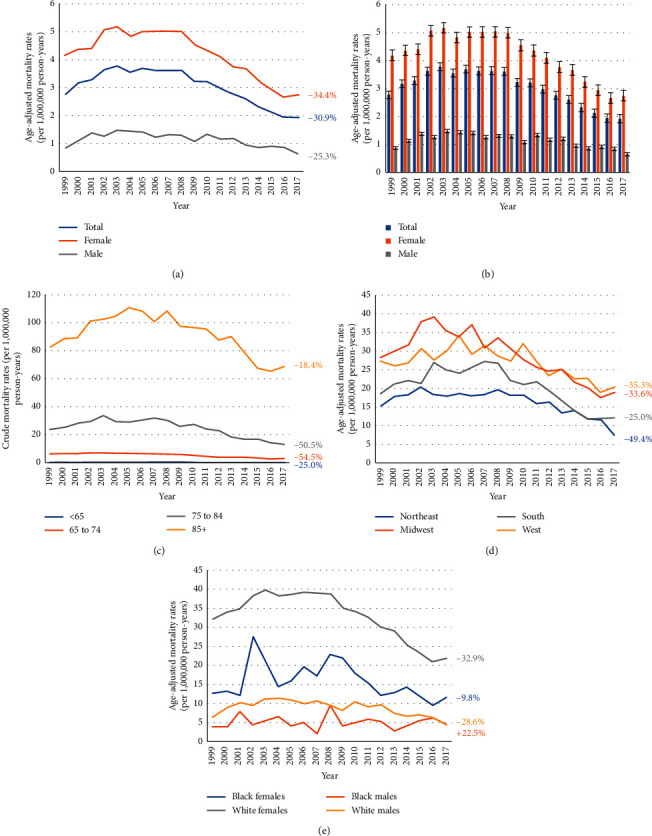
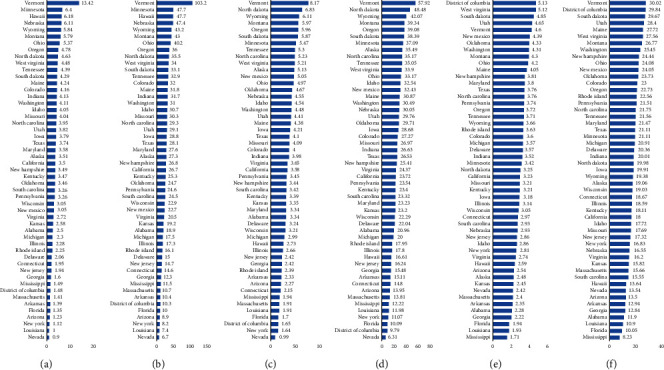
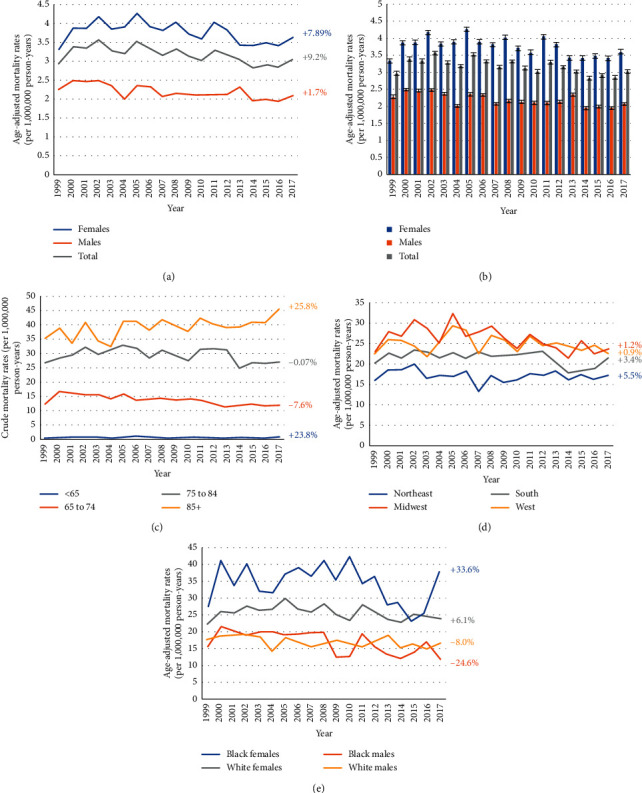
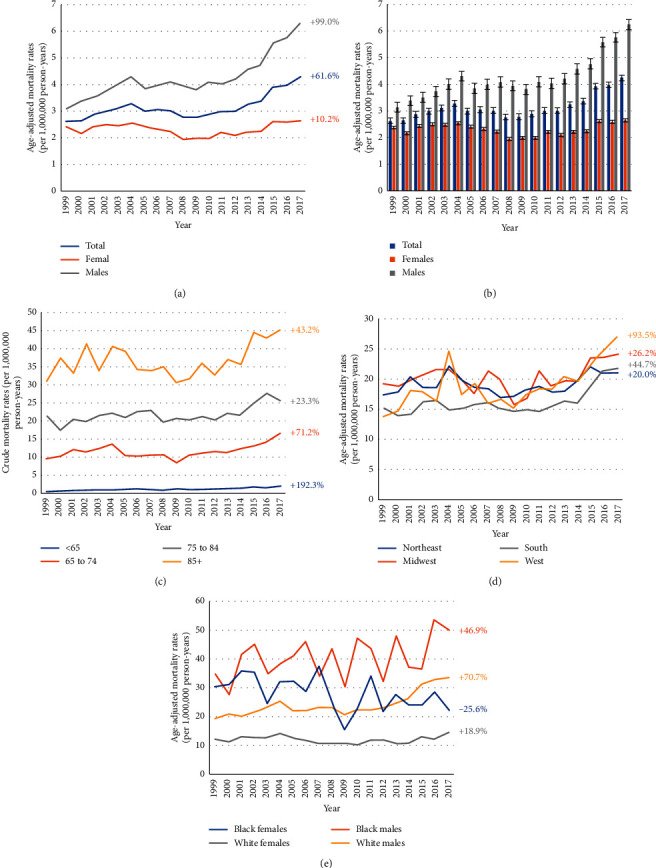
The AAMR for osteoporosis in the population with diabetes was significantly higher in females (AAMR: 4.17, 95% CI: 4.10-4.24) than in males (AAMR: 1.12, 95% CI: 1.07-1.16). Deaths due to osteoporosis increased gradually from 1999, peaked in 2003 (AAMR: 3.78, 95% CI: 3.55-4.00), and reached a nadir in 2016 (AAMR: 2.32, 95% CI: 2.15-2.48). The AAMR for RA associated with diabetes was slightly higher in females (AAMR: 4.04, 95% CI: 3.98-4.11) than in males (AAMR: 2.45, 95% CI: 2.39-2.51). The mortality rate due to RA increased slightly from 1999 (AAMR: 3.18, 95% CI: 2.97-3.39) to 2017 (AAMR: 3.20, 95% CI: 3.02-3.38). The AAMR for osteomyelitis associated with diabetes was higher in males (AAMR: 4.36, 95% CI: 4.28-4.44) than in females (AAMR: 2.31, 95% CI: 2.26-2.36). From 1999 to 2017, the AAMR from osteomyelitis in this population was 2.63 (95% CI: 2.44-2.82) per 1,000,000 person-years in 1999 and 4.25 (95% CI: 4.05-4.46) per 1,000,000 person-years in 2017.
We found an increase in the age-adjusted mortality rates of RA and osteomyelitis and a decrease of osteoporosis associated with diabetes from 1999 to 2017. We suggest that increased attention should therefore be given to these diseases in the population with diabetes, especially in efforts to develop preventative and treatment strategies.
糖尿病患者容易发生骨质疏松、骨髓炎或类风湿关节炎(RA)。此外,糖尿病患者出现这些并发症可能导致更高的死亡率。我们研究的目的是评估糖尿病患者中骨质疏松、骨髓炎或类风湿关节炎的特征及死亡率。
我们使用疾病控制与预防中心的WONDER系统(CDC WONDER;https://wonder.cdc.gov)分析了1999年至2017年与糖尿病相关的骨质疏松、骨髓炎和RA死亡情况。我们使用编码对潜在死因和促成死因进行分类。计算了每100万人年的粗死亡率(CMR)和年龄调整死亡率(AAMR)。
糖尿病患者中女性骨质疏松的年龄调整死亡率(AAMR:4.17,95%可信区间:4.10 - 4.24)显著高于男性(AAMR:1.12,95%可信区间:1.07 - 1.16)。骨质疏松导致的死亡从1999年开始逐渐增加,在2003年达到峰值(AAMR:3.78,95%可信区间:3.55 - 4.00),并在2016年降至最低点(AAMR:2.32,95%可信区间:2.15 - 2.48)。与糖尿病相关的RA的年龄调整死亡率女性(AAMR:4.04,95%可信区间:3.98 - 4.11)略高于男性(AAMR:2.45,95%可信区间:2.39 - 2.51)。RA导致的死亡率从1999年(AAMR:3.18,95%可信区间:2.97 - 3.39)到2017年略有增加(AAMR:3.20,95%可信区间:3.02 - 3.38)。与糖尿病相关的骨髓炎的年龄调整死亡率男性(AAMR:4.36,95%可信区间:4.28 - 4.44)高于女性(AAMR:2.31,95%可信区间:2.26 - 2.36)。1999年至2017年,该人群中骨髓炎的年龄调整死亡率为每100万人年1999年时为2.63(95%可信区间:2.44 - 2.82),2017年时为4.25(95%可信区间:4.05 - 4.46)。
我们发现1999年至2017年与糖尿病相关的RA和骨髓炎的年龄调整死亡率有所上升,而骨质疏松的死亡率有所下降。因此,我们建议应更加关注糖尿病患者中的这些疾病,特别是在制定预防和治疗策略方面。