Yin Peiyi, Shi Qingming, Xiao Fan, Zhao Biao, Yu Wang, Wu Kai, Peng Kun
Department of Orthopedics, The Second Affiliated Hospital of Nanchang University, Nanchang, Jiangxi, China.
Department of Anesthesiology, The Second Affiliated Hospital of Nanchang University, Nanchang, Jiangxi, China.
Arch Med Sci. 2019 Nov 25;16(6):1419-1431. doi: 10.5114/aoms.2019.89979. eCollection 2020.
In senile osteoporosis countering the age-mediated bone loss, promotion of osteoblastogenesis and identification of responsible micro-RNA (miR) would be a successful strategy.
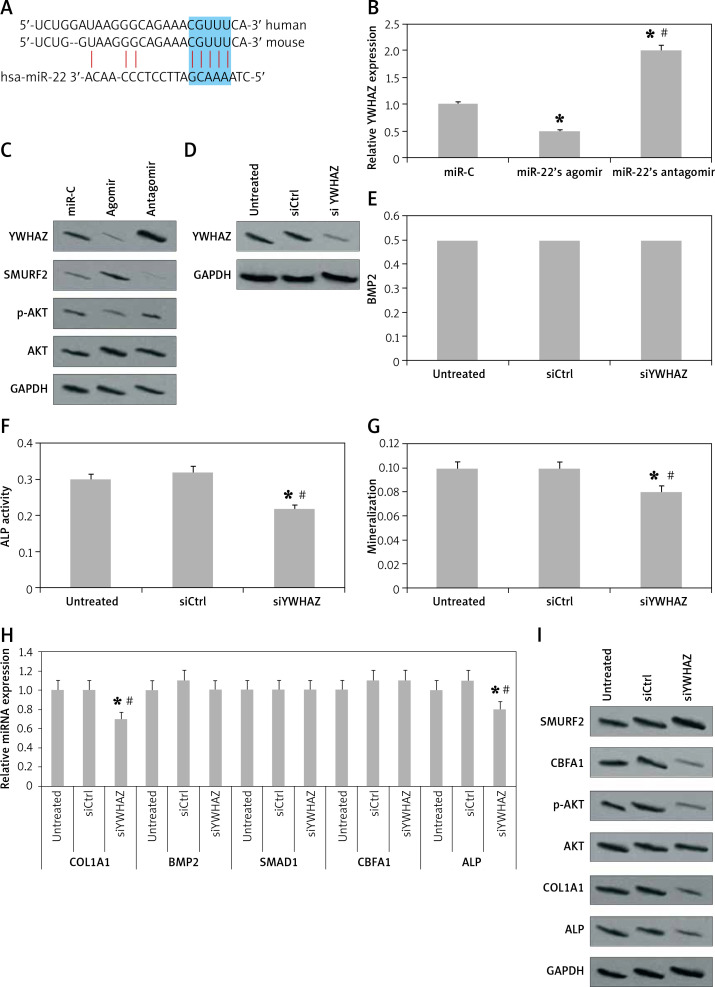
miR microarray screening was carried out to identify the suppressed miRs after real time polymerase chain reaction (RT-PCR) analysis in mesenchymal stem cells (MSCs) derived from adult bone marrow during the proliferation to the mineralization stage. The primary calvarial pre-osteoblasts (human) were harvested and received transfection of miR-22's antagomir or agomir . Bioinformatics study suggested YWHAZ as the favorable target gene. Next, YWHAZ knockdown was studied for its effect on differentiation of osteoblasts. For studies, ovariectomized or sham mice were injected with miR-22's antagomir for a period of 6 weeks. The stromal cells were isolated in the 6 week for experiments.
miR-22 was found to be down-regulated in bone marrow derived mesenchymal stem cells. miR-22's antagomir converted the pre-osteoblasts to a more differentiated and mineralized phenotype showing upregulated protein expression of COL1A1, ALP and CBFA1. The miR-22's antagomir suppressed YWHAZ, enhanced stability of CBFA1 and promoted the differentiation of osteoblasts. , miR-22's antagomir promoted mineralization and osteoblastogenesis, elevated bone strength and reversed the ovariectomy mediated bone loss in sham mice.
Inhibition of miR-22 may be a potential target for treating osteoporosis clinically. The findings hence suggest that inhibition of miR-22 may be an effective anabolic therapeutic approach in treating osteoporosis clinically.
在老年性骨质疏松症中,应对年龄介导的骨质流失,促进成骨细胞生成并鉴定相关的微小RNA(miR)将是一种成功的策略。
进行miR微阵列筛选,以鉴定在从成年骨髓来源的间充质干细胞(MSC)从增殖到矿化阶段的实时聚合酶链反应(RT-PCR)分析后被抑制的miR。收集原代颅骨前成骨细胞(人),并进行miR-22的拮抗剂或激动剂转染。生物信息学研究表明YWHAZ是有利的靶基因。接下来,研究YWHAZ基因敲低对成骨细胞分化的影响。在实验中,对去卵巢或假手术小鼠注射miR-22的拮抗剂,持续6周。在第6周分离基质细胞用于实验。
发现miR-22在骨髓来源的间充质干细胞中表达下调。miR-22的拮抗剂使前成骨细胞转变为更具分化和矿化的表型,显示COL1A1、ALP和CBFA1的蛋白表达上调。miR-22的拮抗剂抑制YWHAZ,增强CBFA1的稳定性并促进成骨细胞的分化。此外,miR-22的拮抗剂促进矿化和成骨细胞生成,提高骨强度,并逆转假手术小鼠中去卵巢介导的骨质流失。
抑制miR-22可能是临床治疗骨质疏松症的潜在靶点。因此,这些发现表明抑制miR-22可能是临床治疗骨质疏松症的一种有效的合成代谢治疗方法。